Helping design and engineering professionals discover, evaluate and specify technologies and processes that shorten the design cycle and enable success.


Alert!
Digital Engineering ceased publication on July 1, 2026. This website remains available as an archive of engineering content.
For inquiries or information, please email [email protected].

Digital Engineering April 2026
In the latest issue of Digital Engineering, we take a look at the latest innovations in design for additive manufacturing, including the use of natural language inputs, social media cosplayers, and AI integration. The issue also includes a feature…

January Special Focus Issue: Design for Additive
In this Special Focus Issue of Digital Engineering, learn about the latest advancements in design for additive manufacturing, including new software tools, additive in automotive, custom medical devices, and more.
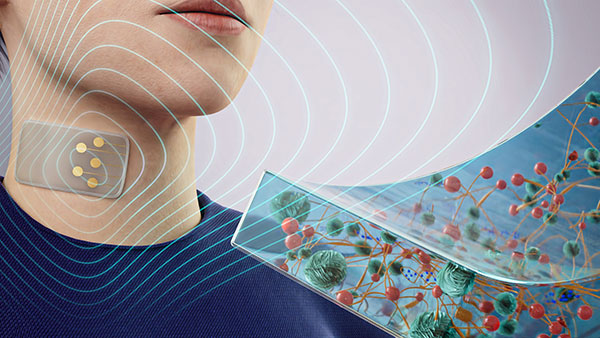
By utilizing nanoengineered hydrogels that exhibit tunable electronic and thermal biosensing capabilities, researchers at Texas A&M University have developed a 3D-printed electronic skin (E-skin) that can flex, stretch and sense like human skin.
“The ability to replicate the sense of touch and integrate it into various technologies opens up new possibilities for human-machine interaction and advanced sensory experiences,” says Dr. Akhilesh Gaharwar, professor and director of research for the Department of Biomedical Engineering. “It can potentially revolutionize industries and improve the quality of life for individuals with disabilities.”
Future uses for the E-skin include wearable health devices that continuously monitor vital signs like motion, temperature, heart rate and blood pressure, providing feedback to users and helping them improve their motor skills and coordination.
“The inspiration behind developing E-skin is rooted in the desire to create more advanced and versatile interfaces between technology, the human body and the environment,” Gaharwar says. “The most exciting aspect of this research is its potential applications in robotics, prosthetics, wearable technology, sports and fitness, security systems and entertainment devices.”
The E-skin technology, detailed in a study published by Advanced Functional Materials, was developed in Gaharwar’s lab. Drs. Kaivalya Deo '22 , a former student of Gaharwar and now a scientist at Axent Biosciences, and Shounak Roy, a former Fulbright Nehru doctoral fellow in Gaharwar’s Lab, are the paper's lead authors.
Creating E-skin involves challenges with developing durable materials that can simultaneously mimic the flexibility of human skin, contain bioelectrical sensing capabilities and employ fabrication techniques suitable for wearable or implantable devices.
“In the past, the stiffness of these systems was too high for our body tissues, preventing signal transduction and creating mechanical mismatch at the biotic-abiotic interface,” Deo says. “We introduced a ‘triple-crosslinking’ strategy to the hydrogel-based system, which allowed us to address one of the key limitations in the field of flexible bioelectronics.”
Using nanoengineered hydrogels addresses some of the challenging aspects of E-skin development during 3D printing due to hydrogels' ability to decrease viscosity under shear stress during E-skin creation. The team said this feature facilitates the construction of 2D and 3D electronic structures, an essential aspect of replicating the multifaceted nature of human skin.
The researchers also utilized ‘atomic defect’ in molybdenum disulfide nano-assemblies, a material containing imperfections in its atomic structure that allow for high electrical conductivity, and polydopamine nanoparticles to help the E-skin stick to wet tissue.
“These specially designed molybdenum disulfide nanoparticles acted as crosslinkers to form the hydrogel and imparted electrical and thermal conductivity to the E-skin; we are the first to report using this as the key component,” Roy says. “The material's ability for adhesion to wet tissues is particularly crucial for potential healthcare applications where the E-skin needs to conform and adhere to dynamic, moist biological surfaces.”
Other collaborators include researchers from Dr. Limei Tian’s group in the biomedical engineering department at Texas A&M and Dr. Amit Jaiswal at the Indian Institute of Technology, Mandi. The study is funded by the National Institutes of Health, the Department of Defense and the United States-India Educational Foundation.
Sources: Press materials received from the company and additional information gleaned from the company’s website.


DE's editors contribute news and new product announcements to Digital Engineering. Press releases may be sent to them via [email protected].
Follow DE






About Us · Contact Us · Editorial Team · Advertising · Privacy Policy · Subscriber Services · © 2026 Digital Engineering 24/7 · Peerless Media