Helping design and engineering professionals discover, evaluate and specify technologies and processes that shorten the design cycle and enable success.


Alert!
Digital Engineering ceased publication on July 1, 2026. This website remains available as an archive of engineering content.
For inquiries or information, please email [email protected].
Sponsored

Digital Engineering April 2026
In the latest issue of Digital Engineering, we take a look at the latest innovations in design for additive manufacturing, including the use of natural language inputs, social media cosplayers, and AI integration. The issue also includes a feature…

January Special Focus Issue: Design for Additive
In this Special Focus Issue of Digital Engineering, learn about the latest advancements in design for additive manufacturing, including new software tools, additive in automotive, custom medical devices, and more.
 Dear DE Reader:
Edison was a revolutionary, so reading various iterations of the word “revolution” generally irks me. Light bulbs, audio recordings and 1,091 more patents—that's revolutionary. Still, one has to admit that additive manufacturing—3D printing—has fundamentally altered the design process as much as CPUs and graphics accelerators. In “A Revolution in Design,” your industry cohorts explain how 3D printing revolutionized their design processes.
This short paper provides an overview of how and to what advantage small- and mid-sized design, engineering and manufacturing outfits leverage 3D printing today. This isn't a heavy technical tome. There's no discussion of stuff like layer thicknesses, tensile modulus and so on. Anyone can read it. But the skeptical engineer and money manager definitely should read it. It's subtly complex and highly informative.
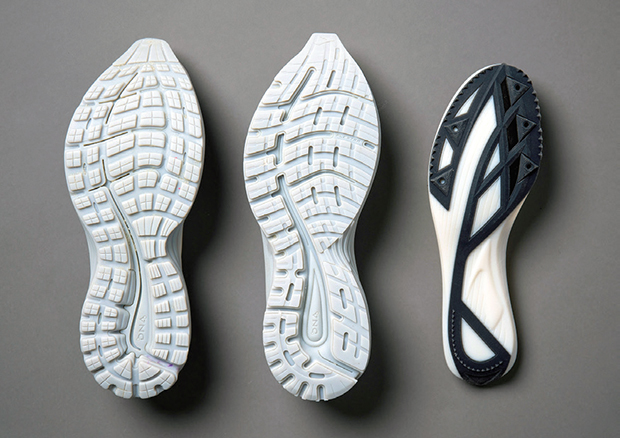 Before designers at Brooks Running had an in-house, Connex3 3D printer they waited in line with everybody else for a service bureau to make and deliver their prototypes, such as the outsoles and midsoles shown here. Brooks Running image courtesy of Stratasys Ltd.
The basic theme is that technological, ease-of-use and market-driven trends have made in-house, professional-level 3D printing an affordable, flexible asset within your design for manufacturing processes. Keep in mind that this paper comes from Stratasys. They have their own direct manufacturing services division. So, they're not saying you're nuts using some service bureau for prototypes or small volumes.
What they are saying is that you could be missing out on technology that, compared to traditional approaches, could shorten development cycles, help you make better products and pay for itself many times over. Actually, Stratasys doesn't say a lot. The paper introduces a topic such as time to market, more thorough design evaluations or cost-effectiveness and then lets a real-world designer do the talking.
For example, when speaking of the benefits of validating 3D printed designs in-house versus the cost and time delays of waiting for a service bureau to deliver prototypes, a footwear developer flatly remarks that “our 3D printer has revolutionized our entire design validation process.”
Echoing Edison's “I've just found 10,000 ways that won't work,” one designer early in the paper says that “3D printing prototypes gives us the ability to fail fast.” This point also arises later when an engineer says that rapid design iterations provide the ability to go back to the lab and improve designs continuously.
The potential 3D printing embodies has moved beyond its beginnings to become, well, a revolutionary force in the hands of savvy engineers. “A Revolution in Design” offers many insights from a few of the growing number of them. Hit the link for your complimentary copy.
Thanks, Pal. – Lockwood
Anthony J. Lockwood, Editor at Large, DE


Every day, our customers find simpler, smarter approaches to stubborn design problemsand greater confidence to confront towering human and technological challenges. Less hindered by the usual constraints, they can imagine, design, iterate and…
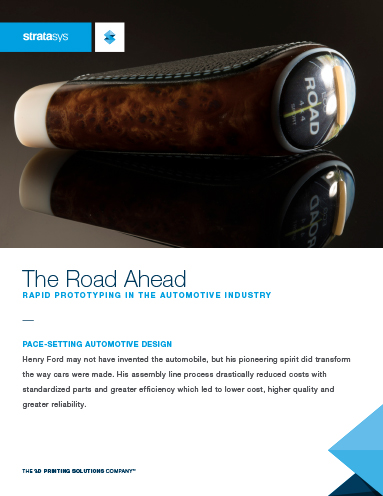
Rapid Prototyping in The Automotive Industry
Henry Ford may not have invented the automobile, but his pioneering spirit did transform the way cars were made. His assembly line process drastically reduced costs with standardized parts and greater efficiency which led to lower cost, higher quality and greater reliability.

DE's editors contribute news and new product announcements to Digital Engineering. Press releases may be sent to them via [email protected].
Follow DE






About Us · Contact Us · Editorial Team · Advertising · Privacy Policy · Subscriber Services · © 2026 Digital Engineering 24/7 · Peerless Media