Helping design and engineering professionals discover, evaluate and specify technologies and processes that shorten the design cycle and enable success.



May 2026 Special Focus: Artificial Intelligence in Design and Simulation
In this Special Focus Issue, learn about the latest developments in the integration of artificial intelligence into engineering workflows.

Design & Simulation Software Guide 2025
In this Special Issue, Digital Engineering presents its second annual guide to design and simulation software vendors.
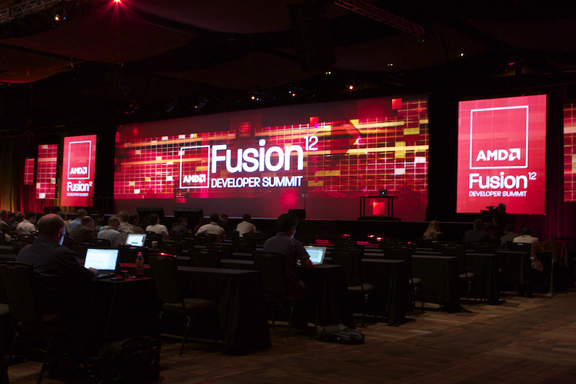
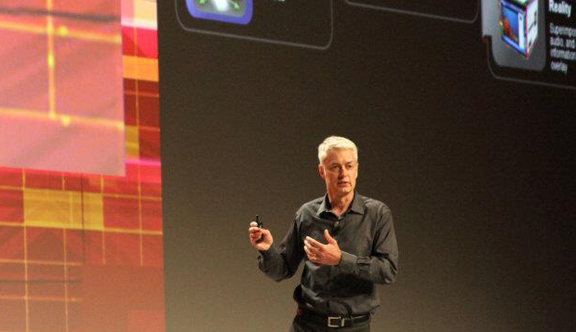
Skilled programmers who can sneak into the GPU and execute their parallel jobs belong to an elite group. They are "Ninja programmers," as AMD corporate fellow Phil Rogers call them.
Rogers, who delivered the keynote at this week's AMD Fusion Developer Summit, believes GPU computing should be available to a broader audience, to the common programmers who make a living churning out codes in C, C++, JAVA, and Python. In fact, Rogers may even object to the term GPU computing. If it were up to AMD and Rogers, GPU and CPU computing could be one and the same, fused together into a Heterogeneous System Architecture (HSA).
HSA for Common Programmers
"The CPU ecosystem is well-established, with millions of programers, millions of applications," said Rogers. "Programmers that move to GPU today, there are relatively few of them."
But parallel programming workload is expected to grow, at a rate and volume that will likely outpace the school of Ninjas. "The future is going to have more parallel workload as more and more media is processed both on client devices and up in the cloud," Rogers said.
The solution is to remove the barrier of entry to GPU programming. One way AMD plans to do it is through HSA, compatible with high-level programming language most programmers already know and use. Accordingly, AMD announced HSA Bolt, described by Rogers as "a parallel primitive library [that] takes advantage of GPU’s power efficiency [and] ... supports Open CL and C++AMP."
HSA Bolt uses "a single source code base for CPU and GPU," according to Rogers. "We made it possible to write a single version and compile it both ways," he added.
Momentum with HSA
Rogers reminded the audience, "Last year, we shipped the APU that combines the CPU and the GPU in a single piece of silicon, with a unified memory controller." HSA's future will be defined by "a unified address space for the CPU and GPU that works in the pageable memory ... We make the memory system fully coherent between CPU and GPU."
HSA hits another milestone this week with the launch of HSA Foundation, featuring AMD and ARM as founding members. The foundation is a not-for-profit consortium, dedicated to make it easy to program for parallel computing. With HSA, scalar processing on the CPU and parallel processing on the GPU can coexist in the same code.
AMD's rival NVIDIA aims to promote parallel programing for the GPU through its CUDA platform. Chip maker Intel has its own plan to power parallel processing with its many integrated cores (MIC) architecture, codenamed Knights Corner. As parallel processing goes mainstream, the increased processing power available in handhelds, desktops, notebooks, and workstations is expected to facilitate more sophisticated applications, such as Kinect-style gesture computing, automatic face recognition, and simulation.
AMD Fusion Developer Summit continues throughout the rest of the week.


Kenneth Wong is Digital Engineering's resident blogger and senior editor. Email him at [email protected] or share your thoughts or suggestions at digitaleng.news/facebook.
Follow DE
Join over 90,000 engineering professionals who get fresh engineering news as soon as it is published.






About Us · Contact Us · Editorial Team · Advertising · Privacy Policy · Subscriber Services · © 2026 Digital Engineering 24/7 · Peerless Media