Helping design and engineering professionals discover, evaluate and specify technologies and processes that shorten the design cycle and enable success.




Cut Retrieval-Augmented Generation (RAG) Hallucinations by 50%
Most teams hit the same wall with enterprise AI: LLMs that hallucinate, pipelines that don’t scale, and infrastructure that’s harder to design than the models themselves.

What Is Intelligent BOM Management? A Guide to Smarter Product Development
Learn how intelligent Bill of Materials (BOM) management helps teams collaborate, reduce errors, and bring innovative products to market faster with cloud-based PLM tools.
AMD makes available the AMD Instinct ecosystem with expanded system support from partners including ASUS, Dell Technologies, Gigabyte, HPE, Lenovo and Supermicro, the new AMD Instinct MI210 accelerator and capabilities of ROCm 5 software. The AMD Instinct and ROCm ecosystem is offering exascale-class technology to a broad base of HPC and AI customers, addressing the demand for compute-accelerated data center workloads and reducing the time to insights and discovery, AMD reports.
“With twice the platforms available compared to our previous generation accelerators, growing customer adoption across HPC and AI applications, and new support from commercial ISVs in key workloads, we’re continuing to drive adoption of the AMD Instinct MI200 accelerators and ROCm 5 software ecosystem,” says Brad McCredie, corporate vice president, Data Center GPU and Accelerated Processing, AMD. “Now with the availability of the AMD Instinct MI210 accelerator to the MI200 family, our customers can choose the accelerator that works best for their workloads, whether they need leading-edge accelerated processing for large scale HPC and AI workloads, or if they want access to exascale-class technology in a commercial format.”
The AMD Instinct MI200 series accelerators are designed to power discoveries in exascale systems, enabling researchers, scientists and engineers to tackle great challenges, according to AMD. The AMD Instinct MI210 accelerators specifically enable exascale-class technologies for customers who need high-level HPC and AI performance in a PCIe format, the company reports.
An open software platform that allows researchers, scientists and engineers to tap the power of AMD Instinct accelerators to drive scientific discoveries, the AMD ROCm platform is built on the foundation of numerous applications and libraries powering top HPC and AI applications.
With ROCm 5, AMD extends its software platform by adding new hardware support for the AMD Instinct MI200 series accelerators and the AMD Radeon PRO W6800 professional graphics card, plus Red Hat Enterprise Linux 8.5 support, increasing accessibility of ROCm for developers and enabling performance across key workloads, AMD reports.
Through the AMD Infinity Hub, the central location for open-source applications that are ported and optimized on AMD GPUs, end-users can find, download and install containerized HPC apps and ML frameworks. AMD Infinity Hub application containers are designed to ease the issue of obtaining and installing software releases while allowing users to learn based on shared experiences and problem-solving opportunities, AMD notes.
As more purpose-built applications are optimized to work with ROCm and AMD Instinct accelerators, AMD continues to grow its software ecosystem with the addition of commercial ISVs, including Ansys, Cascade Technologies, and TempoQuest. These updates are on top of existing application support in ROCm which includes HPC, AI and Machine Learning applications, AMBER, Chroma, CP2K, GRID, GROMACs, LAAMPS, MILC, Mini-HAAC, NAMD, NAMD 3.0, ONNX-RT, OpenMM, PyTorch, RELION, SPECFEM3D Cartesian, SPECFEM3D Globe, and TensorFlow.
AMD is also enabling partners like ASUS, Dell Technologies, Gigabyte, HPE, Lenovo, Supermicro, and System Integrators including Colfax, Exxact, KOI Computers, Nor-Tech, Penguin and Symmetric to offer differentiated solutions to address computing challenges.
The AMD Accelerator Cloud offers customers an environment to remotely access and evaluate AMD Instinct accelerators and AMD ROCm software. Whether it’s porting legacy code, benchmarking an application or testing multi-GPU or multi-node scaling, the AMD Accelerator Cloud gives prospective customers and partners quick and easy access to the latest GPUs and software, according to AMD.
Sources: Press materials received from the company and additional information gleaned from the company’s website.


AMD, or Advanced Micro Devices, has driven innovation in high-performance computing, graphics and visualization technologies. They develop high-performance computing and visualization products to solve some of the world’s toughest and most…
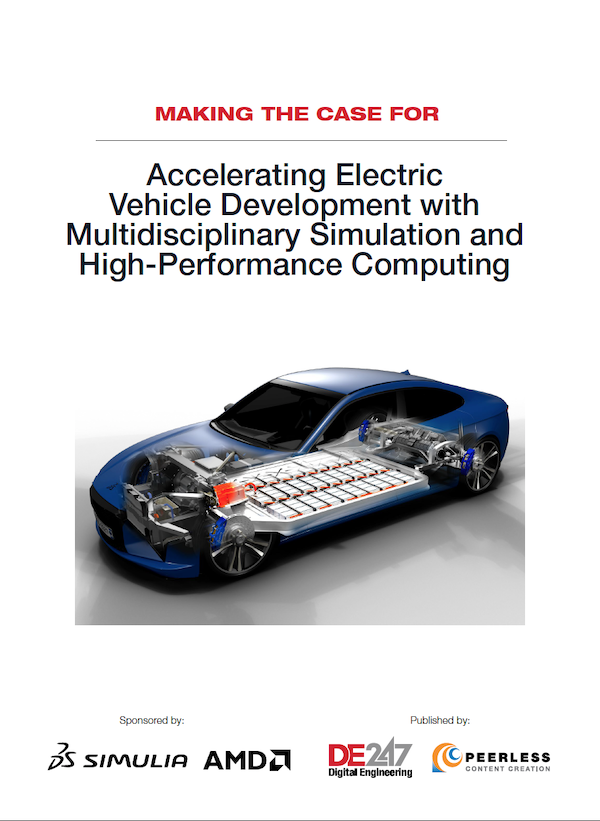
Accelerating Electric Vehicle Development with Multidisciplinary Simulation and High-Performance Computing
In this new Making the Case guide, learn how a unified approach to design and multidisciplinary simulation from Dassault Systèmes, combined with high-performance computing powered by AMD EPYC™ processors, can accelerate EV design.

DE's editors contribute news and new product announcements to Digital Engineering. Press releases may be sent to them via [email protected].
Follow DE
Join over 90,000 engineering professionals who get fresh engineering news as soon as it is published.






About Us · Contact Us · Editorial Team · Advertising · Privacy Policy · Subscriber Services · © 2026 Digital Engineering 24/7 · Peerless Media