Helping design and engineering professionals discover, evaluate and specify technologies and processes that shorten the design cycle and enable success.



May 2026 Special Focus: Artificial Intelligence in Design and Simulation
In this Special Focus Issue, learn about the latest developments in the integration of artificial intelligence into engineering workflows.

Design & Simulation Software Guide 2025
In this Special Issue, Digital Engineering presents its second annual guide to design and simulation software vendors.
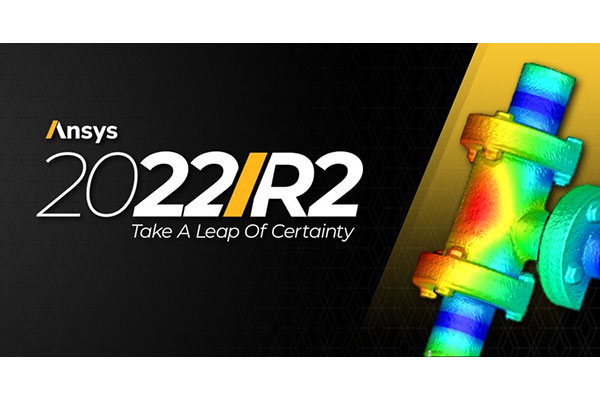
Ansys 2022 R2 provides an analysis, artificial intelligence/machine learning (AI/ML) optimization, and scalable platform for tough engineering challenges.
Ansys 2022 R2 provides insights for multiple industries to meet their goals. For example, Ansys Granta products help engineers factor in material sustainability earlier in the design process. By displaying the latest sustainability data in simulation and computer-aided design (CAD) tools, engineers from multiple industries can gain perspective on material choices as part of their ecodesign strategies.
New features in Ansys Speos optical simulation software help automatically create the back face of a lens. This helps automotive lighting designers create lenses that achieve specific beam patterns, which also helps the general lighting industry create custom light patterns and control light pollution.
Model-based simulation and digital twins are helping leading organizations transform to embrace streamlined, insight-driven business models. For instance, Ansys Maxwell 2022 R2 electromechanical device analysis software provides reduced-order models (ROMs) for induction machines with improved predictive accuracy, which can be used in Ansys Twin Builder for electric vehicle drive system simulations.
Ansys 2022 R2 delivers technical innovations that connect physics and disciplines across scales. For example, Ansys LS-DYNA is used in automotive crash, electronics drop tests, airbag deployment and impact analysis. The new release includes a multi-scale co-simulation capability engineers use to predict solder ball fatigue failure in a printed circuit board (PCB) within a macro-scale drop test.
As simulations become larger and more complex, Ansys 2022 R2 empowers users to run large jobs and overcome hardware capacity limitations with HPC and enhanced solver algorithms that use graphic processor units (GPUs).
In Ansys 2022 R2, the Fluids product line continues to make computational fluids dynamics (CFD) simulations more sustainable.
The Speos optical solver takes advantage of multi-GPU, multi-node deployments. The new capability in Speos enables users to increase the number of rays to boost simulation predictive accuracy.
Sources: Press materials received from the company and additional information gleaned from the company’s website.

Engineering simulation is our sole focus. For more than 45 years, we have consistently advanced this technology to meet evolving customer needs.ANSYS develops, markets and supports engineering simulation software used to predict how product…
Study on HPC and Cloud Computing for Engineering Simulation
This new research report explores how companies are using HPC and simulation on the cloud.

DE's editors contribute news and new product announcements to Digital Engineering. Press releases may be sent to them via [email protected].
Follow DE
Join over 90,000 engineering professionals who get fresh engineering news as soon as it is published.






About Us · Contact Us · Editorial Team · Advertising · Privacy Policy · Subscriber Services · © 2026 Digital Engineering 24/7 · Peerless Media