Helping design and engineering professionals discover, evaluate and specify technologies and processes that shorten the design cycle and enable success.



May 2026 Special Focus: Artificial Intelligence in Design and Simulation
In this Special Focus Issue, learn about the latest developments in the integration of artificial intelligence into engineering workflows.

April 2026 Special Focus Issue: Generative Design
In this Special Focus Issue, Digital Engineering takes a look at how generative design solutions can be used across different types of design problems and with a variety of manufacturing approaches to accelerate design space exploration, and…
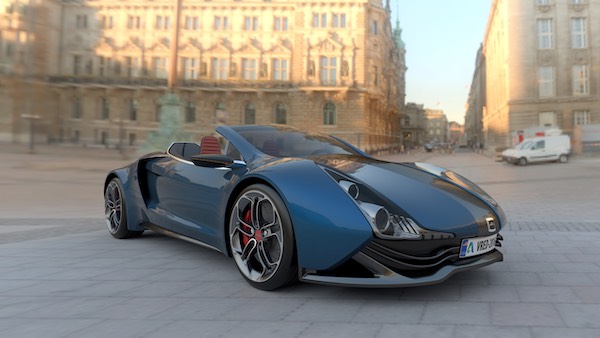
Realism when designing virtual models is tantamount to automakers’ ability to shorten the vehicle development lifecycle. To accelerate the pace, leading software providers ANSYS and Autodesk are teaming up to deliver streamlined integration between two of their core platforms.
As part of newly-forged collaborative effort, ANSYS and Autodesk will seamlessly integrate Autodesk’s VRED 3D visualization tool used extensively by automotive design studios with ANSYS’ physic-based lighting simulation platform, a staple of engineers. By marrying the two platforms, the partners hope to facilitate the design of hyper-realistic visualizations of vehicle interiors and exteriors with highly accurate lighting simulation. By facilitating such virtual prototypes, automotive design teams can reduce the amount of rework and double work between separate functions, which in turn, helps to streamline overall development and expedite the market launch of vehicle programs.
The main role of automotive engineers is to ensure design intent can be produced, optimized, and is cost effective—a charter enabled by ANSYS simulation portfolio. In particular, engineers tap ANSYS physics-based simulation tools to detect potential lighting defects early on for both exterior and interior scenarios and especially for the advanced interior lighting now common to automotive cockpits. Instead of each function working separately, an integrated workflow ensures the same level of accuracy and predictability throughout the entire design process, allowing designers to maintain their existing VRED tool chain and still benefit from the accuracy and predictive capabilities of ANSYS simulation while designs are still in play.
“Connecting the two solutions will bridge the two worlds by providing lighting accuracy to the design studios while quickening data preparation for engineering use cases,” explains Eric Bantegnie, vice president and general manager, systems business unit at ANSYS. “Providing such capabilities, along with the ability to reuse the workflow already in place at the design level, is key to limiting the double work between designers and engineers. It also helps optimize the data flow between teams and products.”
The integrated engineering workflow also aids in safety and compliance—both essential as automakers steer towards new terrain in areas like electrification and autonomous vehicles. The tight coupling between VRED Professional and ANSYS physics-based lighting solutions dramatically increases the realism of the virtual prototype at the early-stage design, which aids in data reusability, optimized workflows, and streamlining design iterations. By doing so, professionals become more productive and can focus more on innovation and less on tools plumbing, Bantegnie explains.
“Thanks to this integration, a VRED Professional user will easily be able to check regulations and lighting certifications directly inside their tools and directly bridge with other ANSYS products,” he explains. For example, being able to tap into ANSYS VRXPERIENCE HMI would allow a designer to validate HMI interactions in real time as well as check on the performance of sensors and their impact on safety.
Watch this video to learn more about the ANSYS optical solutions portfolio.
This video provides more information on the latest version of Autodesk VRED.


Autodesk is a world leader in 3D design, engineering, and entertainment software. They produce software for the architecture, engineering, construction, manufacturing, media, and entertainment industries.

Beth Stackpole is a contributing editor to Digital Engineering. Send e-mail about this article to [email protected].
Follow DE
Join over 90,000 engineering professionals who get fresh engineering news as soon as it is published.






About Us · Contact Us · Editorial Team · Advertising · Privacy Policy · Subscriber Services · © 2026 Digital Engineering 24/7 · Peerless Media