Helping design and engineering professionals discover, evaluate and specify technologies and processes that shorten the design cycle and enable success.


Alert!
Digital Engineering ceased publication on July 1, 2026. This website remains available as an archive of engineering content.
For inquiries or information, please email [email protected].

May 2026 Special Focus: Artificial Intelligence in Design and Simulation
In this Special Focus Issue, learn about the latest developments in the integration of artificial intelligence into engineering workflows.

April 2026 Special Focus Issue: Generative Design
In this Special Focus Issue, Digital Engineering takes a look at how generative design solutions can be used across different types of design problems and with a variety of manufacturing approaches to accelerate design space exploration, and…
Ansys announces that, together with Arm, the company is providing simulation solutions based AWS Graviton2 processors as part of its cloud offerings enabled by Amazon Web Services (AWS). It makes the first availability of Ansys' electronic design automation (EDA) semiconductor simulation solutions on the Arm Neoverse architecture.
Beginning with Ansys' APL (Apache Power Library) characterization tool, Ansys will offer more semiconductor analysis software products that can run on AWS Graviton2-powered Amazon Elastic Compute Cloud (EC2) instances, the announcement states.
"We designed Arm Neoverse to deliver the performance and efficiency required for workloads in cloud environments," said Philippe Moyer, vice president of Design Enablement, Physical Design Group at Arm. "By collaborating with Ansys and AWS to make APL available for the Arm architecture, we are continuing to enable the EDA ecosystem on Arm, ensuring Ansys' semiconductor tools portfolio runs effectively on optimized hardware."
The deployment of Ansys' APL characterization tool on Arm Neoverse affordably expedites the development and verification of technology solutions for Ansys customers on AWS, according to Ansys.
"This port makes the Arm architecture and AWS more attractive to chip design customers, empowering them to improve productivity and cost savings across their organizations," said John Lee, VP and GM at Ansys. "Access to cloud computing has become vital to our customers as their chip designs keep getting bigger. By making more of Ansys' semiconductor simulation portfolio available on this new platform, we give our customers broader access to the cloud."
The Graviton2 processor built on the Arm Neoverse architecture delivers up to 40% better price performance over comparable current generation instances for a wide variety of workloads, Ansys points out.
According to the announcement, the collaboration lays the foundation for deploying more of Ansys' comprehensive semiconductor simulation portfolio on processors built in Arm architectures.

Engineering simulation is our sole focus. For more than 45 years, we have consistently advanced this technology to meet evolving customer needs.ANSYS develops, markets and supports engineering simulation software used to predict how product…
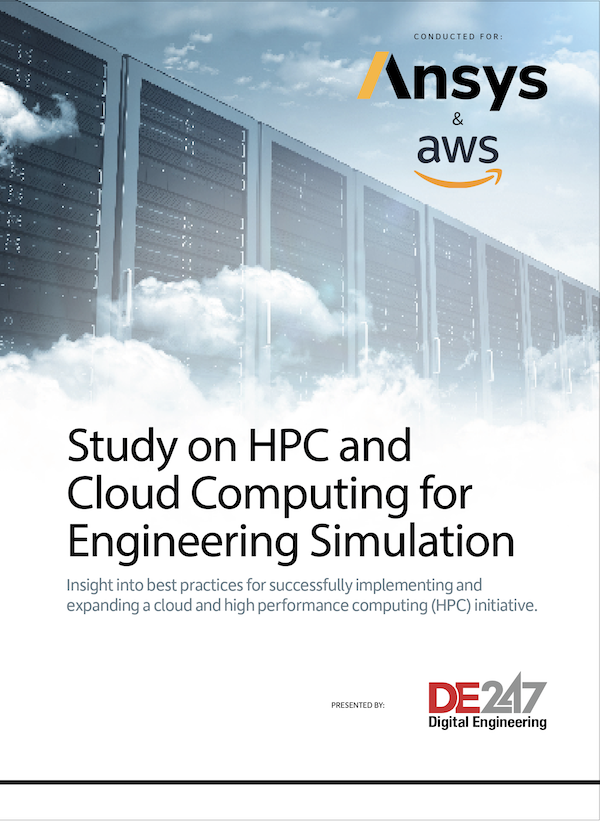
Study on HPC and Cloud Computing for Engineering Simulation
This new research report explores how companies are using HPC and simulation on the cloud.

Kenneth Wong is Digital Engineering's resident blogger and senior editor. Email him at [email protected] or share your thoughts or suggestions at digitaleng.news/facebook.
Follow DE






About Us · Contact Us · Editorial Team · Advertising · Privacy Policy · Subscriber Services · © 2026 Digital Engineering 24/7 · Peerless Media