Helping design and engineering professionals discover, evaluate and specify technologies and processes that shorten the design cycle and enable success.


Alert!
Digital Engineering ceased publication on July 1, 2026. This website remains available as an archive of engineering content.
For inquiries or information, please email [email protected].

May 2026 Special Focus: Artificial Intelligence in Design and Simulation
In this Special Focus Issue, learn about the latest developments in the integration of artificial intelligence into engineering workflows.

April 2026 Special Focus Issue: Generative Design
In this Special Focus Issue, Digital Engineering takes a look at how generative design solutions can be used across different types of design problems and with a variety of manufacturing approaches to accelerate design space exploration, and…
The NAFEMS ASSESS Summit, held in Atlanta in March, brought together leading simulation end users and vendors to discuss the future of the industry, new technology innovations, and marked a turning point in the leadership of the organization.
At the Summit, attendees got to meet new ASSESS Executive Director Nick Appleyard, and bid farewell to ASSESS Initiative founder and leader Joe Walsh, who has been overseeing the effort since 2015. The group was established as an independent think tank to help shape the future of engineering simulation and expand its use across industries and roles.
Appleyard (who is also a consultant at CIMData and previously worked at Siemens) has been tasked with leading “ASSESS 2.0.” That work will include refining the group’s efforts in simulation expansion.

Walsh opened the event with an overview of recent ASSESS/NAFEMS accomplishments, including the launch of the UMC4ES s standard for simulation model characteristics; the NAFEMS Simulation Maturity Assessment Service; and the NAFEMS Aiolas artificial intelligence (AI) search tool. ASSESS is planning multiple executive reviews in 2025, along with one paper on certification.
Walsh also provided an overview of the state of simulation democratization, noting that “The role of simulation has evolved from being a support act to a leadership role in business strategy,” he said. “The broader use of simulation is required by most companies to enable digital transformation."
He also noted that large-scale simulation democratization is “extremely rare,” and that getting there requires a number of shifts in expertise, culture, organizational structures, and more.
Realizing the benefits of simulation also requires organizations to better understand what simulation can do, including its limitations and applicability. “Every simulation supports a decision that has been made, or that will be made,” Walsh said. “If it doesn’t, you shouldn’t be running the simulation.”
As simulation expands throughout an organization, engineers also have to make sure that all stakeholders in the process, especially non-experts, understand the limits of simulation as well. “Whenwe have people doing simulations who don’t have the same level of physics expertise who don’t have the understanding of nonlinear analysis – we need to make sure they understand variability and uncertainty. Otherwise, they will take every answer as gospel. They need to know that simulation gives you a range of answers.”
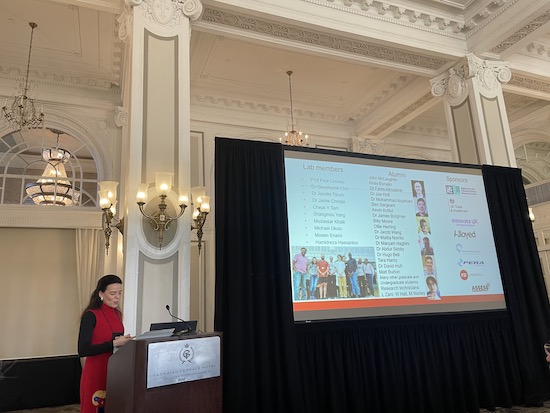
Appleyard and other attendees paid tribute to Walsh as they discussed the future of the organization (NAFEMS CEO Tim Morris joined in via Zoom).
“I see this as a think tank where bold thinkers and visionaries can share ideas and learn from each other,” Appleyard said. “We want to help lead the industry in using simulation to affect change.”
Appleyard said that he hopes to enable ASSESS to leverage NAFEMS resources more broadly, continue the annual Summit, and establish a broader focus on the business impacts of simulation. He also hopes to launch more projects and workshops.
The ASSESS Summit also featured presentations from leading end users, academics and software vendors. Carmen Torres-Sanchez of the University of Loughborough led a keynote presentation on her team’s work in moving from physics-based simulation to data-driven approaches around bioinstructive alloys. She also discussed the NAFEMS WISE subcommittee, which was launched to foster gender diversity to simulation engineering.
Attendees also got a look at the latest computer aided engineering (CAE) market trends from Petra Gartzen, senior consultant at Cambashi. According to the data, mechanical CAE (MCAE) is the largest segment of the manufacturing design software market at 37%, followed by MCAD (27%), PLM (19%) and CAM (11%). It is also the fastest growing segment, with a CAGR of 9.5% over the past 17 years with no signs of slowing down. Revenue is expected to double over the next seven years.
“Simulaton-led design is entering the manufacturing industry, and that will continue to give CAE software another boost,” Gartzen said.
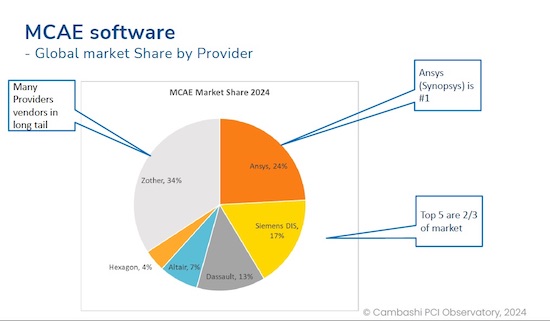
There has been significant merger and acquisition activity in the space, with electronics design and mechanical CAE companies joining forces. Ansys (which is merging with Synopsys) leads the market with 24% share, followed by Siemens (17%), Dassault (13%), Altair (which is being acquired by Siemens, at 7%), and Hexagon (4%). But a whopping 34% of the market falls into the “other” category. Gartzen said that 82% of vendors in the space have revenues of less than $10 million.
As Gartzen pointed out, the simulation market has a “long tail” of small companies, and more are emerging every year. “Just in doing this research, we uncovered another 40 companies we were not previously aware of,” she said.

Amandine Battentier of Schlumberger discussed the challenges and benefits the company encountered while rolling out a simulation data and process management (SPDM) initiative. Michale Balchanos, Aerospace Systems Design Laboratory (ASDL), discussed simulating potential lunar settlements, while Alfred Svobodnik from MVoid Group evaluated the business benefits of early-stage digital twins in the automotive industry.
McKinsey Consulting presented findings based on a series of interviews with simulation users, vendors, and academics around the future direction of simulation. There was broad agreement that artificial intelligence (AI) and machine learning (ML) would play a larger role in expanding access to simulation tools and data.
There were additional sessions led by representatives from Honda, Queen’s University Belfast, and a Day 2 keynote from Jack Castro of Boeing.
You can learn more about the ASSESS Summit here.


NAFEMS is the International Association for the Engineering Modelling, Analysis and Simulation Community. We focus on the practical application of numerical engineering simulation techniques such as the Finite Element Method for Structural…
Simulation Focus: Conference on Advancing Analysis and Simulation in Engineering (CAASE) Preview
The CAASE18 (Conference on Advancing Analysis and Simulation in Engineering) kicking off June 5-7, 2018 on the south shore of Lake Erie in Cleveland, OH plans to take the engineering analysis community by storm. The event is expected to play host to potentially 500 attendees from nearly 250 companies while delivering a wealth of educational opportunities covering all facets of engineering analysis and simulation.

Brian Albright is the editorial director of Digital Engineering.
Contact him at [email protected].






About Us · Contact Us · Editorial Team · Advertising · Privacy Policy · Subscriber Services · © 2026 Digital Engineering 24/7 · Peerless Media