Helping design and engineering professionals discover, evaluate and specify technologies and processes that shorten the design cycle and enable success.


Alert!
Digital Engineering ceased publication on July 1, 2026. This website remains available as an archive of engineering content.
For inquiries or information, please email [email protected].

May 2026 Special Focus: Artificial Intelligence in Design and Simulation
In this Special Focus Issue, learn about the latest developments in the integration of artificial intelligence into engineering workflows.

Design & Simulation Software Guide 2025
In this Special Issue, Digital Engineering presents its second annual guide to design and simulation software vendors.
As companies across the globe struggle to safely reopen workspaces in the wake of the on-going pandemic, simulation is playing a critical role.
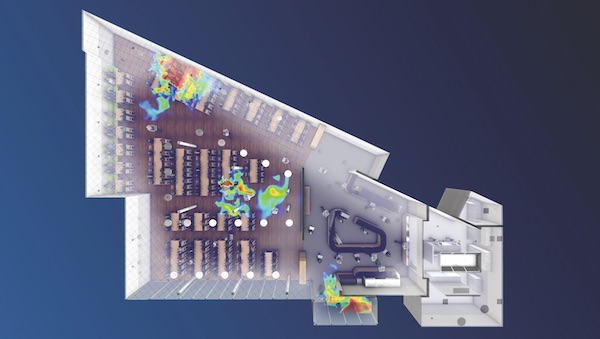
At GEA, a technology supplier in the food processing space, simulation software and digital twin technology are at the forefront of the company’s reopening efforts, specifically as a way to bring its Oelde, Germany, cafeteria back online. The cafeteria, a favorite gathering spot for the firm’s 1,900 employees, has been closed since March, and management was hungry to explore airflow patterns as a way to understand how the virus could spread through the air as well as contaminate surfaces like plates, trays, and tables.
“The cafeteria is an important meeting point for our employees, customers, and business partners and plays a huge role in the social side of work,” says Erich Nitzsche, vice president engineering standards & services, at GEA. “We had to ask ourselves under which conditions we could open them up again without putting employee health at risk. The missing piece of the puzzle was being able to simulate the environmental conditions. The challenge was to combine human factors, physics, and technical framework into one model that provides answers.”
To do that, GEA turned to Dassault Systèmes and SIMULIA applications powered by the 3DEXPERIENCE platform. The partners built a 3D virtual twin of the cafeteria with parameters, including employees infected with the virus coughing and sneezing, to simulate particle flow behavior throughout the space. GEA wanted to understand how the virus could spread as well as to see where there might be areas of high virus concentration.
The team used Dassault’s high accuracy CFD Solver PowerFLOW, based on the Lattice-Boltzmann Method—a tool that is highly scalable and well suited for simulating transient efforts for aerodynamics/aeroacoustics and thermal applications, according to Christian Barthel, SIMULIA expert at Dassault Systèmes. A full digital twin of the cafeteria was created, including detailed 3D geometry and boundary conditions like mass flows.
Based on simulation results, GEA can now initiate specific measures like reworking the cafeteria’s entrance and exit, adapting the seating arrangements, as well as introducing additional safety measures in the kitchen area. “The results not only help us to identify risk areas and develop suitable solutions, but we can also use them in our communication with employees,” says Peter Brüggenkötter, head of HSE Management at GEA. “Increasing employee awareness is particularly valuable at a time when everyone is reaching capacity with the pandemic situation. We want to motivate our employees while helping them to respect and maintain our defined safety measures.”
GEA plans to leverage the simulation data to make the changes that will allow it to open the cafeteria shortly. Dassault officials said they are seeing an uptick in interest for this type of use case for simulation for safe re-opening hospitals, shopping malls, churches, and sports facilities, among other large venue institutions. “They have one thing in common—the need for reliable analysis in order to increase the safety of people to secure their business,” says Dassault’s Barthel.
To learn about how GEA leveraged simulation and digital twin technology as part of its COVID-19 planning, watch this video.


Dassault Systèmes, the 3DEXPERIENCE Company, is a catalyst for human progress. We provide business and people with collaborative virtual environments to imagine sustainable innovations. The 3DEXPERIENCE platform enables companies to create and…

Electrum utilizes the 3DEXPERIENCE platform on the cloud to develop their new electric motorcycle
Electrum, a new brand of electric motorcycles, utilizes the 3DEXPERIENCE platform. Their mission is to support Indonesia’s shift to low-carbon, sustainable transport and to ultimately help the country’s government achieve its vision of net zero carbon emissions by 2060.

Beth Stackpole is a contributing editor to Digital Engineering. Send e-mail about this article to [email protected].
Follow DE






About Us · Contact Us · Editorial Team · Advertising · Privacy Policy · Subscriber Services · © 2026 Digital Engineering 24/7 · Peerless Media