Helping design and engineering professionals discover, evaluate and specify technologies and processes that shorten the design cycle and enable success.



May 2026 Special Focus: Artificial Intelligence in Design and Simulation
In this Special Focus Issue, learn about the latest developments in the integration of artificial intelligence into engineering workflows.

April 2026 Special Focus Issue: Generative Design
In this Special Focus Issue, Digital Engineering takes a look at how generative design solutions can be used across different types of design problems and with a variety of manufacturing approaches to accelerate design space exploration, and…
"Many of the sounds we hear every day are entirely fabricated by engineers to persuade us to buy things," according to a recently published BBC news item ("How Engineers Create Artificial Sounds to Fool Us," July 8, 2011).
One of the most notable examples might be the sound your iPad, iPod, or iPhone makes when you unlock it or type on its virtual keypad. The software-driven feature achieves this without involving any interlocking gears and spurs. So why does the operation produce the distinctly metallic click? Here's my guess: The mechanical sound is an integral part of a consumer's expectation of how things work, so the product designer decided to engineer it into the device's artificial behavior.
"The shutter noise on a digital camera is just one example of a sound entirely fabricated to make a modern gadget imitate older technology," BBC article points out. There's also the prevalent use microphones and speakers in mobile devices to allow users to record voice memos and play back music tracks. Needless to say, analysis and simulation software makers take note.
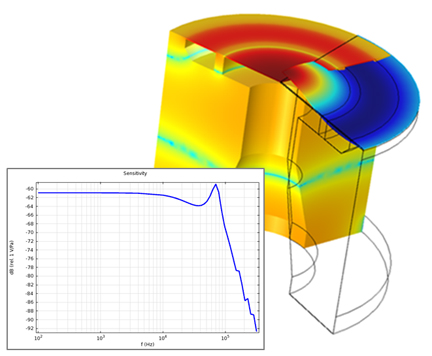
Last week, COMSOL released a major upgrade to its Acoustic Module, an add-on to its flagship software COMSOL Multiphysics.
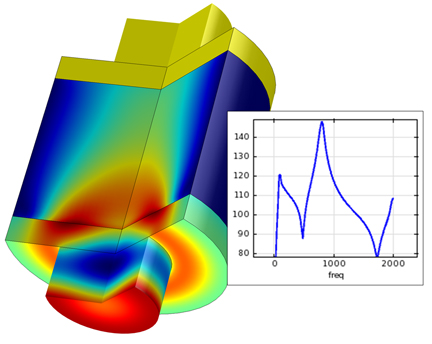
"This release of the Acoustics Module brings a new level of predictive power to acoustic simulations,” according to Dr. Mads J. Herring Jensen, technical product manager for acoustics at COMSOL. “For the first time, manufacturers of acoustic devices for smart phones, hearing aids, and earpieces can perform thermoacoustic simulations with an industry-standard commercial multiphysics software package. The ability to combine such simulations with electrical circuits and structural vibrations raises the bar for state-of-the-art acoustics simulations of mobile devices.”
COMSOL explains, "The new modeling tools for thermoviscous acoustics in the Acoustics Module enable highly accurate simulation of miniaturized speakers and microphones for hand-held devices. The ability to include thermoviscous acoustics, also known as thermoacoustics, in a simulation is necessary to accurately model acoustics in geometries with small dimensions. Near walls, viscosity and thermal conduction become important considerations because they create a viscous and a thermal boundary layer where losses are significant. The new thermoacoustics capabilities of the Acoustics Module take such effects fully into account."
Other use of acoustic simulation may be "to represent the filling's acoustic damping properties" in automotive design. The Acoustics Module’s new poroelastic wave functionality is expected to offer a new and more accurate approach to this challenge.


Kenneth Wong is Digital Engineering's resident blogger and senior editor. Email him at [email protected] or share your thoughts or suggestions at digitaleng.news/facebook.
Follow DE
Join over 90,000 engineering professionals who get fresh engineering news as soon as it is published.






About Us · Contact Us · Editorial Team · Advertising · Privacy Policy · Subscriber Services · © 2026 Digital Engineering 24/7 · Peerless Media