Helping design and engineering professionals discover, evaluate and specify technologies and processes that shorten the design cycle and enable success.



Digital Engineering April 2026
In the latest issue of Digital Engineering, we take a look at the latest innovations in design for additive manufacturing, including the use of natural language inputs, social media cosplayers, and AI integration. The issue also includes a feature…

January Special Focus Issue: Design for Additive
In this Special Focus Issue of Digital Engineering, learn about the latest advancements in design for additive manufacturing, including new software tools, additive in automotive, custom medical devices, and more.
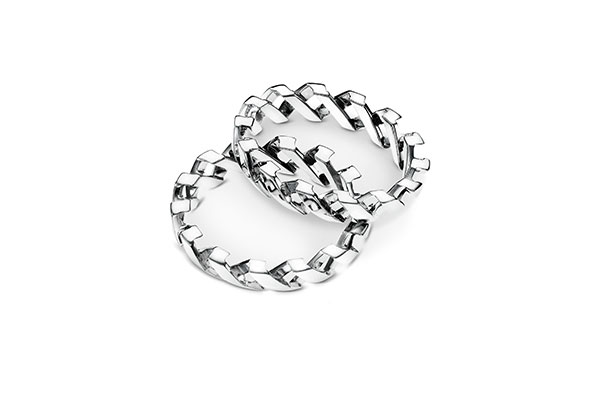
Desktop Metal announces that 925 sterling silver is qualified for 3D printing on the Production System platform, including the P-1 and P-50, offering jewelry and luxury goods manufacturers a means to directly 3D print quality jewelry, watches, belt buckles and decorative hardware for handbags.
Desktop Metal is also fast-tracking development of more precious metal alloys in 2022, including 18K yellow gold, with research and development on rose gold. Desktop Metal and ETEC polymer brand have partnered with major jewelry producers such as Cartier, Stuller, Shinola and Swarovski.
“The qualification of precious metals for direct 3D printing on high-speed binder jetting systems is a major milestone for the jewelry and luxury goods industry,” says Ric Fulop, founder and CEO of Desktop Metal. “All the design freedom and customization of 3D printing can now be delivered directly at high volumes without all of the labor associated with traditional manufacturing processes.”
To advance the technology and materials needed for the luxury goods and jewelry market, Desktop Metal is partnering with two leaders in precious metals powder and parts production: Formula 3D Corporation founded by Christian Tse of Christian Tse Designs & Manufacturing Inc. for the U.S. market, and Neoshapes for international clientele. Both collaborations aim to enable the luxury goods and jewelry markets to adopt metal binder jetting processes to produce end-use parts in precious metals, steels and more.
Formula 3D Corporation offers designers and manufacturers an end-to-end solution for 3D printing precious metals—from the design to customer-ready finished quality jewelry.
A new video released with Christian Tse showcases how this Monrovia, CA-based luxury design and manufacturing house is using the Desktop Metal Production System P-1 for jewelry manufacturing.
“Desktop Metal’s Production System adds extraordinary value to our existing jewelry manufacturing processes, increasing efficiency of production, getting new designs to market faster, and offering our customers greater versatility and multiple styling options. We can actually print in precious metals in two hours what we do in two days with casting,” says Christian Tse. “In addition, creating jewelry with binder jetting is allowing us to consider new options to circumvent some of the supply chain challenges facing the fine jewelry industry. We can bypass shipping delays and mounting costs, as well as avoid duties, by printing the precious silver directly, as opposed to shipping the physical metal.”
Neoshapes, a Swiss company based in Geneva, Switzerland, founded by experienced executives in the luxury goods industry, takes an end-to-end approach—from the production and supply of powder, to the printing and post-processing of precious metals components, as well as consultancy services to enable industry players to easily transition their production processes to binder jet technology.
“Binder jetting opens up new perspectives for the luxury industry, even more now with the qualification of precious metal alloys, giving further leverage to develop and produce creative products from a single file, leaping forward into the digital supply chain. The time to market for new creative products is also reduced considerably, allowing brands to better meet demand while maintaining minimal inventories,” says Stéphane Vigié, Neoshapes co-founder.
The Production System’s Single Pass Jetting (SPJ) technology, which delivers high-speed 3D printing of metals, enables jewelers to adopt an entirely digital and agile manufacturing workflow. Jewelers can have greater design flexibility and control, allowing designers and manufacturers to scale new designs previously impossible or difficult to produce without significant manual labor—such as chain link bracelets or necklaces, where the links can be 3D printed in place as one piece instead of being manually assembled one link at a time.
In addition, jewelers can leverage AM for localized production, decreasing the reliance on long lead-time global supply chains and offering opportunities for onshoring manufacturing.
The benefits of additive manufacturing for luxury goods and jewelry applications are significant:
Up to tens of thousands of jewelry pieces per day can be 3D printed on the Production System, and manufacturers can produce the same pieces or customized ones—all in a single build.
By eliminating ttechniques like casting, manufacturers can iterate and scale new designs easily—once a design is finalized, printing and production can begin immediately. Manufacturers can also establish digital inventories, storing design files digitally to be made on demand.
With the Production System, substantially all of the loose powder recovered during the printing and depowdering process can be recycled and reused for subsequent prints.
For more about the Production System and printing in precious metals, click here.
Sources: Press materials received from the company and additional information gleaned from the company’s website.


Desktop Metal was started to address a problem—how to make metal 3D printing accessible for engineering teams. In 2013, CEO Ric Fulop began collaborating with world-leading experts in materials science, engineering, and 3D printing. Their work…

DE's editors contribute news and new product announcements to Digital Engineering. Press releases may be sent to them via [email protected].
Follow DE
Join over 90,000 engineering professionals who get fresh engineering news as soon as it is published.






About Us · Contact Us · Editorial Team · Advertising · Privacy Policy · Subscriber Services · © 2026 Digital Engineering 24/7 · Peerless Media