Helping design and engineering professionals discover, evaluate and specify technologies and processes that shorten the design cycle and enable success.


Alert!
Digital Engineering ceased publication on July 1, 2026. This website remains available as an archive of engineering content.
For inquiries or information, please email [email protected].

Design & Simulation Software Guide 2025
In this Special Issue, Digital Engineering presents its second annual guide to design and simulation software vendors.

Design & Simulation Software Guide
In this Special Issue, Digital Engineering presents its inaugural guide to design and simulation software vendors, including listings for CAD, CAM, simulation, generative design, PLM, rendering and visualization, design for additive manufacturing,…
Xin Ning, an assistant professor of aerospace engineering at Penn State University, specializes in developing materials for use in space. He has now received a National Science Foundation (NSF) grant to apply his research a little closer to home, with a stretchable sensor and foldable field hospital that could aid in the COVID-19 pandemic.
“Two years ago, I had the idea for an expandable chamber that could be deployed on the International Space Station with the ability to monitor astronaut health,” Ning says. “When COVID-19 started to spread, I thought this idea could be useful on Earth.”
The two-year, $265,000 grant is a part of the “EArly-concept Grants for Exploratory Research” (EAGER) program that funds early stage research with transformative potential.
The first step in Ning’s project is to develop a stretchable sensor that fits to a patient’s chest and abdomen.
“It will actually be a network of sensors that can move with the patient and monitor breathing, temperature and coughing—three of the most important vital signs to know when it comes to this virus,” Ning says. “It’s pretty difficult to measure breathing and coughing via a wearable sensor because they, by their nature, cause us to move a lot. By having many sensors connected into one network, vital signs are easier to accurately monitor.”
Ning also plans to make the sensor foldable. By making the sensor foldable, it could compress into a small package for storage and transportation.
The wearable sensor will pair with an antenna, which would remove the need for wires or batteries.
“It’s similar to the technology that allows you to buy a coffee by scanning your phone at the cash register, but we modify it to improve transmission range to offer great flexibility,” Ning says.
This flexibility may be helpful for the second part of Ning’s project: a foldable field hospital.
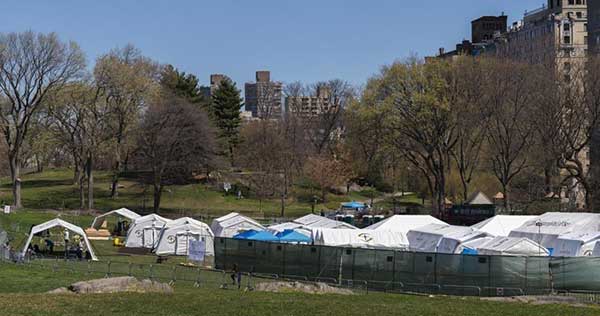
“During this pandemic, the sheer number of patients forced the development of field hospitals across Asia, Europe—even in Central Park in New York,” Ning said.
Field hospitals help mitigate patient crushes and overflows, especially in the face of a highly contagious disease. Health care professionals can triage patients at a field hospital, reserving the established hospital resources for the most serious cases.
The problem is that field hospitals can take significant resources to build and operate, according to Ning. His solution is an easy-to-assemble unit that can hold one to two patients and fold into a container the size of a large suitcase.
“We’re using origami concepts to develop this,” Ning says. “Origami is basically modular assembly that is repetitive and scalable. Once we have the one-to-two-patient unit, we can add on to expand the field hospital.”
Each unit would have an antenna that transmits power to the sensors worn by the patients, as well as receives the vital sign information.
This project includes an educational plan to to involve undergraduates in the research, called, “We Are. We Care.” “'We Are' represents the Penn State slogan and spirit of being a community that innovates, solves problems and commits to excellence, Ning says. “We Care” reflects the objective of this educational plan: cultivating students’ passion for engineering innovation to help people.
“Projects funded through EAGER are considered high risk, but, if they work, they have a high payoff,” Ning says. “My project is a radically different approach to health care for patients with COVID-19, and I’m eager to make it work.”
Sources: Press materials received from the company and additional information gleaned from the company’s website.


DE's editors contribute news and new product announcements to Digital Engineering. Press releases may be sent to them via [email protected].
Follow DE






About Us · Contact Us · Editorial Team · Advertising · Privacy Policy · Subscriber Services · © 2026 Digital Engineering 24/7 · Peerless Media