Helping design and engineering professionals discover, evaluate and specify technologies and processes that shorten the design cycle and enable success.


Alert!
Digital Engineering ceased publication on July 1, 2026. This website remains available as an archive of engineering content.
For inquiries or information, please email [email protected].
Sponsored


May 2026 Special Focus: Artificial Intelligence in Design and Simulation
In this Special Focus Issue, learn about the latest developments in the integration of artificial intelligence into engineering workflows.

Design & Simulation Software Guide 2025
In this Special Issue, Digital Engineering presents its second annual guide to design and simulation software vendors.
Computer modeling and simulation has been used in engineering for many decades. Anyone working in R&D is likely to have either directly used simulation software or indirectly used the results generated by someone else's model. There are clear benefits of using simulation to get a preview of the real-world outcome before committing to a project plan. However, a model is only as useful as it is realistic, and sometimes the spec changes at a rapid pace. The way simulation has largely been used over the past 30 years has required specific expertise and training on how to use the software of choice. While companies that use it stand to gain a lot, the total gain is still limited by the number of employees who have the necessary skills to build computational models. But that does not need to be the case.
Take a company that produces speakers for luxury cars, for instance. Multiphysics modeling makes it much faster and easier to visualize how different designs will sound in specific car cabins before going to production. But if the car is still in the process of being designed, even the perfect car cabin replica can become outdated very quickly. The way sound bounces off the interior might go from acoustic bliss to tinny tunes if the car door design or trim type changes. Updating and rerunning the model over and over takes time, and the lag between learning about the interior changes to updating the model only extends the project timeline. At one audio technology supplier for car manufacturers, the team worked across time zones and the lag was a huge pain. To overcome this challenge, they built their own custom simulation apps based on their full-fledged model.
Instead of constantly updating large models to account for design changes, their global and cross-functional team entered the changes into input fields in a custom user interface — built by them in-house, exactly to suit their own needs. Since the app is powered by their own underlying acoustics model, they could quickly and easily visualize how their loudspeakers would sound inside the car environment, design changes and all. Here the apps were built by and for R&D teams to improve their own work and while it benefited the company, it is still "just" another example of using modeling and simulation for R&D. Apps have the potential to break far beyond the traditional simulation software user groups.
Let's consider a construction company. Building more leads to more revenue, but hiring enough contractors for the job does not guarantee a larger profit. Concrete is affected by air and soil temperature during the curing phase as well as internal temperatures influenced by chemical reactions when water and cement are combined. Picking the best concrete mix and deciding when to remove the supporting framework determines how fast the concrete will harden and how strong and durable it will be. Multiphysics simulation would provide contractors with more accurate estimates than intuition and guesswork, especially when incorporating information such as the building part being cast, the material surrounding the concrete, and onsite weather conditions, now and in the forecast. This type of information is best gathered in the moment, out in the field. It is not practical to send a simulation engineer out with the construction crew nor is it realistic to teach the crew how to use simulation software. But it is possible to have a simulation engineer build a custom app for the onsite crew to use. Simulation apps would allow contractors to test their choices virtually before picking the best mix and curing time based on both science and their local onsite conditions. One of the world's largest suppliers of cement and precast concrete rolled out an app exactly for this use a couple of years ago, and they are continuing to expand on their use of simulation apps today.
.png)
Next, consider a manufacturing company. Here, the indoor environment can be more tightly controlled, but there are still many uncertainties that can impact production outcomes. Predicting them in advance will lead to better business results. In the case of an additive manufacturing factory producing parts via metal powder bed fusion, for example, simulation engineers can optimize the designs in advance back at the office. However, the end result might not match the model if the facility conditions are not ideal at the time of production. Heat and humidity inside the facility can cause the metal powder to oxidize and pick up moisture while in storage, which will alter how it flows, melts, picks up electric charges, and solidifies. Furthermore, the powder is flammable and toxic, especially when it dries out. Measuring and managing humidity levels in the factory impacts both product quality and worker safety. One such company modeled their own factory and built simulation apps around it to monitor and predict factory conditions based on variables like outside climate, number of running machines, and machine positions. Their staff then use the apps on the spot to figure out how to adjust ventilation and production schedules to create the conditions they need for the best results.
Now, running direct experiments in a lab or using test rigs allows for seeing exactly what the real outcome is based on carefully selected inputs and a controlled setup. By coupling testing with simulation, though, you can improve understanding and make faster predictions using the lab-generated results. For example, when researching thermal elastohydrodynamic lubrication of gear contacts, scientists might learn through observation that a diamond-like carbon coating on the gears' surface improves their efficiency, but that only shows what happens, not why. In this case, having a simulation app in the lab would allow for easily inputting the details of the actual setup and get a multiphysics simulation of how the heat flows inside the system. A research team that did this understood from the model that the efficiency improvement stemmed from the fact that the coating traps heat in the contact, which lowers the lubricant's viscosity and thereby decreases friction. They would not have known this using only the naked eye.
Simulation can be used as an effective decision-making tool in the office, field, factory, and lab. When organizations build and distribute their own custom apps, everyone in the workforce will be able to make decisions based on forecasts that account for real-world complexities and the underlying laws of physics — without having to first learn how to use simulation software or take up a lot of someone else's time.
Learn more about simulation apps in this resource: www.comsol.com/benefits/simulation-apps
Fanny Griesmer is the chief operating officer of COMSOL, Inc., which develops, markets, and sells the COMSOL Multiphysics® simulation software.



COMSOL is a global provider of simulation software for product design and research to technical enterprises, research labs, and universities. Its COMSOL Multiphysics® product is an integrated software environment for creating physics-based models…
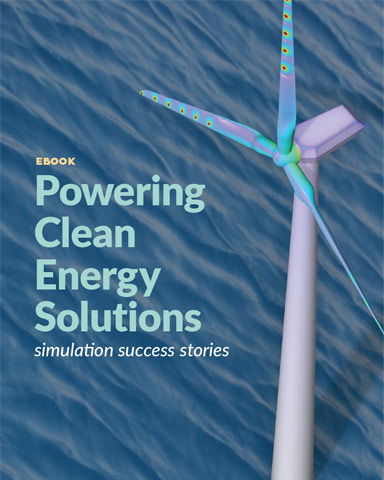
Ebook download: Powering Clean Energy Solutions
In this ebook, we explore 6 cases where modeling and simulation were used to help overcome these new design challenges. Topics include water turbines, sand-based heat storage, hydrogen fuel cells, and more.

Join over 90,000 engineering professionals who get fresh engineering news as soon as it is published.






About Us · Contact Us · Editorial Team · Advertising · Privacy Policy · Subscriber Services · © 2026 Digital Engineering 24/7 · Peerless Media