Helping design and engineering professionals discover, evaluate and specify technologies and processes that shorten the design cycle and enable success.



May 2026 Special Focus: Artificial Intelligence in Design and Simulation
In this Special Focus Issue, learn about the latest developments in the integration of artificial intelligence into engineering workflows.

April 2026 Special Focus Issue: Generative Design
In this Special Focus Issue, Digital Engineering takes a look at how generative design solutions can be used across different types of design problems and with a variety of manufacturing approaches to accelerate design space exploration, and…
When your chosen engineering software vendor has more than 1,000 products, how to you even start to consider all the options for process improvement? The answer emerging from the last of seven sessions in the Digital Transformations track at this year’s SolidWorks World was to forget about specific products and work on themes that match your digital transformation agenda.
“You eat the elephant one bite at a time,” said Louis Feldstein, the worldwide director of high tech solutions for Dassault Systemès, the parent company of SolidWorks. At best, digital transformation is an evolutionary journey, Feldstein said. Startups have an advantage in starting with the latest technology and processes, but most existing engineering teams have to “find where they are on the roadmap” and build a plan, he added.
Dassault says the journey of digital transformation starts with a definition; they like the one from research firm IDC:
“Digital Transformation is the continuous process by which enterprises adapt to the disruptive changes in their customers and markets by leveraging digital competencies to innovate new business models, products, and services that seamlessly blend digital and physical and business and customer experiences while improving operational efficiencies and organizational performance.”
This definition gives wide latitude in where to look for both the easy fixes and the major pain points.
Sometimes the first steps do not come as a result of a great visionary plan. Feldstein told of one client who only wanted to solve a single problem. It seemed their internal processes usually ended up with Marketing having product imagery from a beta version of the product. “Every customer has a different set of problems,” he said. In each situation, the company needs to identify key performance indicators (KPIs) to work on first.
KPIs were made famous by business researcher Peter Drucker, who once summed up the concept of key performance indicators by saying: “What gets measured gets done.”
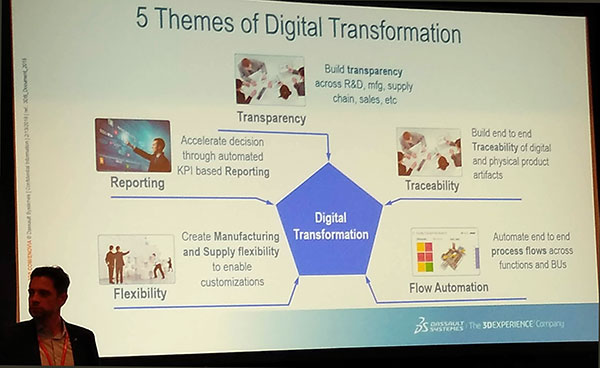
Dassault’s David Mann, a business development director, said there are five themes to keep in mind as a company studies how to initiate or improve digital transformation:
Two products on the market can serve as metaphors for the power and potential for digital transformation, said Mann: the commercial drone and the electric automobile. Small personal drones have gone from being radio controlled analog machines to software-driven digital devices.
The typical electric car has become “a tablet with wheels,” Mann said. “The next generation are not cars but autonomous AI devices.” As the automotive industry moves toward a design ratio of 40% mechanical and 60% electronic, “the supply has been turned upside down.” Such shifts, Mann said, are driving digital transformation.
Dassault Systemès is best known for its CAD tools CATIA and SOLIDWORKS, but Feldstein said only a small portion of digital transformation is about CAD. “We are CAD neutral for the next generation of transformation,” he said. Focusing on the capabilities of single tools results in “each silo working faster and faster.” The new changes for digital transformation are about opening processes up to the wider enterprise as described in the five themes mentioned above.
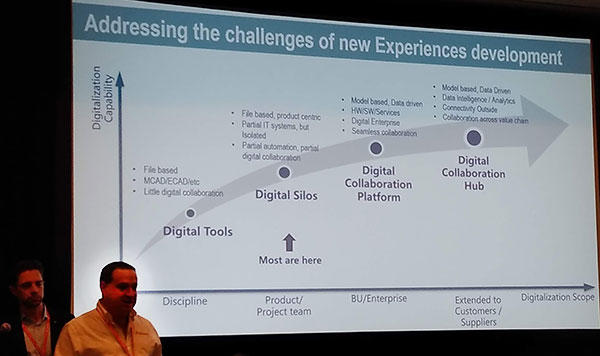
Mann described the path of digital transformation as a series of four challenges or levels of awareness. The first is Digital Tools, which focus on a specific discipline. Second is Digital Silos, which has a focus on product and project teams. Most manufacturers are on this level, Mann said. The third is Digital Collaboration Platform, which covers a business unit or the complete enterprise. The fourth is Digital Collaboration Hub, which extends the power of digital transformation beyond the organization to suppliers and customers.
Two questions from the audience came in response to the “digital challenges” chart. The first question was about how to integrate either enterprise resource management (ERP) or supply chain management (SCM) into a digital transformation scheme. On a practical level, Feldstein says, there is no simple integration of ERP or SCM because almost every company using either has added a high degree of customization to their installations.
A second question asked about the relationship of product lifecycle management (PLM) to digital transformation. “PLM is a workgroup tool,” Mann told the audience. “This is a holistic explanation.”


Dassault Systèmes, the 3DEXPERIENCE Company, is a catalyst for human progress. We provide business and people with collaborative virtual environments to imagine sustainable innovations. The 3DEXPERIENCE platform enables companies to create and…

Electrum utilizes the 3DEXPERIENCE platform on the cloud to develop their new electric motorcycle
Electrum, a new brand of electric motorcycles, utilizes the 3DEXPERIENCE platform. Their mission is to support Indonesia’s shift to low-carbon, sustainable transport and to ultimately help the country’s government achieve its vision of net zero carbon emissions by 2060.

Randall S. Newton is principal analyst at Consilia Vektor, covering engineering technology. He has been part of the computer graphics industry in a variety of roles since 1985.
Follow DE
Join over 90,000 engineering professionals who get fresh engineering news as soon as it is published.






About Us · Contact Us · Editorial Team · Advertising · Privacy Policy · Subscriber Services · © 2026 Digital Engineering 24/7 · Peerless Media