Helping design and engineering professionals discover, evaluate and specify technologies and processes that shorten the design cycle and enable success.


Alert!
Digital Engineering ceased publication on July 1, 2026. This website remains available as an archive of engineering content.
For inquiries or information, please email [email protected].
Sponsored


May 2026 Special Focus: Artificial Intelligence in Design and Simulation
In this Special Focus Issue, learn about the latest developments in the integration of artificial intelligence into engineering workflows.

April 2026 Special Focus Issue: Generative Design
In this Special Focus Issue, Digital Engineering takes a look at how generative design solutions can be used across different types of design problems and with a variety of manufacturing approaches to accelerate design space exploration, and…
Integrating more modern, innovative technology into existing workflows involves investment, and is time consuming to begin with, in the long run it will save manufacturers money and cut lead times by improving processes. But if you're starting to think about jumping on the XR bandwagon, what do you need to consider?
The AR/VR market has been driven over the last 5 years by a raft of new headsets and mobile devices- many from familiar names like Apple, Facebook, HTC, Google, Microsoft and Samsung- along with dozens of start-ups. The headset devices can cost from £250.00 to £3,500.00 which means price, certainly at the lower end, is not a barrier to adoption.
Other than an expectation that Apple will release an MR headset sometime in the next 12 -24 months, there is no expected “breakthrough”, or major change to the technologies, just a lot of incremental improvement to what already exists.
The result is that business is moving away from focusing on the technology and devices, to a phase of planning how best to deploy, and achieve a financial return from, investments in XR.
Companies are now assembling teams to study how XR technologies can be applied to the process of designing and manufacturing products. Leading companies recognise that their customers expect them to be leaders in this area. Many of these early adopters are now beginning to deploy XR solutions.
To make XR meaningful for a business, you have to understand that there’s got to be a relevant use case. Without a strong use case, there will not be any traction.
The big question is: Is XR ready for industrial use and how do companies deploy it?
People talk in grandiose terms about having an XR strategy, but you can’t really have a strategy on XR unless you understand something about the technology and where it’s going to benefit your business.
What you have to recognise is that you are going to have to go through an education and learning process, which means that you’ve got to invest in that in order to have some understanding of how XR might impact your business.
One of the key factors is to accept that it has to be use case driven, which really means it has to be led by end user departments. That said, those departments may need help and support, and so IT or innovation groups who are often looking at XR as a technology may also need to be involved.
So the first thing companies should focus on is to decide what area of their business do they think XR might help them in, whether it’s design, manufacturing, inspection, training or remote assistance.
When researching XR, don’t fall into the trap of believing everything you see on YouTube, and don’t get hung up on devices – e.g. ‘Should it be HTC Vive, Oculus Rift, HoloLens, Magic Leap?’ The pace of change around both hardware and software is very rapid. What’s the right decision on a device today will change in 12 months. Focus on the use case.
Companies need to implement a use case where they can run it on many different devices, and they need to be device and data neutral i.e. whatever data they create, they need to create it so that they can use it on the next generation of devices. That’s a trend people are beginning to grasp.
Related Resource
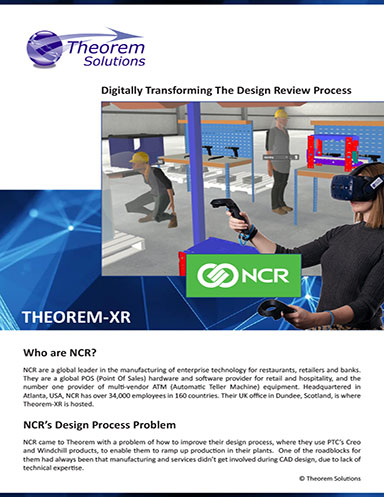
Digitally Transforming the Design Review Process
In only a short time, ATM manufacturer NCR (National Cash Registers) have revolutionized their design review and prototyping processes with the help of Theorem-XR. Download Now!
Obviously you’ve got to select a technology and an approach to it, but don’t get concerned that because you’ve gone for a particular device type, it will cause problems later. Yes, there will be a level of upheaval if you choose a particular technology and device, but it shouldn’t stop you moving forward.
Once you’ve got that knowledge and an appreciation of the technologies and how they might address certain things, you need to stand back and choose your use case. Because having a good use case will create a good business case, and without a good business case, you’re not going to get budget for the investment that you’re going to need to make.
The other thing to think about to think about is ‘what type of solution do we go for?’, because there are different approaches. You can go to solution providers and buy off the shelf, out the box technologies, you can develop it yourself, or potentially contract somebody to develop it for you. This is another key decision that needs to be made fairly early on.
If you’re going for an ‘out the box’ solution, do some research on who are solution providers in relation to your use case. Speak with them, try out their technology. You’ve got to make some early investment in hardware to do that, but that’s relatively low cost. Make those fundamental decisions of ‘are we looking to take something off the shelf, or are we looking to develop it?’ That will obviously then guide how much effort, time and support you need from IT and/or internal development groups to do that.
Related Resource
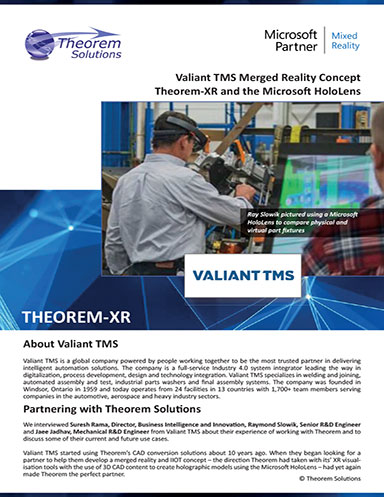
Valiant TMS Merged Reality Concept
Theorem's Visualization Experience software has provided Valiant TMS with a unique opportunity to visualize 3D CAD models placed directly over real world equipment, tooling and components. Download Now!
Don’t try and boil the ocean. Choose a use case, break that down into small elements which will improve your business, and then go out and solve that, and prove that it does benefit your business. If you choose a practical use case, choose elements of that which can be delivered today. You will then show benefit to the business. If you try to be too broad in your approach, with all the dynamics that are going on, the chances are you won’t get there.
With more people working from home, and teams being geographically spread out, the remote collaboration capabilities of XR are more relevant than ever.
Today, some organisations have made significant progress. They have adopted this technology and use it every day – they rely on it to perform at a higher level. What started as an idea is now being used by teams globally; growth and adoption is still accelerating as more people are exposed to the benefits it brings.
The XR industry is still a relatively new one, so software and hardware will continually be evolving. There will always be bigger, better apps and devices- that’s the nature of technology. But if there is no real world use for any of it, then what’s the point?


Theorem Solutions enables engineering and manufacturing companies to extend the use of their 3D design data in the latest innovative and emerging technologies. Providing specialist tools for CAD Translation, Interactive Documentation and Full…
Digitally Transforming the Design Review Process
In only a short time, ATM manufacturer NCR (National Cash Registers) have revolutionized their design review and prototyping processes with the help of Theorem-XR.

Join over 90,000 engineering professionals who get fresh engineering news as soon as it is published.






About Us · Contact Us · Editorial Team · Advertising · Privacy Policy · Subscriber Services · © 2026 Digital Engineering 24/7 · Peerless Media