Helping design and engineering professionals discover, evaluate and specify technologies and processes that shorten the design cycle and enable success.


Alert!
Digital Engineering ceased publication on July 1, 2026. This website remains available as an archive of engineering content.
For inquiries or information, please email [email protected].
Sponsored

May 2026 Special Focus: Artificial Intelligence in Design and Simulation
In this Special Focus Issue, learn about the latest developments in the integration of artificial intelligence into engineering workflows.

Design & Simulation Software Guide 2025
In this Special Issue, Digital Engineering presents its second annual guide to design and simulation software vendors.

 Dear DE Reader:
The “need it last week” demands of clients and markets keep pushing beyond your in-house power for running complex simulations efficiently. You know some sort of HPC (high-performance computing) capacity is the solution. But what to do? How do you specify and manage HPC resources anyway? Your IT staff is maxed out already. Today's Check it Out link offers an online resource that can help you find the answers.
Simplifying HPC cluster deployment and maintenance for your ANSYS solutions is the end-goal of the ANSYS HPC Cluster Appliance Program. And “simplifying” means what?
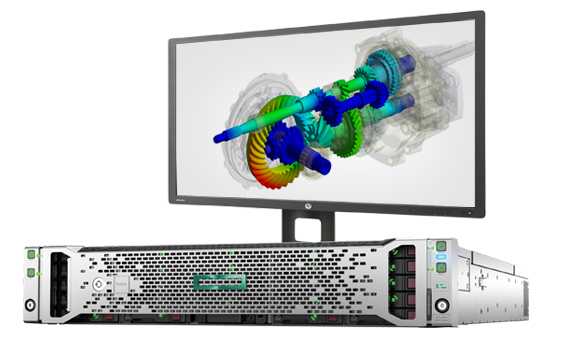 The landing site for the ANSYS HPC Cluster Appliance Program offers resources that can help you understand how you can migrate from running complex simulations in a desktop workstation environment to an in-house or external high-performance computing platform. Image courtesy of ANSYS Inc.
It means two things according to ANSYS and its HPC partners. One, it can be an HPC infrastructure coupled with IT services for your occasional burst capacity needs or a long-term extension of your in-house computing resources. An attraction here is the flexibility of a pay-per-use scenario that gets you the needed horsepower without you buying, maintaining and provisioning more hardware.
Two, simplifying can be as simple as an out-of-the-box, plug-and-simulate, externally managed HPC cluster. If you're not ready for the cloud, this is a cool option. Here, they're talking about an optimized HPC cluster preconfigured with ANSYS and job management software.The ANSYS HPC partners, including Hewlett Packard Enterprise and TotalCAE, have developed HPC reference architectures for ANSYS applications that run from entry-level configurations on up. The partners work with you to develop a solution that meets your needs.
The strength of this landing page is that you can tap into its extensive resources at your own pace. Among its highlights is the “Beyond the Desktop” white paper. It covers everything from startup costs to physical deployment and remote visualization. It has some performance benchmarks and a description of a typical cluster configuration that are must-sees.
The page also offers access to over 25 on-demand webinars exploring various issues on the deployment and use of ANSYS CAE applications in both IT and cloud environments. In particular, the “BD Improved Engineering Simulation Productivity with HPC” webinar should prove helpful. BD, a medical technology company, moved from a workstation environment to one using HPC cluster appliances. They tell you what that was like and what it has meant for their operations.
You know that an HPC environment can help you meet the computational demands of your simulation workloads. But you don't know where to begin. Start by checking out the ANSYS HPC Cluster Appliance Program. It should have your answers.
Thanks, Pal. – Lockwood
Anthony J. Lockwood, Editor at Large, DE

Engineering simulation is our sole focus. For more than 45 years, we have consistently advanced this technology to meet evolving customer needs.ANSYS develops, markets and supports engineering simulation software used to predict how product…
Study on HPC and Cloud Computing for Engineering Simulation
This new research report explores how companies are using HPC and simulation on the cloud.

Anthony J. Lockwood is Digital Engineering's founding editor. He is now retired. Contact him via [email protected].
Follow DE






About Us · Contact Us · Editorial Team · Advertising · Privacy Policy · Subscriber Services · © 2026 Digital Engineering 24/7 · Peerless Media