Helping design and engineering professionals discover, evaluate and specify technologies and processes that shorten the design cycle and enable success.


Alert!
Digital Engineering ceased publication on July 1, 2026. This website remains available as an archive of engineering content.
For inquiries or information, please email [email protected].

May 2026 Special Focus: Artificial Intelligence in Design and Simulation
In this Special Focus Issue, learn about the latest developments in the integration of artificial intelligence into engineering workflows.

April 2026 Special Focus Issue: Generative Design
In this Special Focus Issue, Digital Engineering takes a look at how generative design solutions can be used across different types of design problems and with a variety of manufacturing approaches to accelerate design space exploration, and…
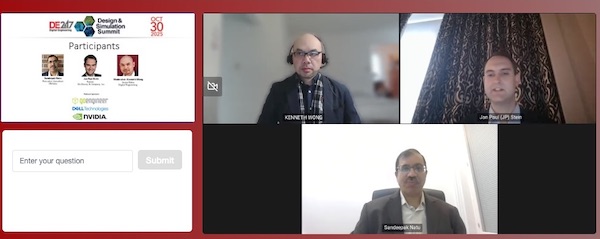
The DE 24/7 Design & Simulation Summit on Oct. 30 led off with a keynote panel session that addressed the utility of artificial intelligence (AI) and machine learning for CAE workflows. Panelists Jan Paul Stein from McKinsey & Company and Sandeepak Natu from CIMdata were on hand to discuss the AI-powered agents and copilots that have become a regular feature of CAD and simulation programs. DE Senior Editor Kenneth Wong moderated the panel.
In the earliest incarnation, the agents are no more than automated programs that crawl through the software makers' public tutorials, manuals, and community chat boards to find answers to the users' questions. But they are expected to evolve and become much more sophisticated over time. In the recent Ansys Simulation World conference, Prith Banerjee, former CTO of Ansys, current Senior VP of Simulation and Analysis Incubation Group at Synopsys, predicted, "Instead of answering your question, the copilot can actually do the settings. That's where it is headed. These are based on hundreds of designs that you have done. So if you are a designer and you like a particular form of design, in the future, the copilot will be personalized to you."
In fact, at the recent Autodesk AU2025 event, the company announced future AI-based capabilities in its Fusion product that would allow natural language prompts to generate editable CAD files. Other vendors have released simulation tools with AI-based features for creating surrogate models or reduced order models (ROMs) to accelerate analysis, and AI is being used to generate synthetic simulation data in some applications.
Both Stein and Natu said that AI will help increase the democratization of simulation, and allow users to solve problems more quickly and efficiently.
Stein cited McKinsey research (conducted with NAFEMS) that showed a potential 20% to 30% time-to-market improvement for companies using AI-based simulation, along with a 5% to 30% productivity performance opportunity.
“What will be the equivalent of a large language model [LLM] in simulation?” Stein said. “There will be a number of predefined AI models. As we get to more universal foundation models, we will see massive acceleration and impact in this space.”
While AI-based tools can speed up simulation work, the panelists emphasized that a human-in-the-loop will still be necessary to make final evaluations and decisions, leveraging their domain-specific expertise. As designs get more complex, AI will also help bridge gaps between disciplines.
“Prloblems are increasingly interdisciplinary, and that is where a lot of these tools will be value,” Natu said. “There is increasing integration of automation software and electronics, which are areas where mechanical engineers don’t have much experience.”
Asked about the potential of AI hallucination in engineering applications, Natu said that results should be evaluated in the context of basic physics. “Make sure that the things you are observing make sense,” he said.
“They are tools that have great power and great promise,” Stein said. “But you need some proper guardrails for using the tools responsibly. You should form a foundation of guardrails upon which you can enable engineers to use generative AI with confidence and creativity within the proper boundaries to get the most out of [the technology].”
The keynote is sponsored by GoEngineer, Dell, and NVIDIA. The entire Design & Simulation Summit is also available on-demand, and you can register to view all sessions here.


Brian Albright is the editorial director of Digital Engineering.
Contact him at [email protected].






About Us · Contact Us · Editorial Team · Advertising · Privacy Policy · Subscriber Services · © 2026 Digital Engineering 24/7 · Peerless Media