Helping design and engineering professionals discover, evaluate and specify technologies and processes that shorten the design cycle and enable success.



Design & Simulation Software Guide 2025
In this Special Issue, Digital Engineering presents its second annual guide to design and simulation software vendors.

Design & Simulation Software Guide
In this Special Issue, Digital Engineering presents its inaugural guide to design and simulation software vendors, including listings for CAD, CAM, simulation, generative design, PLM, rendering and visualization, design for additive manufacturing,…
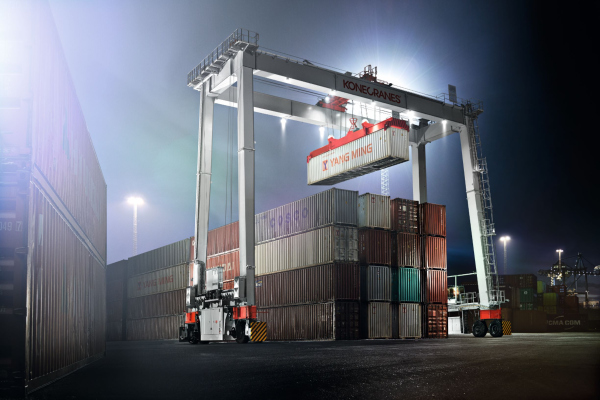
Konecranes, a Finnish company specializing in the manufacture and service of cranes and lifting equipment, has implemented Siemens PLM Software’s digital innovation platform to accelerate its product development process and connect product and performance data together. The company is using MindSphere, the open, cloud-based Internet of Things (IoT) operating system, and the Teamcenter portfolio, to leverage the digital twin and reduce the number of physical prototypes.
The Konecranes proof of value is one of the first implementations of IoT to develop a framework that connects and synchronizes the virtual (engineering design, analysis and simulation) and physical (testing and operational reliability) worlds, according to Siemens.
“The product design process is currently based more on an engineer’s experience and generally shared assumptions than measured facts from existing products,” says Juha Pankakoski, executive vice president, Technology at Konecranes. “These assumptions often lead to non-optimized designs that are over engineered. With an integrated digital twin platform, we see major potential in speeding up the product development process, reducing prototypes, increasing traceability and thus improving quality and reduce development cost.”
At Konecranes, a digital twin was utilized as the communication approach between all three organizations to review data and provide feedback around engineering, simulation and testing intent. Using the Siemens platform for digital innovation, Konecranes has been able to connect the data from all of these organizations to create one 360-degree view of how prototypes are running and performing, and correlating requirements to, real world performance data.
A closed-loop digital twin framework using IoT and product lifecycle management (PLM) technologies can lead to faster design issue resolution and shorter prototyping phases by leveraging virtual sensor data in product simulations to provide accurate results. It can also improve overall quality and a support downstream product lifecycle processes.
“Bringing together assets from both the physical and virtual domains provides a seamless framework of business data which can help eliminate rework, leverage factual data surrounding prototypes, and provide closed-loop feedback regarding physical and virtual assets,” says Tony Hemmelgarn, president and CEO at Siemens PLM Software.
“The proof of value of the digital twin achieved at Konecranes confirms the business value of integrated IoT and PLM technology," Hemmelgarn adds. "The power of the Digital Twin connecting MindSphere IoT real time data to the virtual engineering assets in a seamless user experience turns generated data into actionable information to create a closed-loop decision environment for continuous optimization.”
Sources: Press materials received from the company and additional information gleaned from the company’s website.


Simcenter™ software, from Siemens Digital Industries Software, uniquely combines system simulation, 3D CAE and test to help you predict performance across all critical attributes earlier and throughout the entire product lifecycle. By combining…
Making the Case for Artificial Intelligence and Machine Learning in Engineering
In this paper, Siemens Digital Industries Software and Digital Engineering will provide an overview of how AI/ML-enabled software can improve design workflows, while also addressing common questions and concerns around implementing this technology in an engineering organization.

DE's editors contribute news and new product announcements to Digital Engineering. Press releases may be sent to them via [email protected].
Follow DE
Join over 90,000 engineering professionals who get fresh engineering news as soon as it is published.






About Us · Contact Us · Editorial Team · Advertising · Privacy Policy · Subscriber Services · © 2026 Digital Engineering 24/7 · Peerless Media