Helping design and engineering professionals discover, evaluate and specify technologies and processes that shorten the design cycle and enable success.


Alert!
Digital Engineering ceased publication on July 1, 2026. This website remains available as an archive of engineering content.
For inquiries or information, please email [email protected].
Sponsored

May 2026 Special Focus: Artificial Intelligence in Design and Simulation
In this Special Focus Issue, learn about the latest developments in the integration of artificial intelligence into engineering workflows.

Design & Simulation Software Guide 2025
In this Special Issue, Digital Engineering presents its second annual guide to design and simulation software vendors.

 Dear DE Reader:
Mark Twain loved to hate his type-writer (sic). He cussed his “newfangled writing machine” as devilish and degrading his morals. Yet he was smitten by its potential from first click. He boasted about being the first person to “apply” it to literature. New technology and operator befuddlement often engenders such emotions, especially as you transition to new ways of doing something you think you know how to do.
For design and manufacturing outfits, that means additive manufacturing (AM), particularly making metal parts. “Making the Case for Simulation of Additive Manufacturing” argues that many companies are hemorrhaging money and time learning how to use metal AM through trial and error. It asserts that the key to benefiting from AM metal printing's potential lies in formulating a design for AM (DfAM) strategy that accounts for its unique design challenges and manufacturing capabilities.
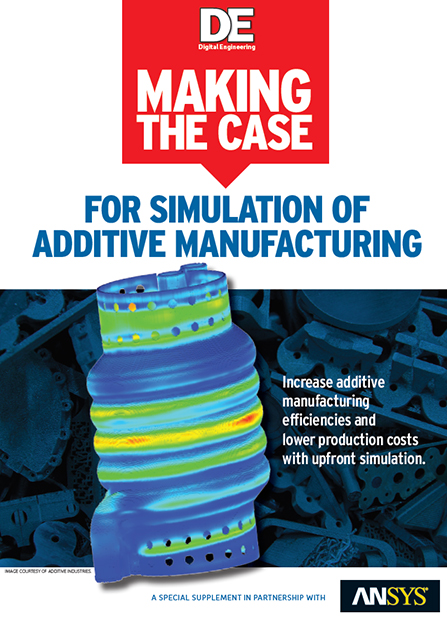 Produced by Digital Engineering in partnership with ANSYS, the special supplement “Making the Case for Simulation of Additive Manufacturing” explores how simulation tools engineered for metal 3D printing can help companies reduce learning curves as well as minimize scrap and rework costs.
Therein lies the problem. DfAM presents an array of gnarly upfront design requirements that are new to the traditional engineering approach to component design. Among others, this means complex internal lattices, support structure placements and variable material behaviors. Consequently, many companies have a disjointed workflow made up of CAD, analysis, topology and other application users all working in silos trying to design a component for metal 3D printing.
This supplement makes the case that a unified platform of AM simulation tools coupled with DfAM best practices can help companies rationalize their DfAM strategy, shorten learning curves and streamline workflows. Ultimately, a unified, AM-focused simulation-driven design workflow should reduce scrap and rework costs substantially while enabling companies to exploit metal AM efficiently and profitably.
The paper lays out how the toolsets within the ANSYS Additive Suite can help designers, analysts, AM operators and their organization achieve such goals. This includes capabilities for topology; lattice creation and optimization; manipulating, cleaning and repairing geometry; setting up and solving print builds; simulating the AM thermal-mechanical build process; and optimizing and fine-tuning machine and material parameters.
To expand its main points the supplement provides multiple links to additional data, including videos, a number of real-world illustrations and a slew of mini case studies. It provides point-by-point guidance for presenting your case for AM simulation to management.
“Making the Case for Simulation of Additive Manufacturing” should prove enormously helpful if you're struggling to implement a DfAM strategy or if you're thinking about some newfangled AM machinery for your floor. Hit the link for your complimentary copy.
Thanks, Pal. – Lockwood
Anthony J. Lockwood, Editor at Large, DE

Engineering simulation is our sole focus. For more than 45 years, we have consistently advanced this technology to meet evolving customer needs.ANSYS develops, markets and supports engineering simulation software used to predict how product…
Study on HPC and Cloud Computing for Engineering Simulation
This new research report explores how companies are using HPC and simulation on the cloud.

Anthony J. Lockwood is Digital Engineering's founding editor. He is now retired. Contact him via [email protected].
Follow DE






About Us · Contact Us · Editorial Team · Advertising · Privacy Policy · Subscriber Services · © 2026 Digital Engineering 24/7 · Peerless Media