Helping design and engineering professionals discover, evaluate and specify technologies and processes that shorten the design cycle and enable success.


Alert!
Digital Engineering ceased publication on July 1, 2026. This website remains available as an archive of engineering content.
For inquiries or information, please email [email protected].

Digital Engineering April 2026
In the latest issue of Digital Engineering, we take a look at the latest innovations in design for additive manufacturing, including the use of natural language inputs, social media cosplayers, and AI integration. The issue also includes a feature…

January Special Focus Issue: Design for Additive
In this Special Focus Issue of Digital Engineering, learn about the latest advancements in design for additive manufacturing, including new software tools, additive in automotive, custom medical devices, and more.
If proof of success is in continuity, the success of Mcor’s technology and signature material is the release of the Matrix 300+. According to the company, the new 3D printer is faster and features selectable layer thickness that allows for objects to be created in one of two modes: draft or presentation.
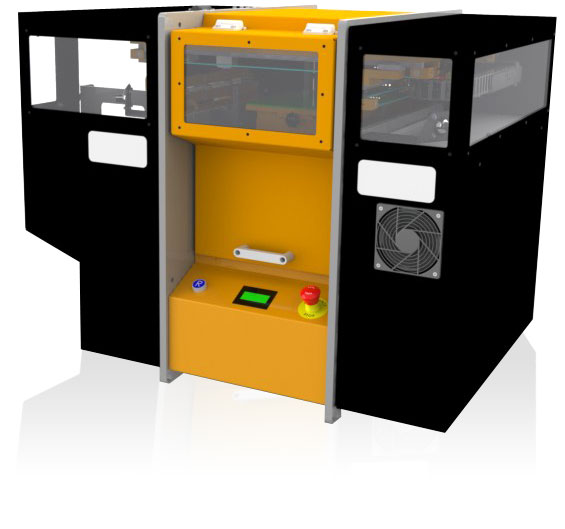
The Matrix 300+ includes new software intended to reduce build time and improve the quality of prints, and offers a new technology the company refers to as variable volume deposition (VVD). The idea behind VVD is to allow the creation of stronger and more complex objects.
“With the Matrix 300+, our customers can economically print high-definition durable parts in-house,” said Conor MacCormack, Mcor co-founder and CEO. “With a faster print speed and increased print capability, the new Matrix 300+ delivers even more value for engineering, education, AEC and packaging design applications.”
Mcor’s newest AM system offers a layer thickness of either 0.1 mm (0.004 in.) or 0.19 mm (0.007 in.) for draft or presentation mode, respectively. The Matrix 300+ has a resolution of 0.1 mm (0.004 in.) and a build envelope of 256 x 169 x 150 mm (9.39 x 6.89 x 5.9 in.).
While it might not seem possible that objects created from paper could have much in the way of durability, I’ve handled Matrix-built objects myself and, post-processing with an infiltrant, I can report that they are remarkably resilient. The Mcor line of AM machines seems to be popular with educational organizations. The company includes the Royal College of Art, Florida State University and KCI Medical among its customers.
The Matrix 300+ will go on sale globally in late 2012.
Below you will find a video that covers the Mcor Technologies process. Non-German speaking audiences may want to skip ahead to about the 35-second mark.
Source: Mcor Technologies


John Newman is a Digital Engineering contributor who focuses on 3D printing. Contact him via [email protected] and read his posts on Rapid Ready Technology.
Follow DE






About Us · Contact Us · Editorial Team · Advertising · Privacy Policy · Subscriber Services · © 2026 Digital Engineering 24/7 · Peerless Media