Helping design and engineering professionals discover, evaluate and specify technologies and processes that shorten the design cycle and enable success.


Alert!
Digital Engineering ceased publication on July 1, 2026. This website remains available as an archive of engineering content.
For inquiries or information, please email [email protected].


Digital Engineering April 2026
In the latest issue of Digital Engineering, we take a look at the latest innovations in design for additive manufacturing, including the use of natural language inputs, social media cosplayers, and AI integration. The issue also includes a feature…

January Special Focus Issue: Design for Additive
In this Special Focus Issue of Digital Engineering, learn about the latest advancements in design for additive manufacturing, including new software tools, additive in automotive, custom medical devices, and more.
While introducing a keynote speaker at RAPID 2014, SME President Michael F. Molnar joked that, after 21 years, the rapid prototyping and manufacturing event was finally old enough to buy a drink. It was an appropriate analogy as one of the event’s biggest segments, 3D printing, has matured to the point of being accepted by many of the companies that attended The Big M, a manufacturing conference co-located with RAPID 2014 for the first time this year in Detroit.
In fact, the RAPID side of the exhibition hall was noticeably more crowded than The Big M side, as attendees crowded booths filled with 3D printers, 3D scanners, metrology equipment, computer-aided manufacturing machines, as well as materials and software.
“The caliber of company names on the badges of people visiting our booth has been really impressive this year,” said David Burns, president and chief operating officer of ExOne. He said big industry is now showing a keen interest in additive manufacturing.
The Big M co-location and the Detroit venue may have contributed to the spirit of the event. Many of the presentations and announcements at RAPID 2014 focused on the role advanced manufacturing have to play in boosting the profile of manufacturing in America.
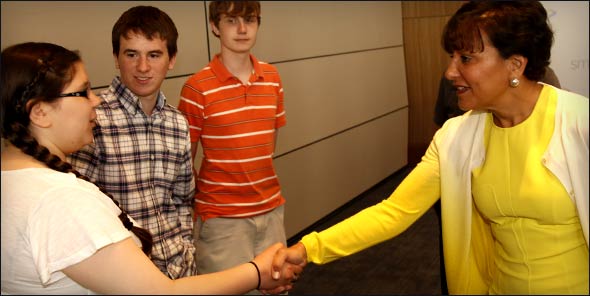 U.S. Secretary of Commerce Penny Pritzker greets students from one of
For example, during the opening keynote, U.S. Secretary of Commerce Penny Pritzker announced the M.Lab21 initiative between SME and 3D Systems to enhance high school industrial arts and vocational education classes. The program will offer starter kits intended to transform shop classes and incorporate additive manufacturing into curriculums.
“We need the public and private sectors to work together now more than ever to focus our investments on areas with the highest potential for growth,” said Secretary Pritzker. “Our objective (at the Whitehouse Office of Manufacturing Policy) is to break down the silos across the government and encourage meaningful public-private partnerships at every level to move American manufacturing forward.”
Terry Wohlers’ data seemed to support the hypothesis that industry has latched onto 3D printing. Wohlers is principal consultant and president of Wohlers Associates, which produces an annual report on the state of the additive manufacturing industry.
He opened the final day of the conference by pointing out trends he has seen over the past year. According to the 2014 Wohlers Report, sales of 3D printers capable of producing metal parts increased almost 76% vs. 2012. Such machines are not widely used by hobbyists. That growth is primarily coming from the medical, dental and aerospace industries.
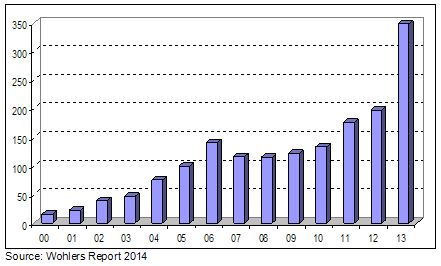 Metal based AM machine unit sales by year. In 2013, 348 such machines were sold. Source: Wohlers Associates, Inc.
In the past, materials were sometimes blamed for the seemingly slow uptake of 3D printing by industry when compared to the consumer 3D printer hype, but many RAPID 2014 exhibitors had material solutions on display:
A tour of ExOne's nearby facility in Troy, MI, revealed the company is beta testing a ceramic material for use in its additive manufacturing machines that dispense layers of resins into specially engineered sands or powders. Representatives of the company explained how they take customer design files, prepare them for 3D printing, perform quality checks on the physical products and ship them out.
ExOne uses a @FARO_HQ Arm scanner in its quality control room for inspection and reverse engineering. #RAPID2014 pic.twitter.com/Y0VXjbvXWw— Desktop Engineering (@DEeditor) June 10, 2014
@3DPUnlimited is demonstrating its large-format 3D printer. It's open source and starts at <$16,000. #RAPID2014 pic.twitter.com/RIDAN9PtKw— Desktop Engineering (@DEeditor) June 11, 2014
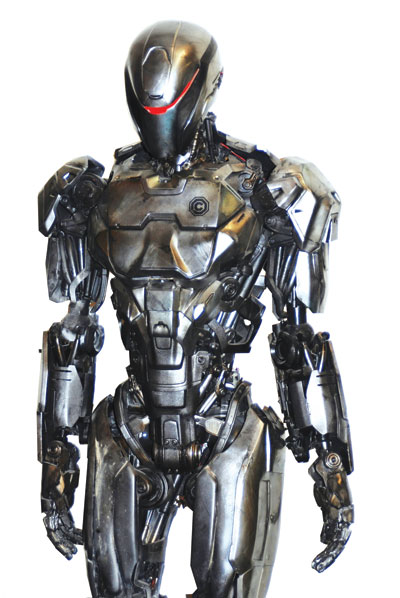 RoboCop suit and helmet designed and produced by Legacy Effects using Stratasys Objet Connex multi-material 3D printing.
For more coverage of RAPID 2014, see Desktop Engineering's Twitter feed for an archive of our live tweets from the show, as well as our previous coverage here on Rapid Ready Technology. Below is an album of RAPID 2014 images posted on Desktop Engineering's Facebook page.


Jamie Gooch is the former editorial director of Digital Engineering.
Follow DE






About Us · Contact Us · Editorial Team · Advertising · Privacy Policy · Subscriber Services · © 2026 Digital Engineering 24/7 · Peerless Media