Helping design and engineering professionals discover, evaluate and specify technologies and processes that shorten the design cycle and enable success.


Alert!
Digital Engineering ceased publication on July 1, 2026. This website remains available as an archive of engineering content.
For inquiries or information, please email [email protected].

Digital Engineering April 2026
In the latest issue of Digital Engineering, we take a look at the latest innovations in design for additive manufacturing, including the use of natural language inputs, social media cosplayers, and AI integration. The issue also includes a feature…

January Special Focus Issue: Design for Additive
In this Special Focus Issue of Digital Engineering, learn about the latest advancements in design for additive manufacturing, including new software tools, additive in automotive, custom medical devices, and more.
Other than build envelope size, one of the continuing developments in additive manufacturing (AM) is use of color. With a few exceptions, very few printers offer anything like multi-color prints during the same run. If the project you are working on requires full color, the number of knives you have available becomes very small.
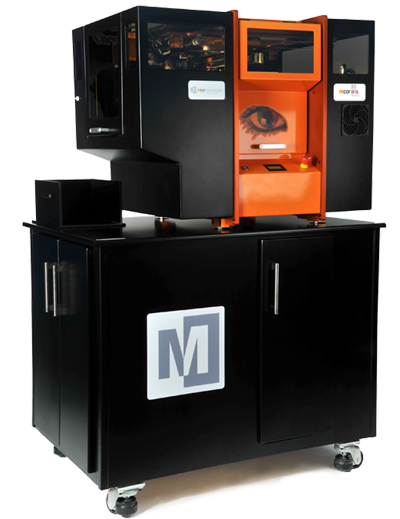
Enter Mcor Technologies' newest offering: the Iris. This new AM system offers full color prints, rather than simply different blocks of solid colors.
“With the IRIS, what you see on your screen is what you get in your hand, and that’s limited only by your imagination,” said Dr. Conor MacCormack, co-founder and CEO of Mcor Technologies. “Ink was intended for paper, which is the ideal canvas for bright, high-resolution colour.”
The Iris uses the same process as Mcor’s earlier printer, the Matrix 300, which, for those unfamiliar with the company, is what the ASTM calls sheet lamination. Unlike other printers which use metal or plastic to build objects, Mcor printers use standard printer paper. These objects aren’t going to be used in an automobile anytime soon, but, when infiltrants are added, are much sturdier than one might expect.
The build size is 256 x 169 x 150 mm (9.39 x 6.89 x 5.9 in.). Layer thickness is 0.1mm (0.004 in.) for standard A4 paper. Color resolution is where the Iris really stands out, with 5760 x 1440 x 508 dpi. Mcor’s new 3D printer accepts the usual STL, OBJ, VRML file formats.
Mcor Technologies is offering the Iris for just under $16,000 as part of its Free D plan. The plan also includes machine use, free materials and service.
Below you’ll find a video demonstrating the Iris.
Source: Mcor Technologies


John Newman is a Digital Engineering contributor who focuses on 3D printing. Contact him via [email protected] and read his posts on Rapid Ready Technology.
Follow DE






About Us · Contact Us · Editorial Team · Advertising · Privacy Policy · Subscriber Services · © 2026 Digital Engineering 24/7 · Peerless Media