Helping design and engineering professionals discover, evaluate and specify technologies and processes that shorten the design cycle and enable success.


Sponsored

May 2026 Special Focus: Artificial Intelligence in Design and Simulation
In this Special Focus Issue, learn about the latest developments in the integration of artificial intelligence into engineering workflows.

Design & Simulation Software Guide 2025
In this Special Issue, Digital Engineering presents its second annual guide to design and simulation software vendors.
Optimization driven design allows an efficient exploration of the design space to improve existing solutions, as well as identify options that would have not emerged with a traditional approach. The quest for the perfect design requires large numbers of analyses of objectives and constraints escalating the level of precision of models.
However, including higher-fidelity analyses in the design process increases complexity and computational expense, and can be quite time and resources intensive.
The use of analytical models can minimize the expenses of high-fidelity ones at reduced computational cost and ultimately speed up the solution of an optimization problem. Two models of the same physical system with different fidelity can be created: one accurate and expensive and one less costly but less precise.
Multi-fidelity optimization provides a mean to leverage both low- and high-fidelity data in order to minimize the cost of the parametrization while maximizing the accuracy of estimates.
With VOLTA, the ESTECO web platform for multidisciplinary business process optimization and simulation data management, multi-fidelity optimization is taken to a new level with the use of cloud services.
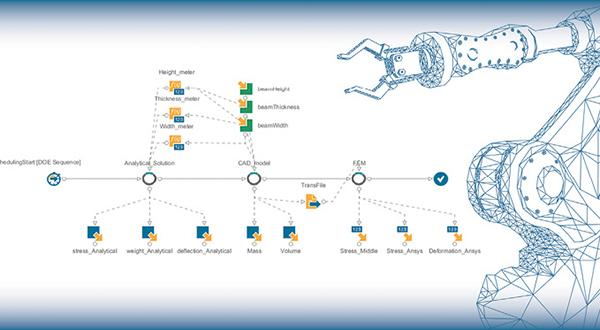
As an example, let’s think of a 3D FEM simulation, used by engineers to get true insights into a structure design to prevent possible structural failures.
The structure is evaluated using a Google Sheet (spreadsheet) to get a first analytic estimation of the deflection and stress—our low-fidelity model. The low-fidelity model filters out unqualified designs and skips the high-fidelity model run. When the prediction of low fidelity models is promising, VOLTA generates model geometry by updating the model in OnShape or other Saas CAD software. The result is connected seamlessly via VOLTA in ANSYS Workbench for the 3D FEM simulation—the high-fidelity model. At this stage, stresses and deflections are computed. VOLTA drives the multi-fidelity optimization and facilitates the design choice, all on cloud services.
Engineers can choose the most appropriate VOLTA optimization strategy, where all ESTECO best-in-class algorithms are available, to analyze the best design. Computational resources and time-to-market are minimized while product quality remains high.
The use of ESTECO web technologies and cloud services give innovative companies access to new means of reducing development costs and time, without compromising the outcome of the engineering design process, essential to be competitive in today’s fast-paced market.



With almost 20 years’ experience, the company supports leading organizations in designing the products of the future, today. Our smart engineering suite brings enterprise-wide solutions for design optimization, simulation data management and…
Moving to Collaborative, Simulation-Led Engineering
Simulation is an important part of any enterprise’s quest to create better products, more quickly. Optimizing early in a design cycle can jump-start innovation, enabling the team to explore more alternatives, more quickly — and to make trade-offs based on physical data rather than on gut feel.

Join over 90,000 engineering professionals who get fresh engineering news as soon as it is published.






About Us · Contact Us · Editorial Team · Advertising · Privacy Policy · Subscriber Services · © 2026 Digital Engineering 24/7 · Peerless Media