Helping design and engineering professionals discover, evaluate and specify technologies and processes that shorten the design cycle and enable success.


Alert!
Digital Engineering ceased publication on July 1, 2026. This website remains available as an archive of engineering content.
For inquiries or information, please email [email protected].

Digital Engineering April 2026
In the latest issue of Digital Engineering, we take a look at the latest innovations in design for additive manufacturing, including the use of natural language inputs, social media cosplayers, and AI integration. The issue also includes a feature…

January Special Focus Issue: Design for Additive
In this Special Focus Issue of Digital Engineering, learn about the latest advancements in design for additive manufacturing, including new software tools, additive in automotive, custom medical devices, and more.
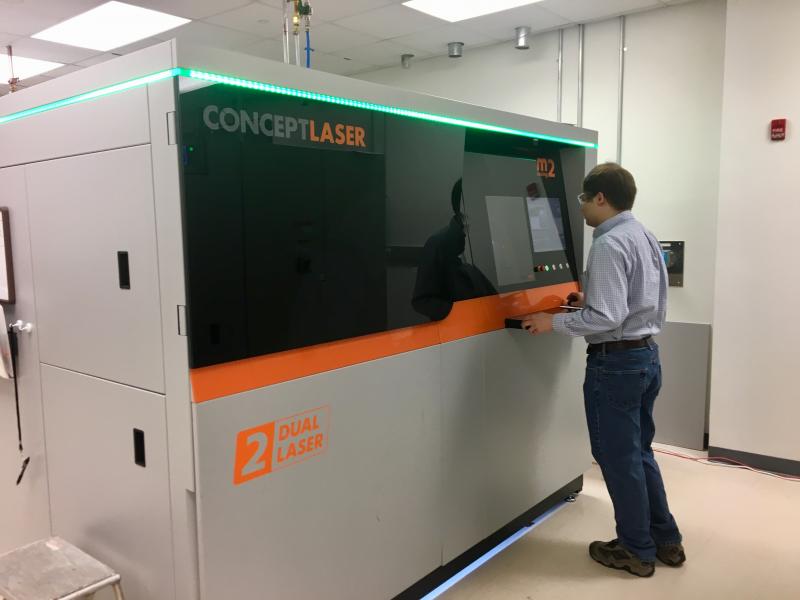
To help address the problem, the Navy has teamed with several 3D printing specialists to accelerate the fabrication of printed parts for its ships and aircraft.
Scientists at GE Global Research, the development arm of GE, have won a four-year, $9 million contract with the Office of Naval Research to create a rapid process for printing digital models of replacement or newly designed parts.
The GE Global Research team will work with engineers from GE Aviation, GE Additive, Honeywell, Lawrence Livermore National Laboratory, Penn State, Navy Nuclear Lab, and the National Center for Defense Manufacturing and Machining to build digital twins from model-based data on parts and sensor data from metal printers. This is part of an effort to accelerate the qualification and certification of printing replacement parts that are no longer manufactured for existing marine and aviation assets. The process will also be used to create parts for newly designed vehicles and equipment.
“Using GE’s Digital Twin technology, we’re aiming to rapidly speed up the time that parts could be re-engineered or newly created using 3D printing processes,” said Ade Makinde, principal engineer, additive technologies at GE Global Research. “With today’s technology, the process for designing a new part can take years. We think we can reduce that timeframe to weeks, with the unique digital solutions under development.”
Producing exact duplicate parts that meet the Navy’s requirements is difficult using current 3D printing methods. By developing processes to quickly print and install replacement parts, the Navy can better maintain its aging fleet, which has an average age of 17 years.
The program includes two phases. The first phase will focus on creating software and hardware to support the solutions. The second phase will involve building a complete additive system that can create the duplicate parts using a 3D direct metal laser melting (DMLM) printer.
You can read more about the Navy’s efforts to create replacement parts in our previous post here.
Source: GE


Brian Albright is the editorial director of Digital Engineering.
Contact him at [email protected].






About Us · Contact Us · Editorial Team · Advertising · Privacy Policy · Subscriber Services · © 2026 Digital Engineering 24/7 · Peerless Media