Helping design and engineering professionals discover, evaluate and specify technologies and processes that shorten the design cycle and enable success.



Design & Simulation Software Guide 2025
In this Special Issue, Digital Engineering presents its second annual guide to design and simulation software vendors.

Design & Simulation Software Guide
In this Special Issue, Digital Engineering presents its inaugural guide to design and simulation software vendors, including listings for CAD, CAM, simulation, generative design, PLM, rendering and visualization, design for additive manufacturing,…
At the GTC conference last month, NVIDIA announced its NVIDIA Isaac GR00T N1 foundation model to advance humanoid robot development. The company also announced simulation frameworks and blueprints, such as the NVIDIA Isaac GR00T Blueprint for generating synthetic data, and Newton, an open-source physics engine for developing robots.
“The age of generalist robotics is here,” said Jensen Huang, founder and CEO of NVIDIA. “With NVIDIA Isaac GR00T N1 and new data-generation and robot-learning frameworks, robotics developers everywhere will open the next frontier in the age of AI.”
The GR00T N1 foundation model features a dual-system architecture, inspired by principles of human cognition. “System 1” is a fast-thinking action model, mirroring human reflexes or intuition, the company says. “System 2” is a slow-thinking model for deliberate, methodical decision-making.
According to NVIDIA, System 2 reasons about its environment and the instructions it has received to plan actions. System 1 then translates these plans into precise, continuous robot movements. System 1 is trained on human demonstration data and a massive amount of synthetic data generated by the NVIDIA Omniverse platform.
GR00T N1 can generalize across common tasks — such as grasping, moving objects with one or both arms, and transferring items from one arm to another — or perform multistep tasks that require long context and combinations of general skills. These capabilities can be applied across use cases such as material handling, packaging and inspection. Developers and researchers can post-train GR00T N1 with real or synthetic data for their specific humanoid robot or task.
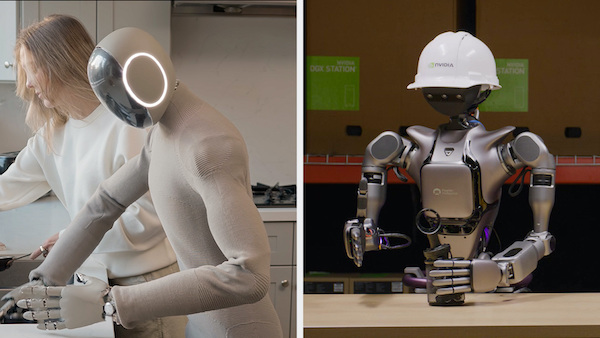
In his GTC keynote, Huang demonstrated 1X’s humanoid robot autonomously performing domestic tidying tasks using a post-trained policy built on GR00T N1. The robot’s autonomous capabilities are the result of an AI training collaboration between 1X and NVIDIA.
“The future of humanoids is about adaptability and learning,” said Bernt Børnich, CEO of 1X Technologies. “NVIDIA’s GR00T N1 model provides a major breakthrough for robot reasoning and skills. With a minimal amount of post-training data, we were able to fully deploy on NEO Gamma — furthering our mission of creating robots that are not tools, but companions that can assist humans in meaningful, immeasurable ways.”
NVIDIA also announced a collaboration with Google DeepMind and Disney Research to develop Newton, an open-source physics engine that lets robots learn how to handle complex tasks with greater precision.
Built on the NVIDIA Warp framework, Newton will be optimized for robot learning and compatible with simulation frameworks such as Google DeepMind’s MuJoCo and NVIDIA Isaac Lab. Additionally, the three companies plan to enable Newton to use Disney’s physics engine.
Disney Research will be one of the first to use Newton to advance its robotic character platform that powers next-generation entertainment robots, such as the Star Wars-inspired BDX droids that joined Huang on stage during his GTC keynote.
The NVIDIA Isaac GR00T Blueprint for synthetic manipulation motion generation helps address the need for training data for these solutions. Built on Omniverse and NVIDIA Cosmos Transfer world foundation models, the blueprint lets developers generate exponentially large amounts of synthetic motion data for manipulation tasks from a small number of human demonstrations.
To further equip the developer community with valuable training data, NVIDIA is releasing the GR00T N1 dataset as part of a larger open-source physical AI dataset — also announced at GTC and now available on Hugging Face.


Since its founding in 1993, NVIDIA (NASDAQ: NVDA) has been a pioneer in accelerated computing. The company’s invention of the GPU in 1999 sparked the growth of the PC gaming market, redefined computer graphics, ignited the era of modern AI and…

Cut Retrieval-Augmented Generation (RAG) Hallucinations by 50%
Most teams hit the same wall with enterprise AI: LLMs that hallucinate, pipelines that don’t scale, and infrastructure that’s harder to design than the models themselves.

Brian Albright is the editorial director of Digital Engineering.
Contact him at [email protected].

Join over 90,000 engineering professionals who get fresh engineering news as soon as it is published.






About Us · Contact Us · Editorial Team · Advertising · Privacy Policy · Subscriber Services · © 2026 Digital Engineering 24/7 · Peerless Media