Helping design and engineering professionals discover, evaluate and specify technologies and processes that shorten the design cycle and enable success.


Alert!
Digital Engineering ceased publication on July 1, 2026. This website remains available as an archive of engineering content.
For inquiries or information, please email [email protected].

Design & Simulation Software Guide 2025
In this Special Issue, Digital Engineering presents its second annual guide to design and simulation software vendors.

Design & Simulation Software Guide
In this Special Issue, Digital Engineering presents its inaugural guide to design and simulation software vendors, including listings for CAD, CAM, simulation, generative design, PLM, rendering and visualization, design for additive manufacturing,…
NVIDIA shares that the nation’s manufacturers, industrial software developers and robotics companies are using NVIDIA Omniverse technologies to build robotic factories and new autonomous collaborative robots to help address labor shortages and drive American reindustrialization, according to NVIDIA.
“AI is transforming the world’s factories into intelligent thinking machines—the engines of a new industrial revolution,” says Jensen Huang, founder and CEO of NVIDIA. “Together with American’s manufacturing leaders, we’re building physical AI, Omniverse digital twins and collaborative robots that will drive productivity, resilience and competitiveness across the U.S. industrial base.”
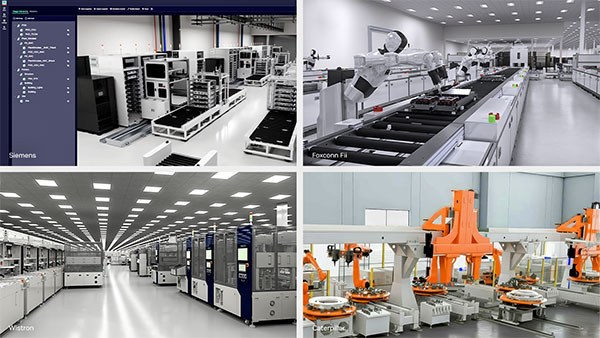
NVIDIA is expanding its “Mega” NVIDIA Omniverse Blueprint for simulating robot fleets to include technologies for designing and simulating factory digital twins. Siemens is the first company to develop digital twin software that supports the Mega Omniverse Blueprint. Currently in beta testing, the new industrial technology stack will be part of the Siemens Xcelerator platform. It will help engineers design and operate large-scale digital twins of factories that bring together realistic 3D models with live operational data.
FANUC and Foxconn Fii are among the first robot manufacturers to support 3D, OpenUSD-based digital twins of their robots for manufacturers to drag and drop equipment into their digital twins.
Caterpillar is applying Omniverse to build digital twins of its factories and supply chains, for use in advanced manufacturing capabilities such as predictive maintenance and dynamic scheduling, NVIDIA NIM microservices to drive workflow automation and predict and optimize factory maintenance, and NVIDIA cuOpt software to optimize supply chain performance.
Lucid Motors is using Omniverse to build digital twins of its factories for real-time factory planning and optimization, as well as to train AI-driven robotics systems. Toyota is using idealworks’ iw.sim technology, which integrates capabilities from the Mega Omniverse Blueprint, to create digital twins of its Georgetown, KY, facility and explore complex automation scenarios.
TSMC is using Omniverse to accelerate fab design and construction, as well as the NVIDIA Isaac platform for the development of robotics for specific operations at its Phoenix, AZ, facility.
Robotics companies are using NVIDIA’s three-computer architecture to build and deploy advanced fleets of robots to bridge skills gaps and improve safety across industries.
Figure and NVIDIA announced a collaboration to accelerate next‑generation humanoid robotics. Using NVIDIA accelerated computing to build its Helix vision language action model and the Isaac platform for simulation and training, Figure is building a large‑scale humanoid fleet capable of everything from household chores to industrial support.
Amazon Robotics is using Omniverse libraries and frameworks to shorten the development of Amazon’s various manipulation systems and mobile robots, which run on the NVIDIA Jetson platform.
Sources: Press materials received from the company and additional information gleaned from the company’s website.


Since its founding in 1993, NVIDIA (NASDAQ: NVDA) has been a pioneer in accelerated computing. The company’s invention of the GPU in 1999 sparked the growth of the PC gaming market, redefined computer graphics, ignited the era of modern AI and…

Cut Retrieval-Augmented Generation (RAG) Hallucinations by 50%
Most teams hit the same wall with enterprise AI: LLMs that hallucinate, pipelines that don’t scale, and infrastructure that’s harder to design than the models themselves.

DE's editors contribute news and new product announcements to Digital Engineering. Press releases may be sent to them via [email protected].
Follow DE






About Us · Contact Us · Editorial Team · Advertising · Privacy Policy · Subscriber Services · © 2026 Digital Engineering 24/7 · Peerless Media