Helping design and engineering professionals discover, evaluate and specify technologies and processes that shorten the design cycle and enable success.


Alert!
Digital Engineering ceased publication on July 1, 2026. This website remains available as an archive of engineering content.
For inquiries or information, please email [email protected].

Digital Engineering April 2026
In the latest issue of Digital Engineering, we take a look at the latest innovations in design for additive manufacturing, including the use of natural language inputs, social media cosplayers, and AI integration. The issue also includes a feature…

January Special Focus Issue: Design for Additive
In this Special Focus Issue of Digital Engineering, learn about the latest advancements in design for additive manufacturing, including new software tools, additive in automotive, custom medical devices, and more.
Stratasys Ltd. reports that global automotive manufacturer Peugeot has integrated Stratasys’ 3DFashion technology into the interior of its new Inception concept, achieving resolution that would not have been possible with traditional embellishment methods.
Heralding a new era for the Stellantis-owned Peugeot brand and embodying its vision for future electric vehicles, the Inception concept is the first design manifesto led by the company’s brand design director, Matthias Hossann, and represents a major change for the marque. The car incorporates an interior design that features advanced materials produced exclusively using Stratasys J850 TechStyle 3D printers.
The vehicle interior of the Inception concept is aligned with Peugeot’s new design architecture for electric vehicles. It features a minimalistic cockpit. Integral to this experience are immersive seats covered with a velvet made from 100% recycled polyester. This velvet extends onto the floor and features 3D patterns created with Stratasys’ 3D printing technology.
“At Peugeot, we always like to combine function with aesthetics,” says Maud Rondot, CMF designer, Advanced Design Team at Peugeot, the department responsible for the future vision of the Peugeot brand. “Our objective with the Inception concept’sseating area was to modernize the velvet material used and decompartmentalize the design by extending it to also serve as a visually impactful floor mat.”
According to Rondot, where the floor area space would typically need to be treated with a protective overlay, the Inception concept instead leverages direct-to-textile 3D printing to deliver functionality, texture and esthetics.
“Although we have access to relatively flat designs with current embellishment methods, it is not possible to build thickness and height. This is why we turned to Stratasys, and it is thanks to the company’s exclusive 3DFashion technology that we could 3D print directly onto the flexible material,” she adds.
A fundamental theme of the Inception concept aims to capture the relationship between materials and light, which required the Peugeot Advanced Design team to use materials that would befit the car’s specific look and embody the brand’s vision for future electric vehicles.
To support this move towards new architecture, new space and decompartmentalization, Peugeot worked with single material effects. This saw the team select a metallic shade for the velvet, which is designed visually and symbolically to play with light and convey something more futuristic, before using the J850 TechStyle 3D printer to create the semi-transparent "micro-architectures."
“Instead of covering the whole stretch of material, it was really advantageous that we could leave the velvet visible,” Rondot adds. “3D printing gave us the ability to modify and reprint the files very easily, but also important is its durability and efficiency; indeed, as a technology it doesn’t require molds, which is revolutionary in terms of industrialization.”
Sources: Press materials received from the company and additional information gleaned from the company’s website.


Every day, our customers find simpler, smarter approaches to stubborn design problemsand greater confidence to confront towering human and technological challenges. Less hindered by the usual constraints, they can imagine, design, iterate and…
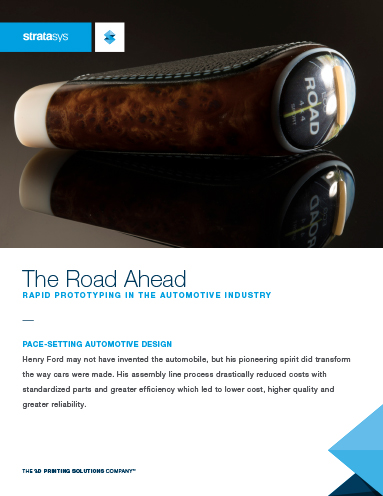
Rapid Prototyping in The Automotive Industry
Henry Ford may not have invented the automobile, but his pioneering spirit did transform the way cars were made. His assembly line process drastically reduced costs with standardized parts and greater efficiency which led to lower cost, higher quality and greater reliability.

DE's editors contribute news and new product announcements to Digital Engineering. Press releases may be sent to them via [email protected].
Follow DE






About Us · Contact Us · Editorial Team · Advertising · Privacy Policy · Subscriber Services · © 2026 Digital Engineering 24/7 · Peerless Media