Helping design and engineering professionals discover, evaluate and specify technologies and processes that shorten the design cycle and enable success.


Alert!
Digital Engineering ceased publication on July 1, 2026. This website remains available as an archive of engineering content.
For inquiries or information, please email [email protected].
Sponsored

Digital Engineering April 2026
In the latest issue of Digital Engineering, we take a look at the latest innovations in design for additive manufacturing, including the use of natural language inputs, social media cosplayers, and AI integration. The issue also includes a feature…

January Special Focus Issue: Design for Additive
In this Special Focus Issue of Digital Engineering, learn about the latest advancements in design for additive manufacturing, including new software tools, additive in automotive, custom medical devices, and more.

 Dear DE Reader:
Rapid prototyping (RP) technology is great stuff. The competitive benefits it can give your joint are legendary. But pundits often slide by some of RP's not so great characteristics, say slowness or complexity. The paper “Breaking the Barriers” explores many of the gotchas of older RP systems as well as many units available today and maps out point-by-point how the Stratasys F123 3D Printer Series overcomes them.
The paper looks at user complaints about RP systems with an eye toward practicality. After a brief recap of why RP has become a driving force in product design despite some technological drawbacks, it jumps right into the fray with a look at speed.
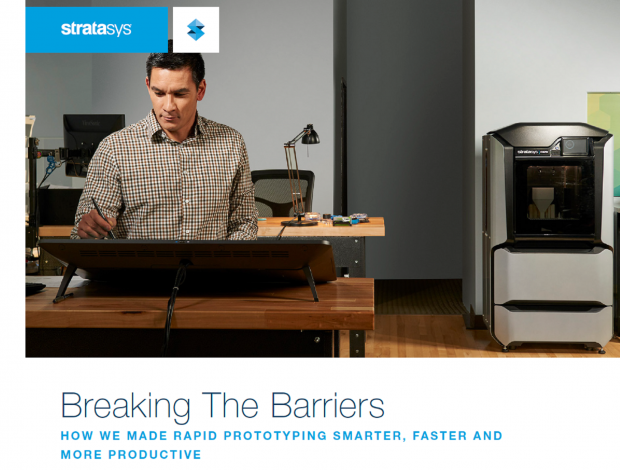 The paper “Breaking the Barriers” looks into how the Stratasys F123 Series 3D printers resolve the challenges of rapid prototyping systems that have vexed designers, engineering and prototyping managers as well as top executives for 30 years. Image courtesy of Stratasys Ltd.
A slow RP system can frustrate your ability to fully test multiple design iterations. That can lead to expensive last-minute redesigns or service calls later. Based on FDM (fused deposition modeling) technology, the F123 series addresses design iteration speed beginning with multiple material options and the flexibility to 3D print concept verification and design validation models quickly. For example, it has a Fast Draft print mode that runs at twice the speed of the standard print operation while using way less material.
But slowness also stems from complexity. That can mean dedicated workrooms, unwieldy workflows and expert staff to manage the thing. None of these are issues with the F123 series, the paper notes. For one, they're office friendly. No nasty chemicals or materials. They operate on standard 110-volt power. They are Wi-FI workgroup-ready, and are as quiet as a home refrigerator.
Two, they're plug-and-play. No expertise required. Loading materials sounds fast and painless. No calibration required. Three, Stratasys' GrabCAD software enables designers to create (or import) and prep models for 3D printing in a familiar CAD-like environment, then hit print like you do for a paper printout.
What does this mean regarding the big issue—money? Stratasys describes how it developed the F123 series using many technologies that the series leverages. Example: Over 20 iterations of a new print head design and 80 head housings were 3D printed during the design development and verification stage. What would it cost you to injection-mold 80 different prototypes?
If you've dithered about integrating RP into your workflow or if past experience makes you leery of investing in the latest generation of the technology, the paper “Breaking the Barriers” should ease your concerns. Hit the link to download your copy.
Thanks, Pal. – Lockwood
Anthony J. Lockwood, Editor at Large, DE


Every day, our customers find simpler, smarter approaches to stubborn design problemsand greater confidence to confront towering human and technological challenges. Less hindered by the usual constraints, they can imagine, design, iterate and…
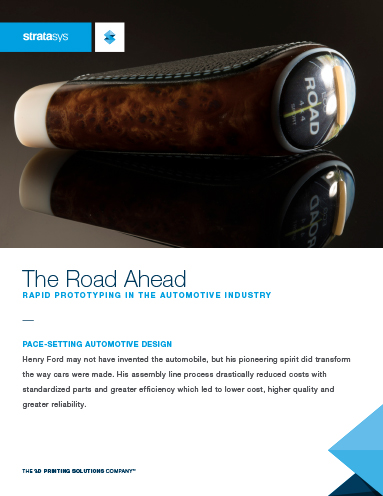
Rapid Prototyping in The Automotive Industry
Henry Ford may not have invented the automobile, but his pioneering spirit did transform the way cars were made. His assembly line process drastically reduced costs with standardized parts and greater efficiency which led to lower cost, higher quality and greater reliability.

Anthony J. Lockwood is Digital Engineering's founding editor. He is now retired. Contact him via [email protected].
Follow DE






About Us · Contact Us · Editorial Team · Advertising · Privacy Policy · Subscriber Services · © 2026 Digital Engineering 24/7 · Peerless Media