Helping design and engineering professionals discover, evaluate and specify technologies and processes that shorten the design cycle and enable success.


Alert!
Digital Engineering ceased publication on July 1, 2026. This website remains available as an archive of engineering content.
For inquiries or information, please email [email protected].

Digital Engineering April 2026
In the latest issue of Digital Engineering, we take a look at the latest innovations in design for additive manufacturing, including the use of natural language inputs, social media cosplayers, and AI integration. The issue also includes a feature…

January Special Focus Issue: Design for Additive
In this Special Focus Issue of Digital Engineering, learn about the latest advancements in design for additive manufacturing, including new software tools, additive in automotive, custom medical devices, and more.
New advancements in high-speed beam scanning could potentially increase the speed of both 2D and 3D printing by as much as 1,000 times.
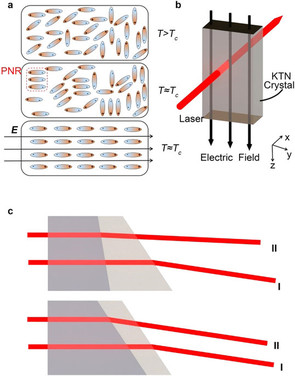
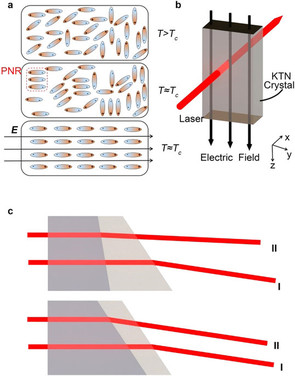 An illustration of a KTN crystal operating under different phases.
Scientists at Penn State’s College of Engineering used a “space-charge-controlled KTN beam deflector with a large electro-optic effect” to achieve much higher scanning speeds.
"Basically, when the crystal materials are applied to an electric field, they generate uniform reflecting distributions, that can deflect an incoming light beam," said Shizhuo Yin, professor of electrical engineering in the School of Electrical Engineering and Computer Science. "We conducted a systematic study on indications of speed and found out the phase transition of the electric field is one of the limiting factors."
The researchers published their findings in Nature Scientific Reports in September.
KTN crystals have a large electro-optic effect; the material’s refractive index can be altered with a relatively low voltage. Until the past decade, growing these crystals in a form that did not scatter light was difficult. Now, single crystals are available for optical and electric applications in more practical sizes.
The scan technology developed at Penn State could enable real-time medical imaging so that images could be generated as doctors are performing surgery, for example. Yin also indicated that this type of scanning could cut 3D printing times from hours to seconds, and potentially allow users to print 20,000 2D pages in a minute.
The beam deflector is a type of crystal. The Penn State team eliminated the electric field-induced phase transition in the KTN crystal by making it work at higher temperatures. According to Penn State, the team went beyond the critical end point in which a liquid and its vapor can co-exist. This pushed the scanning speed from microseconds down to nanoseconds.
Source: Penn State


Brian Albright is the editorial director of Digital Engineering.
Contact him at [email protected].






About Us · Contact Us · Editorial Team · Advertising · Privacy Policy · Subscriber Services · © 2026 Digital Engineering 24/7 · Peerless Media