Helping design and engineering professionals discover, evaluate and specify technologies and processes that shorten the design cycle and enable success.


Alert!
Digital Engineering ceased publication on July 1, 2026. This website remains available as an archive of engineering content.
For inquiries or information, please email [email protected].

May 2026 Special Focus: Artificial Intelligence in Design and Simulation
In this Special Focus Issue, learn about the latest developments in the integration of artificial intelligence into engineering workflows.

Design & Simulation Software Guide 2025
In this Special Issue, Digital Engineering presents its second annual guide to design and simulation software vendors.
To say there’s a lot going on with autonomous vehicle development is an understatement. There’s the vehicles themselves, which include LIDAR, radar, a vast array of sensor technologies, and the sophisticated artificial intelligence algorithms that power the autonomy. There are the smart cities in which the cars will interact as part of their excursions as well as a sophisticated ecosystem of suppliers all collaborating on various aspects of a solution.
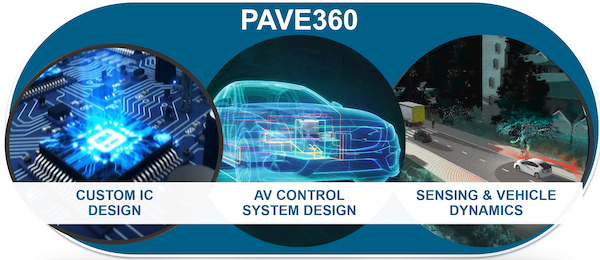
For everything to come together in a timely and cost-effective fashion, there’s no question, simulation must be a foundational building block for development. While various players leverage different simulation tools for specific aspects of self-driving car designs, Siemens PLM Software has just released PAVE360, a validation environment for automotive chips that creates a digital twin to simulate the entire complex ecosystem, not just the next-generation silicon.
“The automotive industry has been focused on a mechanical and electromechanical approach to solving problems—things where model-based system engineering is an effective solution,” says David Fritz, global technology manager for automotive at Siemens PLM Software. “Yet as soon as you get into the complexity of tossing in AI and converged ECUs (electronic control units), it reaches the point where a different approach needs to be applied.”
As a complete, closed-loop simulation platform, PAVE360’s different approach hails from the smart phone industry, which has employed similar verification and validation processes for some time. Using technology from its acquisition of Mentor Graphics, along with other pieces of its simulation portfolio, Siemens PLM Software has built a verticalized simulation solution that covers the entire spectrum, from chip design to aligning with players involved in smart cities. “We are now bringing the technology behind the validation and verification processes that were fine tuned to smartphone design over the last decade to automotive,” Fritz says.
Specifically, PAVE360 extends digital twin simulation beyond processors to include automation hardware and software subsystems, full vehicle models, fusion of sensor data, traffic flows, and the simulation of smart cities, through which the self-driving cars will travel. The platform is designed to support cross-ecosystem collaboration for designing and building custom silicon and software solutions that will power the new generation of autonomous vehicles.
PAVE360’s closed-loop validation capabilities cover the sensing/decision/actuating paradigm that is the heart of automated driving systems. The full digital twin, which scales from the individual blocks of IP in a system-on-chip (SoC) to the hardware and software comprising the SoC to the vehicle subsystems and through the deployment of the vehicle in smart cities, enables designers to test everything from silicon development to full vehicle validation in a virtual world. This approach is critical for autonomous vehicle design, Fritz maintains, because of the vast scale of complex scenarios that need to be tested. Estimates are that 8.8 billion miles of testing would be required to fully validate an autonomous vehicle, which is next to impossible so virtual validation needs to be evolved and widely embraced.
“Validation testing is more comprehensive than testing and creating a chip, where you might program a finite number of examples,” he explains. “What if the chip doesn’t behave the way you think when you put it into the vehicle? We’re taking the digital twin and making it holistic from the inception of the vehicle.”
To learn more about Siemens’ vision for simulation and virtual validation in the development of autonomous vehicles, check out this video.


Simcenter™ software, from Siemens Digital Industries Software, uniquely combines system simulation, 3D CAE and test to help you predict performance across all critical attributes earlier and throughout the entire product lifecycle. By combining…
Making the Case for Artificial Intelligence and Machine Learning in Engineering
In this paper, Siemens Digital Industries Software and Digital Engineering will provide an overview of how AI/ML-enabled software can improve design workflows, while also addressing common questions and concerns around implementing this technology in an engineering organization.

Beth Stackpole is a contributing editor to Digital Engineering. Send e-mail about this article to [email protected].
Follow DE






About Us · Contact Us · Editorial Team · Advertising · Privacy Policy · Subscriber Services · © 2026 Digital Engineering 24/7 · Peerless Media