Helping design and engineering professionals discover, evaluate and specify technologies and processes that shorten the design cycle and enable success.




Digital Engineering April 2026
In the latest issue of Digital Engineering, we take a look at the latest innovations in design for additive manufacturing, including the use of natural language inputs, social media cosplayers, and AI integration. The issue also includes a feature…

January Special Focus Issue: Design for Additive
In this Special Focus Issue of Digital Engineering, learn about the latest advancements in design for additive manufacturing, including new software tools, additive in automotive, custom medical devices, and more.
A rigorous testing process and tight collaboration with parent company Stratasys are the linchpins in Makerbot’s strategy to shore up confidence in its newly-designed Smart Extruder+ product, a replacement for a component that was the source of customer backlash last year and the genesis for a major company restructuring.
The Smart Extruder, announced with Makerbot’s 5th generation of printers back in 2014, was meant to be easy to use and allow users to swap out the part of a 3D printer that gets the most wear and tear. However, the component didn’t perform as expected, and customers complained that it clogged easily and had a short lifespan. Some reports said the original Smart Extruder had an 80% return rate when it initially shipped, which put the company in hot water with customers and was part of a string of problems, including a class action lawsuit, financial issues and layoffs.
Makerbot went back to the drawing board, and recently launched the Smart Extruder+, a redesign of the original part intended to be more reliable and longer-lasting than its predecessor. The new extruder maintains the key design points of the original, including the smarts (via sensors) to automatically detect when the printer’s filament runs out and alerting users via desktop or mobile apps, and is backward compatible with the existing architecture.
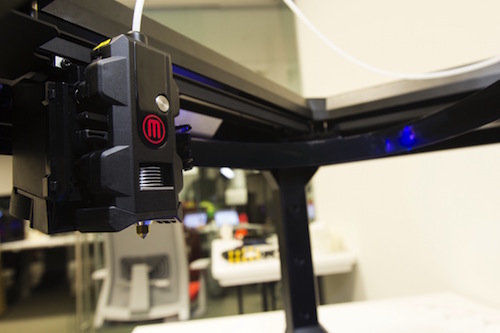 The Makerbot Smart Extruder+ features sensors to keep users apprised about print status as well as to improve print performance over time. Image Courtesy of Makerbot
The Smart Extruder+ boasts improvements in several key areas: reduced filament jams, better homing routines, reduced clogging, and improved connectivity. To address the clogging issues at the heart of the customer complaints, Makerbot engineers extended the PTFE non-stick surface tube used to feed filament into the nozzle, made software improvements to retract the filament less at different speeds, and enhanced the thermal management system, according to Michael Pappas, lead mechanical engineer on the project.
Testing was critical to make sure the new design functioned as intended and that production printers were built properly before shipping off to users. “Reliability was really important — we wanted to launch a product we could really stand behind,” Pappas says.
To create a stand-out test program, Makerbot leaned heavily on the expertise of its parent company Stratasys. The result was the largest testing initiative Makerbot has ever conducted, with two separate groups of extruders, built on two different days, tested at both Makerbot headquarters in New York and Stratasys’ facilities in Eden Prairie, MN. The team says it conducted 160,000 man hours of testing (the equivalent of 18 years) and logged 5,800 print starts — the goal being to simulate real customer usage.
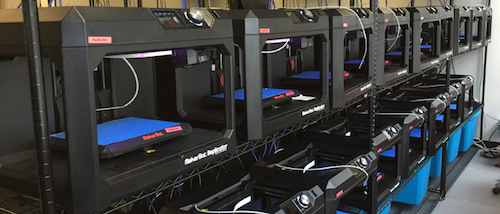 Makerbot teamed up with parent company Stratasys to create a rigorous testing process for the Smart Extruder+, spanning 160,000 hours. Image Courtesy of Makerbot
Makerbot also worked with Stratasys for test setups. In this case, a print verification was done on the extruder once it came off the assembly line, but there was also end-of-line testing that collected metrics like how well the encoder was working or if the sensors performed properly. All of that information was tracked by serial number, giving Makerbot critical insight into product performance and reliability.
“We didn’t seek to improve print quality with this project — we truly wanted to ensure the machine wouldn’t have excessive downtime,” Pappas says. “This provided one more way to have more information … to ensure the extruders are properly built before going out to the customer.”
Watch the video below to learning more about Makerbot and Stratasys’ large-scale reliability testing for the Smart Extruder+.


Beth Stackpole is a contributing editor to Digital Engineering. Send e-mail about this article to [email protected].
Follow DE
Join over 90,000 engineering professionals who get fresh engineering news as soon as it is published.






About Us · Contact Us · Editorial Team · Advertising · Privacy Policy · Subscriber Services · © 2026 Digital Engineering 24/7 · Peerless Media