Helping design and engineering professionals discover, evaluate and specify technologies and processes that shorten the design cycle and enable success.


Alert!
Digital Engineering ceased publication on July 1, 2026. This website remains available as an archive of engineering content.
For inquiries or information, please email [email protected].

Digital Engineering April 2026
In the latest issue of Digital Engineering, we take a look at the latest innovations in design for additive manufacturing, including the use of natural language inputs, social media cosplayers, and AI integration. The issue also includes a feature…

January Special Focus Issue: Design for Additive
In this Special Focus Issue of Digital Engineering, learn about the latest advancements in design for additive manufacturing, including new software tools, additive in automotive, custom medical devices, and more.
Ranked as the top additive manufacturing (AM) platform vendor, Stratasys scored highest in the overall category of implementation and topped four of the 12 ranking criteria, according to ABI Research. Stratasys was closely followed by 3D Systems, Desktop Metal and GE Additive in overall rankings. Newcomer Desktop Metal took the overall top spot in innovation.
The Additive Manufacturing Platform Ranking competitive assessment ranked 10 major vendors of the technology—3D Systems, Carbon, Desktop Metal, Digital Alloys, EOS, ExOne, GE Additive, HP, Renishaw and Stratasys—using ABI Research’s innovation/implementation criteria framework. Each vendor was analyzed based on a combination of AM technology process, material science, software, process and application adaptability, go-to-market strategy, revenue and bookings, availability, customer references, partnerships, cost and channel strategy.
To qualify as an additive manufacturing platform vendor, the company had to have a production additive manufacturing solution on the market, be targeting production AM as its main opportunity, or be working with promising metal alloy AM technologies and techniques that could, in ABI Research’s view, prove a fit for the production AM market. These platforms will produce more than US$360 billion worth of parts and end products each year and nearly US$2 trillion in sum by the end of the next decade.
Stratasys scored highest in implementation, followed by 3D Systems, EOS, Desktop Metal and GE Additive.
“Stratasys, 3D Systems, and EOS are the market incumbents—all have been involved in AM since their inception. 3D Systems went neck-and-neck with Stratasys in all categories, except partnerships, where it was edged out by Stratasys due to Stratasys’ investment in Desktop Metal, collaboration with companies like Siemens, and work with its own global manufacturing network, which companies like UPS use to automatically invoke AM rather than traditional manufacturing processes based on order volume requests,” explains Ryan Martin, principal analyst at ABI Research.
Desktop Metal was a surprise frontrunner among companies to more recently enter the AM arena, edging out incumbents like GE Additive and EOS on the powder-bed side and dusting ExOne and HP in performance on binder jetting.
“Desktop Metal was the technology category leader but could be challenged in the long run if GE Additive and others can cultivate a credible metal binder jetting solution. Others to watch are Carbon, which recently launched its L1 production system, and Digital Alloys, which has a savvy GTM strategy that aligns well with the strength of its Joule Printing technology,” Martin says.
“Desktop Metal took the top spot for innovation due to the applicability of its core technology and the capabilities of its production system relative to others in its category; Desktop Metal is the binder jetting technology category leader, and binder jetting as a technology blows PBF out of the water when it comes to the scale of true production applications. Carbon and GE Additive tied for second and were only 2.5% behind Desktop Metal. Digital Alloys was the surprise fast follower to the runner up position. Digital Alloys has a technology that could displace if not converge with the DED category (where companies like Sciaky play) due to the speed, quality, and affordability of Joule printing,” concludes Martin.
These findings are from ABI Research’s Additive Manufacturing Platforms competitive assessment report. This report is part of the company’s Industrial Solution.
Sources: Press materials received from the company and additional information gleaned from the company’s website.


Every day, our customers find simpler, smarter approaches to stubborn design problemsand greater confidence to confront towering human and technological challenges. Less hindered by the usual constraints, they can imagine, design, iterate and…
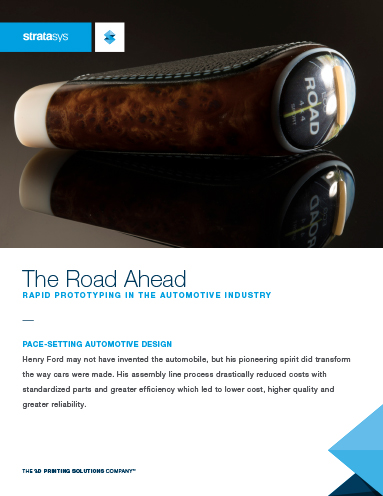
Rapid Prototyping in The Automotive Industry
Henry Ford may not have invented the automobile, but his pioneering spirit did transform the way cars were made. His assembly line process drastically reduced costs with standardized parts and greater efficiency which led to lower cost, higher quality and greater reliability.

DE's editors contribute news and new product announcements to Digital Engineering. Press releases may be sent to them via [email protected].
Follow DE






About Us · Contact Us · Editorial Team · Advertising · Privacy Policy · Subscriber Services · © 2026 Digital Engineering 24/7 · Peerless Media