Helping design and engineering professionals discover, evaluate and specify technologies and processes that shorten the design cycle and enable success.


Alert!
Digital Engineering ceased publication on July 1, 2026. This website remains available as an archive of engineering content.
For inquiries or information, please email [email protected].

May 2026 Special Focus: Artificial Intelligence in Design and Simulation
In this Special Focus Issue, learn about the latest developments in the integration of artificial intelligence into engineering workflows.

April 2026 Special Focus Issue: Generative Design
In this Special Focus Issue, Digital Engineering takes a look at how generative design solutions can be used across different types of design problems and with a variety of manufacturing approaches to accelerate design space exploration, and…
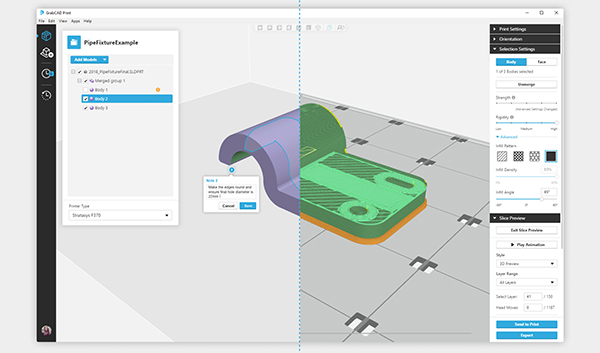
Stratasys plans to remove complexity from design-to-3D print processes with its latest release. GrabCAD Print’s Advanced FDM feature is aimed at ensuring design intent via intuitive model interaction to rapidly deliver strong, light parts, Stratasys notes.
By avoiding CAD-to-STL conversion, users are able to work in high fidelity and advance the design-to-3D print process, Stratasys says. Advanced FDM is designed to speed part production, while maintaining creation of purpose-built parts that minimize weight without compromising strength, according to the company.
“For design and manufacturing engineers, one of the most frustrating processes is ‘dumbing down’ a CAD file to STL format, only to require subsequent re-injection of design intent into the STL printing process,” says Mark Walker, lead software product manager at Stratasys. “This software is engineered to do away with this complexity, letting designers reduce iterations and design cycles, getting to a high-quality, realistic prototype and final part faster than ever before.”
With CAD-native build controls, the solution doesn’t require manual generation of complex toolpaths. Intuitive features achieve desired part characteristics through automatic control of FDM build attributes. Engineers select areas on native design geometry and specify design attributes, letting Advanced FDM automatically calculate 3D print toolpaths.
“GrabCAD Print Advanced FDM’s geometry-based workflows have allowed us to fine-tune part builds, meeting application requirements and process parts more quickly than we could before,” says Robert Heath, additive manufacturing application engineer at Eckhart. “The seamless transition of moving a build between applications is easy and intuitive.”
Assigning attributes directly to CAD models, users pinpoint areas of strength and rigidity, control infills, ensure sufficient material around holes with inserts and avoid seams. Since toolpaths are automatically generated from model assignments, the user can expect to spend significantly less time on part setup, without losing strong, high-quality, purpose-built FDM parts.
“Advanced FDM has proved invaluable in improving our part processing time. When processing a very large number of tools and fixtures in a very time pressured environment, it was crucial to ensure stronger tool areas were correct first time, every time,” says Dave Hewitson, rapid prototyping programmer at McLaren. “Advanced FDM negates the requirement for multiple programs, creating a more streamlined process. It’s also allowed us to more effectively control the structure of end-use car parts, something that was previously very difficult with the solutions we had in hand. This means we can get better parts to the track faster.”
GrabCAD’s Advanced FDM is available now via download with GrabCAD Print (from versions 1.24) and is supported on the following Stratasys 3D printing systems: F370, Fortus 380mc, Fortus 380mc Carbon Fiber Edition, Fortus 450mc, Fortus 400mc, Fortus 900mc, and F900.
Sources: Press materials received from the company and additional information gleaned from the company’s website.


Every day, our customers find simpler, smarter approaches to stubborn design problemsand greater confidence to confront towering human and technological challenges. Less hindered by the usual constraints, they can imagine, design, iterate and…
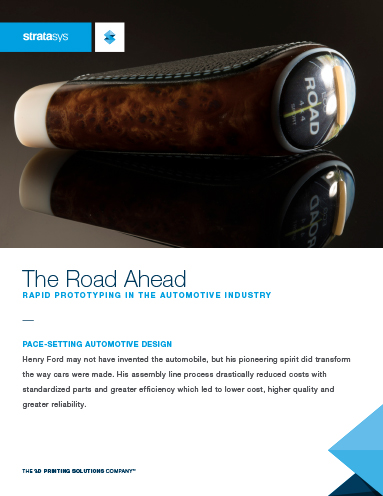
Rapid Prototyping in The Automotive Industry
Henry Ford may not have invented the automobile, but his pioneering spirit did transform the way cars were made. His assembly line process drastically reduced costs with standardized parts and greater efficiency which led to lower cost, higher quality and greater reliability.

DE's editors contribute news and new product announcements to Digital Engineering. Press releases may be sent to them via [email protected].
Follow DE






About Us · Contact Us · Editorial Team · Advertising · Privacy Policy · Subscriber Services · © 2026 Digital Engineering 24/7 · Peerless Media