Helping design and engineering professionals discover, evaluate and specify technologies and processes that shorten the design cycle and enable success.




May 2026 Special Focus: Artificial Intelligence in Design and Simulation
In this Special Focus Issue, learn about the latest developments in the integration of artificial intelligence into engineering workflows.

Design & Simulation Software Guide 2025
In this Special Issue, Digital Engineering presents its second annual guide to design and simulation software vendors.
In 2024, ASSESS, an initiative by NAFEMS (International Association for the Engineering Modeling, Analysis and Simulation Community), published a paper titled “Democratization of Engineering Simulation Theme Strategic Insight 2024.” The paper states, “The shifts in thinking and practice required for successful large-scale Democratization of Engineering Simulation are becoming clearer.”
Efforts to broaden use of simulation began nearly a decade ago, beginning with the integration of simple, linear simulation tools into mainstream CAD programs. Today, basic simulation tools have become a regular feature of design software. The rise of affordable, cloud-hosted, browser-based simulation programs also pushed the mission forward. In the last couple of years, vendors began adding natural language support and AI-based agents to make learning and using simulation easier.
“While early efforts struggled, recent shifts in strategy and technology have accelerated adoption,” Nick Appleyard, executive director of the ASSESS Initiative, observes. “According to an ASSESS strategic insight paper, the engineering simulation market has experienced 10%-15% annual growth for the past four decades, and was estimated at $9.36 billion in 2023, with expectations to exceed $14 billion by 2027. This sustained growth reflects increasing use beyond specialist analysts and into broader product development workflows.”
(Editor’s note: The paper is available to NAFEMS and ASSESS members through the membership portal. Nonmembers interested in the paper may contact ASSESS for access.)
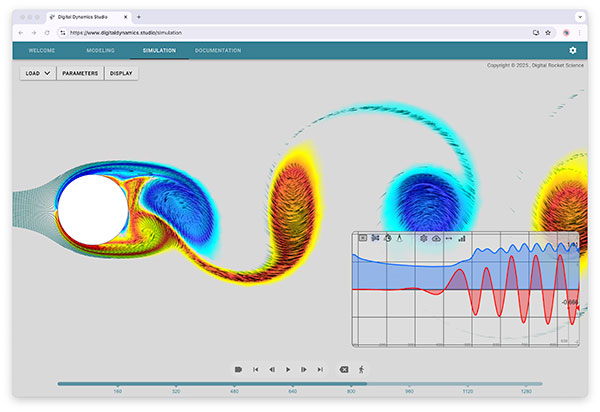
Andrew Johnson’s career path cuts across Digital Rocket Science (as founder), Industrial Light and Magic (as senior research and development engineer), and Roblox (as principal software engineer). His latest project is Digital Dynamics Studio, an interactive computational fluid dynamics (CFD) simulation platform built from the ground up specifically for students in STEM (science, technology, engineering and mathematics) fields to use and explore. The goal is to give students in STEM fields an opportunity to conduct real-time simulation, modeling and analysis using techniques similar to those used by professional scientists and engineers every day, according to Digital Dynamics Studio.
Whereas many FEA and CFD software makers are targeting general designers with limited simulation expertise, Johnson is looking at a different crowd—the students who are destined to become engineers and designers.
“Our target users are novice STEM students, not the professional engineers or product designers that those other platforms are targeting,” Johnson says. “Our goal being, of course, for students to gain experience with these concepts and study applications (aerodynamics, fluid dynamics, heat transfer, etc.) that have been impossible, or very difficult, to study in the classroom before.”
This goal nudged Johnson away from adding AI-driven features in Digital Dynamics Studio. “Since its goal is education, we want the students to set things up for themselves and learn all of the associated issues. Hopefully our software is so easy to set up and use that AI isn’t needed,” he says.
The education and interactivity goal also meant concentrating on 2D analysis instead of 3D. “2D simulations are great for learning the underlying fluid dynamics physics concepts, and computational methodology is much simpler to visualize and understand by the student, and makes the whole geometric modeling process much easier. Expecting a novice student to learn 3D CAD modeling and visualizing fluid-flow results in 3D would be much more challenging and out of scope for classroom usage,” Johnson explains.
However, some automation is implemented within the platform, to be in line with what has now become a standard practice in CFD packages.
“We offer a simple user interface where only the bare minimum of simulation parameters are exposed (viscosity, time-step size, boundary conditions, etc.),” says Johnson. “We also use automatically generated unstructured meshes with adaptive-solution techniques. Our solver uses a dynamic-mesh technique, which means that in a sense, the automatic mesh generation process never stops as it continues to adjust the mesh’s topology and nodal refinement throughout the entire simulation based on the estimated error in the computed solution at each time-step. The student never has to deal with creating and optimizing the mesh, a potentially difficult process, since the entire process is fully automatic.”
As far as Johnson is concerned, Digital Dynamics Studio is ready for classroom use, but he cautioned against using it outside the intended scope.
“Our end goal is education and exploration by students. Although we try to make sure that the simulations are as accurate as possible, our accuracy and fidelity goals are slightly different from platforms targeting professional users since we emphasize interactivity and ease of use. We don’t expect Digital Dynamics Studio to be used in any actual product design in a professional setting,” he says.
One consequence of the introduction of natural language is the birth of AI-powered assistants, with the promise to make CAD modeling and simulation setup much simpler. Last year, at Autodesk University 2024 in San Diego, CA, Autodesk CEO Andrew Anagnost said, “As we move to simple [UIs], what could be simpler than natural language? That is what we’re doing with Autodesk Assistant.” The new Autodesk Assistant lets you ask questions using natural language, and is currently trained to provide answers based on the Autodesk knowledge base, covering the company’s product portfolio.
In February, during 3DEXPERIENCE World 2025, SolidWorks CEO Manish Kumar introduced Aura, a virtual companion currently going through internal beta testing. “Aura learns from you, teaches you, and performs tasks for you,” explained Kumar. It’s available anywhere, on any device, right in the context of your design.” Aura is set to make its public debut in July, according to SolidWorks.
Select titles in the company’s product line will also benefit from the command predictor. It “learns from you to predict your next move. No need to search through the menus for the next command,” explained Kumar. The feature is part of SOLIDWORKS classic as well as the cloud-based SOLIDWORKS xDesign, he added.
Similarly, Ansys has already launched AnsysGPT, a virtual assistant to comb the public sources and Ansys knowledge base to help find simulation-related answers. These tools point to a new generation of simulation software with user interfaces that rely less on menus and dialog boxes, more on natural language input, making the complex processes much easier to learn.
Appleyard has noticed a change in the way simulation democratization is occurring. “Most of the success is driven by a shift from vendor-driven to customer- and industry-driven demand. Companies are realizing the business value of simulation. At the same time, advances in workflow automation, AI/ML (artificial intelligence/machine learning), real-time simulation and the rise of digital twins have made simulation more accessible across other groups. Importantly, many organizations are adopting more holistic strategies, combining process infrastructure, simulation governance and culture change to support broader use,” he says.
Appleyard, like many other analysts, considers simulation a component of product lifecycle management (PLM). In that sense, he still sees some resistance to the mission in the larger picture.
“According to a recent CIMdata market survey, executive sponsorship was cited as one of the major challenges to successful PLM adoption,” he recalls. “According to ASSESS, the expertise gap remains a challenge. Many tools still require deep knowledge, and part-time users need more support. Organizational resistance to changing established workflows also persists, and many companies lack robust simulation governance, which limits trust in results from non-experts. Additionally, while real-time performance is becoming increasingly important, most tools are still too slow for day-to-day use by designers. Finally, interoperability and metadata standardization are still evolving, making it difficult to scale simulation across teams and tools.”
There is still plenty of work to be done. Appleyard’s predecessor, ASSESS founder Joe Walsh, giving his final presentation at the most recent ASSESS Summit, noted that it is important for companies to measure and report real business benefits from simulation (time/cost reductions, innovation acceleration, improved safety, etc.) to achieve wider adoption.
“The role of simulation has evolved from being a support act to a leadership role in business strategy,” Walsh said. “The broader use of simulation is required by most companies to enable digital transformation.”
He also noted that although there are plenty of project/product-level examples of democratization, large-scale simulation democratization is “extremely rare,” and that getting there requires a number of shifts in expertise, culture, organizational structures and more. He added that forward progress is almost inevitable, though, because, “Broader use of simulation is required by most companies to enable digital transformation,” he said.


NAFEMS is the International Association for the Engineering Modelling, Analysis and Simulation Community. We focus on the practical application of numerical engineering simulation techniques such as the Finite Element Method for Structural…

Simulation Focus: Conference on Advancing Analysis and Simulation in Engineering (CAASE) Preview
The CAASE18 (Conference on Advancing Analysis and Simulation in Engineering) kicking off June 5-7, 2018 on the south shore of Lake Erie in Cleveland, OH plans to take the engineering analysis community by storm. The event is expected to play host to potentially 500 attendees from nearly 250 companies while delivering a wealth of educational opportunities covering all facets of engineering analysis and simulation.

Kenneth Wong is Digital Engineering's resident blogger and senior editor. Email him at [email protected] or share your thoughts or suggestions at digitaleng.news/facebook.
Follow DE
Join over 90,000 engineering professionals who get fresh engineering news as soon as it is published.






About Us · Contact Us · Editorial Team · Advertising · Privacy Policy · Subscriber Services · © 2026 Digital Engineering 24/7 · Peerless Media