Helping design and engineering professionals discover, evaluate and specify technologies and processes that shorten the design cycle and enable success.




May 2026 Special Focus: Artificial Intelligence in Design and Simulation
In this Special Focus Issue, learn about the latest developments in the integration of artificial intelligence into engineering workflows.

April 2026 Special Focus Issue: Generative Design
In this Special Focus Issue, Digital Engineering takes a look at how generative design solutions can be used across different types of design problems and with a variety of manufacturing approaches to accelerate design space exploration, and…
The use of computational fluid dynamics (CFD) to simulate and verify aerodynamics in automotive and aerospace is now the norm, but the name of the discipline, computational fluid dynamics, points to its original principles in the water. In this article, we return to CFD’s roots. We turn our attention to CFD solutions that cater to the marine industry to see how the technology has evolved.
To speak of CFD innovation is to reference America’s Cup (AC), the boat race that has become the testing ground for new marine technologies. The upcoming 37th America’s Cup (AC37) protocol states, “No competitor shall carry out fluid dynamic testing of designs, at any scale, in any controlled environment such as a wind tunnel, cavitation tunnel, towing tank or maneuvering basin.” This rule effectively prevents real-world testing of the boats at full scale.
Because real-world tow-tank tests are costly, the rule to limit such tests lowers the barrier of entry for participants, many argue. Intended or not, the rule also pushes the teams to rely heavily on computer simulation. Hence, AC over time became the place for CFD breakthroughs.
Todd Tuthill, vice president aerospace, defense and marine industry at Siemens Digital Industries Software, loves watching the AC. “They start out as boats, then become almost like aircraft. They could almost fly,” he says.
He was referring to the use of hydrofoils, which is becoming a standard practice in the AC. Marine instrument maker Davis describes the device as “a wing-like attachment mounted to the outboard motor cavitation plate, providing lift at the stern of the boat and preventing bow rise.”
If the boats were airborne at all times, then simulating their behavior would be more straightforward. But the effects of hydrofoils on boats are much more complex. “Some aspects of the boat are flying, but some are still under the water,” says Tuthill. “Our software allows AC teams to study what happens in the air and the water simultaneously. The product integrates quite well with NX [Siemens’ mainstream design and simulation software].”
In 2016, Siemens acquired CD-adapco, known for its graphics processing unit (GPU) accelerated CFD software called STAR-CCM+. The technology is now part of the Siemens Simcenter portfolio. In 2021, the company went on to acquire Nextflow, which uses meshless and mesh-based solvers for CFD simulation. In the announcement, the company said it would “integrate Nextflow Software’s meshless CFD technology into the Xcelerator software portfolio for fast and automated analysis of complex applications with transient flows and motion.”
In 2021, Cadence Design Systems (Cadence) acquired CFD software maker Numeca. The technology is now part of Cadence’s Fidelity CFD offerings. For the marine industry, the company has a specialized CFD package, called Fine Marine. “Our [user interface] is tailored to the marine industry; so is the vocabulary in the documentation,” says Benoit Mallol, product engineering director, Marine CFD group, Cadence.
Even if boats sail on water, the marine industry’s use of CFD is usually multiphysics, to address the mix of air and water interacting with the hull. Mallol singled out cavitation as one of the complex phenomena that tests CFD’s limits.
“Cavitation is when the pressure drops underwater, creating bubbles. You often see it around the propeller. This is why the propeller sometimes gets noisy when it’s running. Cavitation can also damage devices,” explains Mallol. “In aircraft, you don’t have this problem because there’s no water. But in hydrofoils, you do. That demands new methods of simulation and investigation.”
Lessons learned in AC tend to trickle down to commercial simulation packages. One example is the C-Wizard. The tool allows users to enter relevant input values—such as speeds, angles and sea conditions—to quickly set up a virtual towing tank test.
“These are things we learned from working with AC teams, including best practices in hydrofoils, which are now integrated into our software,” says Mallol.
In addition, a dynamic velocity prediction program (VPP) was also developed a couple of years ago with Finot-Conq, a French naval architecture firm. Mallol says, “Typically, AC teams have to build either static or dynamic VPP to get a matrix of wind speeds, sea conditions and sail orientations. With our software, any sailboat designer could use this tool to automatically find the optimum sail power setting to reach the maximum speed, finding the boat’s equilibrium at the same time.”

America’s Cup teams could use Siemens CFD solutions to understand the propeller’s behaviors underwater. Image courtesy of Siemens.
What makes the marine industry’s use of CFD complex is the nature of water itself. “Water is a surface, but not a fixed surface. Its shape is constantly changing. On top of that, if you’re in the ocean, you’ll have waves, wind and weather patterns. In that respect, if you need to compute the drag on a ship, it’s much more complex than doing it for a car,” says Julien Chaussée, senior application specialist, Altair.
Altair’s core CFD technology is AcuSolve, a general-purpose CFD solver developed by ACUSIM, acquired by Altair in 2010. It’s augmented by nanoFluidX and ultraFluidX from FluiDyna, acquired by Altair in 2018. This May, the company also acquired FlightStream from the aerospace CFD software developer Research in Flight. FlightStream has a sizable footprint in the aerospace and defense sector. Its presence in marine, energy, turbomachinery and automotive applications is growing, according to Altair. The combination of these CFD technologies make up Altair’s overall CFD offering, available in the Altair HyperWorks design and simulation platform.
In AC37, Altair is the official computational science and artificial intelligence (AI) partner of New York Yacht Club (NYYC) American Magic. Chaussée revealed American Magic uses Altair CFD to examine “everything above the water.” When the hydrofoils are keeping the boat airborne, almost the entire boat is above water; therefore, the air becomes an important domain of study, according to Chaussée.
“It’s not just the hull and the foil arms, but the shapes of the foresails and the mainsails and the interaction between all these components that affect the boat’s speed. So we helped American Magic model and optimize their sailing platform and the sail plan,” says Chaussée. “They would even model the placement of crew members, even someone’s head sticking out of the cockpit, to understand how it affects the drag.”
In the official press release of the partnership, Altair explains, “The first work stream, composed of robust data analytics capabilities, allows the NYYC American Magic team to observe and break down past race performances to see how the team can improve future performances … The second work stream, the ‘AI bot,’ gives the NYYC American Magic team unprecedented race simulation power to optimize vessel and sailor performance through virtual test runs that mirror real-life racing conditions.”
American Magic uses a custom simulation workflow involving Altair HyperMesh and Altair CFD. The work was done as part of Altair’s consulting services. The team also uses Altair Unlimited Virtual Appliance, a managed cloud solution available from the company.


Altair transforms design and decision making by applying simulation, machine learning, and optimization throughout product lifecycles. Altair offers software in five categories related to Computer Aided Engineering (CAE) and High Performance…
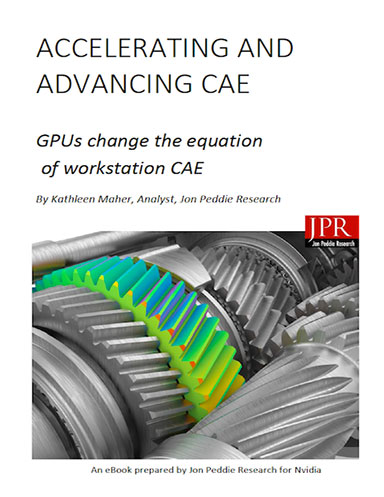
Accelerating and Advancing CAE
GPUs are changing the nature of engineering simulation, according to a new ebook from Jon Peddie Research (JPR). It explains how GPU acceleration is improving CAE workflows.

Kenneth Wong is Digital Engineering's resident blogger and senior editor. Email him at [email protected] or share your thoughts or suggestions at digitaleng.news/facebook.
Follow DE
Join over 90,000 engineering professionals who get fresh engineering news as soon as it is published.






About Us · Contact Us · Editorial Team · Advertising · Privacy Policy · Subscriber Services · © 2026 Digital Engineering 24/7 · Peerless Media