Helping design and engineering professionals discover, evaluate and specify technologies and processes that shorten the design cycle and enable success.


Alert!
Digital Engineering ceased publication on July 1, 2026. This website remains available as an archive of engineering content.
For inquiries or information, please email [email protected].

Design & Simulation Software Guide 2025
In this Special Issue, Digital Engineering presents its second annual guide to design and simulation software vendors.

Design & Simulation Software Guide
In this Special Issue, Digital Engineering presents its inaugural guide to design and simulation software vendors, including listings for CAD, CAM, simulation, generative design, PLM, rendering and visualization, design for additive manufacturing,…

Last week, a pair of zombie hunters from Los Angeles came to town. They were staying at W Hotel in San Francisco, across the street from Yerba Buena Park. They were also chasing down reporters to tell their story. So I joined them for an early evening cocktail.
Markus Schneider and Alex Seifert were from xaitment. Their mission, as stated in the blood-dripped brochure they carried, was to "stop the zombies." They intend to do that by giving zombies an artificial brain, starting at about $10,000 a piece.
If you've ever played computer games or console games, I'm sure you've had zombie encounters. You don't necessarily need to pick up a horror title like Resident Evil to meet them. In any game, you'll come across a horde of nonessential characters -- villagers, guards, pedestrians, and critters, to name but a few -- roaming the virtual landscapes and cityscapes, adding a sense of realism to the make-believe world. These are the zombies xaitment is targeting.
Schneider, executive VP (Americas & Asia), and Seifert, field application engineer (Americas & Asia), introduced me to a line of artificial intelligence (AI) packages. The first in the lineup is xaitMap and xaitMove2, a combo priced at $10,000 (if you buy xaitMap, you get xaitMove2 for free).
With xaitMap, you can load the geometry of a 3D environment (the setup of an assembly plant saved in VRML, for example), then automatically generate navigation meshes (representing the surface areas a character can tread on). With xaitMove2, you could set the behaviors of each entity class (for example, guards always keep a wedge formation when moving; soldiers hide when they come across guards; villagers evade whenever soldiers get too close; and so on).
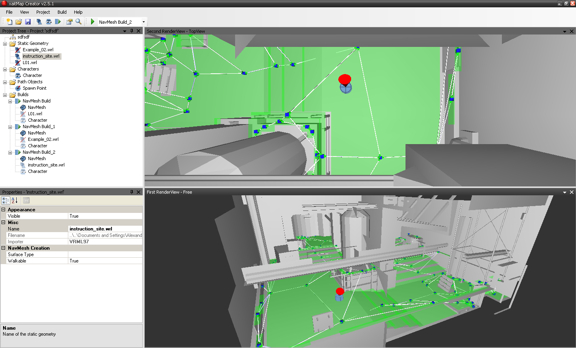
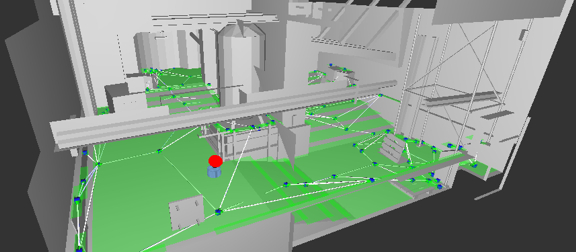
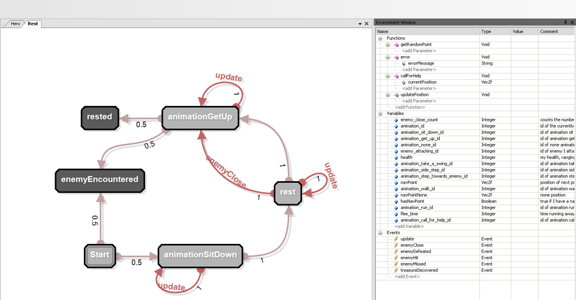
The next product is xaitControl ($25,000), which lets you build behavior hierarchies for your entities in a Visio-like interface. For example, you might define a villager's behaviors as Idle > Explore > Meet Soldier > Flee (or) Evade. But behavior sequences are not linear. Evade (or) Flee may send the villager back into the Explore > Meet Soldier loop, and so on. This kind of behavior modeling is also known as building a state machine.
The higher end products ($45,000 and up) are xaitKnow, for describing and organizing your world assets, and xaitThink, for creating a set of rules that govern your game world. Traditionally, game developers employ a small army of programmers and coders to accomplish most, if not all, of these tasks. By contrast, xaitment products give you a drag-and-drop graphical environment where you can accomplish these. The company points out its products can be used out of the box, whereas an AI engine might require custom configuration.
So why are two AI developers interested in speaking to a CAD reporter? Apparently, they're looking past the game world and into the simulation world. Imagine, for instance, modeling the assembly line of an auto plant, complete with heavy machinery, crates, elevator shafts, and autonomous digital humans. This could potentially be a way to simulate, study, and refine the assembly process before a plant is built, before the machines are installed.
If you think this is too futuristic, meet Jack and Jill, the digital duo that's part of Siemens PLM Software's Tecnomatix9. (They made a cameo appearance in Tecnomatix marketing manager Markus Erlmann's blog post titled "Are Digital Humans Cool?") Some of Siemens' automotive clients have been using these configurable humans to test and verify workplace ergonomics. (For instance, can an assembly worker reach the bottom and top levers without putting undue stress on his or her spine?)
Coincidentally, Seimens is also one of xaitment's partners and clients. Schneider revealed a Siemens contract provided the initial funds needed to launch xaitment's AI business. (Just to be clear, xaitment has no contribution to the development of Jack and Jill, Schneider verified.)
So far, most of the discussion about digital prototyping has been about product prototyping, but digital humans -- or zombies with artificial brains -- might propel us into desktop process prototyping.


Kenneth Wong is Digital Engineering's resident blogger and senior editor. Email him at [email protected] or share your thoughts or suggestions at digitaleng.news/facebook.
Follow DE






About Us · Contact Us · Editorial Team · Advertising · Privacy Policy · Subscriber Services · © 2026 Digital Engineering 24/7 · Peerless Media