Helping design and engineering professionals discover, evaluate and specify technologies and processes that shorten the design cycle and enable success.


Alert!
Digital Engineering ceased publication on July 1, 2026. This website remains available as an archive of engineering content.
For inquiries or information, please email [email protected].
May 2026 Special Focus: Artificial Intelligence in Design and Simulation
In this Special Focus Issue, learn about the latest developments in the integration of artificial intelligence into engineering workflows.

Design & Simulation Software Guide 2025
In this Special Issue, Digital Engineering presents its second annual guide to design and simulation software vendors.
 If you weren’t in Salzburg, Austria, on June 9-12, you missed what is arguably the best vendor-neutral global conference and exhibit dedicated solely to engineering simulation (generally called CAE for short and consisting of finite element structural analysis methods, computational fluid dynamics, multibody dynamics, electromagnetics, co-simulation, and related data and workflow/process management). Approximately 560 people managed to make it there, despite record flooding nearby in Germany, and they participated in an event that surely exceeded their expectations (as it did this author’s).
The 14th NAFEMS World Congress (NWC), sponsored by Dassault Syst mes/SIMULIA and nine other major vendors, contained four days of keynotes, plenary sessions, and parallel topical tracts, complemented by exhibits from 40 of the leading CAE vendors, short courses on the most important CAE topics, and plenty of opportunities for networking with existing CAE colleagues and meeting many new ones. Oh, and last but not least, the NWC was held in the modern Salzburg Conference Center, with some great social events and sightseeing opportunities in one of the most charming cities in Europe.
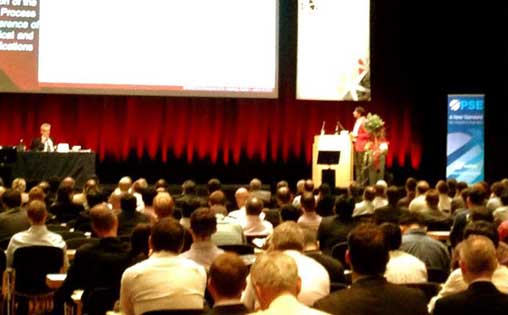 Jerome Buffe, Thales Alenia Aerospace, delivered the Tuesday morning keynote to a packed house at NAFEMS World Congress 2013. Image courtesy of NAFEMS. Jerome Buffe, Thales Alenia Aerospace, delivered the Tuesday morning keynote to a packed house at NAFEMS World Congress 2013. Image courtesy of NAFEMS. |
NAFEMS, founded in 1983 and headquartered in the UK, with regional chapters in the UK, France, Germany/Austria/Switzerland, Italy and the Americas (where this author is a member of the regional Steering Committee), is the largest vendor-neutral, not-for-profit association with the focused mission to promote the effective professional use and benefits of engineering simulation. This is accomplished through a growing number of publications, training courses (both classroom and e-learning), participation in government-funded research programs, and regional conferences. The capstone is the biannual World Congress, which alternates between Europe and the Americas. From 1987 onward, in venues such as Paris, Orlando, London, Boston, Vancouver, Malta and Greece, the World Congress has seen a steadily growing attendance, with 2013 breaking all previous records.
More than 1,100 member organizations, representing industry, government and academia from dozens of countries, belong to NAFEMS. The backbone of NAFEMS’ value and output comes from a growing number of topic-focused volunteer professional working groups, who meet regularly (greatly aided now by the power of the Internet for high-quality virtual meetings) and identify the key issues within their specific topics, develop corresponding white papers, and issue requests for quotations (RFQs) for related “How To” guides and handbooks to be created and published under the NAFEMS banner. The Working Groups form the basis for the choice of World Congress topical tracks and solicitation of presentations, including full published papers available in hyper-linked PDFs on a DVD for all attendees. If you missed the event in Salzburg, you can purchase the complete Proceedings DVD from NAFEMS.
This year’s World Congress, incorporating the First International Conference on Simulation Process and Data Management (SPDM), had plenary sessions each morning, followed by parallel topical tracks consisting of the following:
Sundermeier made a good case for the need for a “revolution” to reach the full potential of CAE in the next five to seven years. He showed that the growing role of the automobile as a mechatronics product requires co-simulation of complete vehicle functional requirements, and thus method coupling and co-simulation will drive the required revolution. Sundermeier presented numerous practical VW examples to prove his points.
CAE and the Cloud
Frank Popielas, director of Dana Corp.’s global CAE efforts and a member of the NAFEMS Americas Steering Committee (NASC), reviewed the CAE market needs and drivers from Dana’s perspective, where CAE is now a mainstream resource allowing a significant traditional supplier like Dana to become a development partner with its major automotive and related original equipment manufacturers (OEMs). He discussed how the emerging visual intuitive environment (no longer requiring manuals to learn), coupled with the Cloud, will provide a virtual desktop for performing and reviewing CAE on the road wherever CAE engineers have Internet access: “The world of iCAE is around the corner.”
In connection with the growing interest in mechatronics and co-simulation, Popielas also mentioned the new formal partnership between NAFEMS and the International Council on Systems Engineering (INCOSE), which was announced last year and further defined with two topical sessions on systems engineering at the NWC. NAFEMS and INCOSE have created a joint Systems Modeling and Simulation Working Group (SMSWG). Popielas is the NAFEMS Chair of this Working Group, which will hold its first meeting at the INCOSE International Symposium in Philadelphia on June 25.
The plenary presentations on Tuesday, June 11, included:
 PSE Designation Introduced
Perhaps the most strategically significant presentation at the NWC was when Tim Morris, CEO of NAFEMS, formally introduced the new Professional Simulation Engineer (PSE) designation and scheme. This author, a 40-year career veteran of research, teaching, development and executive management in CAE, is particularly pleased to see this important step in elevating the hard-earned professional status of at least one branch of the modern engineering world.
The PSE is the result of extensive work by NAFEMS Working Groups, funded in part by the European Community, to structure the elements of today’s simulation engineering work, provide a mechanism for tracking relevant engineering competencies, and finally certify simulation engineers where such certification would aid both employers and employees who do important simulations as part of their engineering work. More details on the PSE may be found at the website NAFEMS.org/pse.
You can watch a NAFEMS video on the PSE designation here:
Further plenary presentations on Wednesday, June 12, included:
The hundreds of excellent presentations made during the many parallel tracts at the NWC are way too numerous to even summarize here. The reader is encouraged to take a deeper look at the NWC Agenda at NAFEMS.org for more details, where complete presentation proceedings of all papers (PDFs on a DVD) may also be purchased.
A couple of the parallel track sessions are, however, worth mentioning here. The two sessions on Systems Engineering, chaired by Frank Popielas and this author, included Sven-Olaf Schulze, Chair of INCOSE-Germany, who presented an overview of INCOSE for NAFEMS, and Ed Ladzinski of Dassault Syst mes, also a member of the NASC and the originator of the idea for the cooperation between INCOSE and NAFEMS, who presented the activities and motivation leading up to the formal NAFEMS-INCOSE partnership. There were also four sessions on the popular emerging issues of HPC and “The Cloud” (including a presentation by this author on the UberCloud HPC Experiment) and one on the controversial topic of open-source software.
If you weren’t in Salzburg, you missed a lot, but you have a chance to make it up by attending the next NAFEMS World Congress in the Spring of 2015 in the U.S. We hope to see you there!
Dennis Nagy is a 40-year veteran of international experience and accomplishments in all aspects of the engineering simulation (CAE) software business. Residing in Chapel Hill, NC, he currently provides global business development and industry/market analysis consulting to multiple CAE/PLM companies via his consulting business BeyondCAE. He may be contacted at [email protected].
More Info
International Council on Systems Engineering
Japan Society for Computational Engineering Sciences






About Us · Contact Us · Editorial Team · Advertising · Privacy Policy · Subscriber Services · © 2026 Digital Engineering 24/7 · Peerless Media