Helping design and engineering professionals discover, evaluate and specify technologies and processes that shorten the design cycle and enable success.


Alert!
Digital Engineering ceased publication on July 1, 2026. This website remains available as an archive of engineering content.
For inquiries or information, please email [email protected].

Digital Engineering April 2026
In the latest issue of Digital Engineering, we take a look at the latest innovations in design for additive manufacturing, including the use of natural language inputs, social media cosplayers, and AI integration. The issue also includes a feature…

January Special Focus Issue: Design for Additive
In this Special Focus Issue of Digital Engineering, learn about the latest advancements in design for additive manufacturing, including new software tools, additive in automotive, custom medical devices, and more.
Two-pound spools of plastic filament run in price anywhere from $30 to $80 (for the really cool glow-in-the-dark variety), and any hobbyist that uses their 3D printer on a consistent basis will run through a roll of the stuff in short order. Oddly, though, you can get 5 pounds of pellets made from exactly the same material for $25 or less.
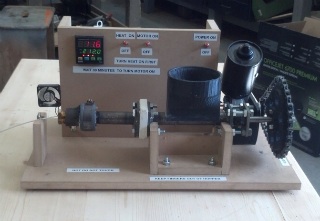
The people at Inventables, a kind of hardware store for the maker crowd, noticed this disparity and in partnership with the Ewing Marion Kauffman Foundation offered a $40,000 prize to anyone who could design an extruder that ground pellets into 3D printer usable filament. The catch, if you want to call it that, was that the extruder must be able to be assembled for under $250.
The contest captured the attention of 83-year-old Hugh Lyman, a retired manufacturer. Since his retirement in 1996, Lyman had been tinkering around with a number of inventions, and the contest caught his eye. Not coincidentally, Lyman owns a 3D printer as well.
“Every time I buy a couple of pounds of filament, it costs me 40 to 50 bucks,” said Lyman. “I was burning through it pretty fast.”
Through some trial-and-error, Lyman designed and built the Lyman Filament Extruder and submitted it. The design was then rejected because he had miscalculated the cost of some of the parts he created himself. Undeterred, Lyman went back to the drawing board and produced the Lyman Filament Extruder II. The second machine came in under the price limit, and Lyman was awarded the $40,000 prize.
In principle, the design of the extruder is simple enough. You fill a hopper with the cheaper plastic pellets, and the machine melts the pellets before squeezing them out through a nozzle to form filament. Lyman hasn’t kept the design to himself, either. You can find the specs at Thingiverse. Being what it is, the maker community has already expanded on the design.
The Lyman Filament Extruder II marks the second device to produce inexpensive filament for 3D printers that we’ve seen, the first being the Filabot, which uses recyclable plastic to make filament. I’m sure we’ll see more of this type of invention as more hobbyist machines make their way into home workshops.
Below you’ll find a video of the Lyman Filament Extruder II.
Source: Time


John Newman is a Digital Engineering contributor who focuses on 3D printing. Contact him via [email protected] and read his posts on Rapid Ready Technology.
Follow DE






About Us · Contact Us · Editorial Team · Advertising · Privacy Policy · Subscriber Services · © 2026 Digital Engineering 24/7 · Peerless Media