Helping design and engineering professionals discover, evaluate and specify technologies and processes that shorten the design cycle and enable success.



May 2026 Special Focus: Artificial Intelligence in Design and Simulation
In this Special Focus Issue, learn about the latest developments in the integration of artificial intelligence into engineering workflows.

April 2026 Special Focus Issue: Generative Design
In this Special Focus Issue, Digital Engineering takes a look at how generative design solutions can be used across different types of design problems and with a variety of manufacturing approaches to accelerate design space exploration, and…
A review of most publications and websites covering mechanical design gives the impression our industry has moved on from 2D drafting to 3D modeling. These models provide downstream utility for applications such as model-based design, digital twin and additive manufacturing (AM).
The reality is that more seats of 2D CAD are still in use today for mechanical design than 3D CAD. Why?
For many companies, 2D use is all about practicality. 2D drafting is more straightforward, making it easier to learn. 2D CAD requires less computational power than 3D modeling—it runs well on inexpensive computers. Perhaps most importantly, 2D CAD software is much less expensive than its 3D counterpart, making it an attractive option for smaller businesses and individuals with budget constraints.
There are many industry-specific applications where traditional 2D plans continue to be widely used. Many smaller machine shops serving small-to-medium size manufacturers still require 2D plans for most contract work. The familiarity and compatibility of 2D drawings make them an enduring choice for these sectors.
Technically, all drafting products labeled as 2D are capable of drafting in three dimensions. The difference is between wireframe drafting and solid modeling. (One can quickly fall into a geometric rabbit hole when comparing 2D and 3D, as the conversation quickly turns to NURBS, splines and projection.)
2D design still has its relevant applications. Many mechanical design activities don’t need the intricate detail or sophistication of 3D CAD models. For instance, schematic design aims to depict functional connections between components, while layout planning concentrates on arranging objects on a 2D surface.
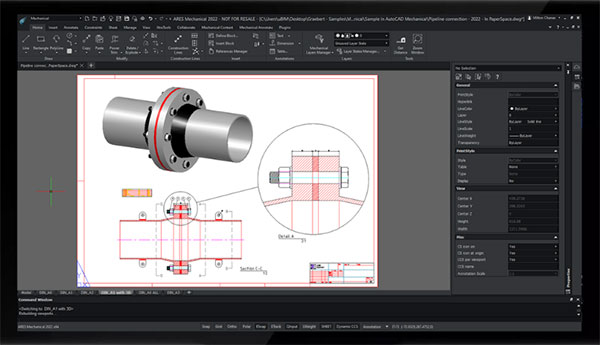
In 2022, Graebert GmbH introduced an update to its ARES Mechanical that could read and write the Mechanical Objects created in AutoCAD Mechanical. Image courtesy of Graebert.
Additionally, creating basic mechanical parts that are sufficiently represented in two dimensions falls into this category. In such cases, opting for 2D CAD can simplify the design workflow and minimize the chance of adding unwarranted complexity. For many companies, it is simply about saving time, which also means saving money.
Manufacturing firms, regardless of their size, have amassed an extensive collection of mostly pertinent and valuable drawings. Maintaining, updating and referring to these drawings is crucial, especially when products undergo updates or replacements. Continued use of 2D CAD supports compatibility with these existing documents, reducing or eliminating the need for translation or conversion.
Drafting documentation remains a vital use case. Designs crafted with 3D CAD software still require 2D format documentation for manufacturing, assembly, technical illustrations and other uses. 2D CAD software is highly efficient in producing detailed technical drawings, including orthographic projections and cross-sectional views. The utility of layer management schemes is significant, and they do not need to be redeveloped when transforming a 3D model into a series of 2D drawings.
CAD vendors see things differently than their customers. Innovation is seen as job No. 1, even if the customer is not asking for it. Introducing new products and technologies creates new sales opportunities. Additionally, the war between perpetual use licenses and network licensing with annual contracts is over: licensing won. Most customers have adjusted to paying for their software annually, receiving such additional benefits as automatic upgrades and user network management tools.
While Autodesk AutoCAD has been the leading force in the 2D CAD market for many years—especially in mechanical design—it is widely acknowledged that the company is now focusing more on maintaining AutoCAD’s current status rather than investing in further refinements. This is despite core AutoCAD and the several extra tool sets available—including Mechanical—taking in more than $627 million dollars in a recent fiscal quarter.
For companies preferring to stick with 2D CAD rather than transitioning entirely to 3D mechanical design, several options are available.
The annual licensing fee for a single copy of AutoCAD Mechanical 2023 is around $1,890. Until 2022, AutoCAD Mechanical was the sole software capable of interpreting and using its extensions to DWG known as custom entities, a.k.a. “smart objects” or “mechanical entities.”
CAD vendor Graebert broke new ground in 2022 by offering compatibility with these special objects. They now provide ARES Mechanical at $1,048, which comes with a perpetual license; annual licensing is also available.

Several 2D CAD products fully support the basic AutoCAD DWG format. However, only Graebert provides a solution compatible with these mechanical custom entities. Graebert prefers the term “mechanical entities.”
Therefore, substituting AutoCAD, particularly its Mechanical version, with a less expensive option isn’t a straightforward comparison. Despite this caveat, there are several alternatives, all employing technology from the Open Design Alliance (ODA). This technology is broadly acknowledged for its complete compatibility with AutoCAD’s DWG format.
The ODA is developing a mechanical software development kit for its members that will provide compatibility with AutoCAD Mechanical Toolkit. Graebert is the only ODA member to ship a product using the technology (much of which Graebert wrote). Unconfirmable reports (industry gossip) suggest two or three more companies will have Mechanical Toolkit compatibility to some degree in 2024.
If compatibility with the smart objects in AutoCAD Mechanical Toolkit is not a priority, there are various options on the market for working with DWG files. They include:
Dassault Systèmes’ DraftSight is a professional-level 2D CAD software featuring an interface legally similar to AutoCAD. Interestingly, a significant portion of DraftSight’s technology is sourced under license from Graebert as well as from the ODA. It integrates seamlessly with Dassault’s 3DEXPERIENCE platform, making it a compelling option for businesses that rely on SolidWorks for 3D design or those needing compatibility with other Dassault software applications.
IMSI/Design's TurboCAD is one of the oldest products in this category. It provides 2D drafting and 3D modeling functions. This software comes in various editions, catering to a range of user requirements from beginners to professionals. Unlike its rivals, TurboCAD is distributed via retail outlets. TurboCAD uses a proprietary file format, translating in and out of DWG as needed via ODA technology.
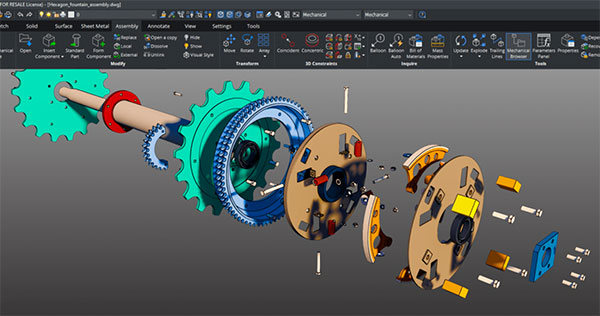
Hexagon BricsCAD offers a professional 2D/3D software suite that includes a specialized version for mechanical design, known as BricsCAD Mechanical. This variant comes equipped with dedicated tools and functionalities, including parametric components, sheet metal design and assembly management.
A standout feature of BricsCAD is its Quad cursor, which introduces a contextual menu to expedite the drawing process by offering rapid access to commonly used commands. In recent years, Hexagon has been integrating artificial intelligence into various components of BricsCAD, enhancing its capabilities.
The IntelliCAD Consortium (ITC) is another co-operative organization producing DWG-compatible software for members. For many years, ITC worked on its own core CAD engine, but switched to ODA technology a few years ago. Most ITC members cater to the construction market, but their basic CAD products are suitable for general drafting.
If country of origin is important, we are listing the last three 2D CAD products separately. All three use ODA technology for their DWG compatibility.
Nanosoft nanoCAD (Russia), Guizhou Gstarsoft GstarCAD (China) and ZWSOFT ZWCAD (China) all offer robust 2D drafting tools familiar to AutoCAD users. These three also offer various programmability options, and all offer an English language version.


Autodesk is a world leader in 3D design, engineering, and entertainment software. They produce software for the architecture, engineering, construction, manufacturing, media, and entertainment industries.

Randall S. Newton is principal analyst at Consilia Vektor, covering engineering technology. He has been part of the computer graphics industry in a variety of roles since 1985.
Follow DE
Join over 90,000 engineering professionals who get fresh engineering news as soon as it is published.






About Us · Contact Us · Editorial Team · Advertising · Privacy Policy · Subscriber Services · © 2026 Digital Engineering 24/7 · Peerless Media