Helping design and engineering professionals discover, evaluate and specify technologies and processes that shorten the design cycle and enable success.


Alert!
Digital Engineering ceased publication on July 1, 2026. This website remains available as an archive of engineering content.
For inquiries or information, please email [email protected].

May 2026 Special Focus: Artificial Intelligence in Design and Simulation
In this Special Focus Issue, learn about the latest developments in the integration of artificial intelligence into engineering workflows.

April 2026 Special Focus Issue: Generative Design
In this Special Focus Issue, Digital Engineering takes a look at how generative design solutions can be used across different types of design problems and with a variety of manufacturing approaches to accelerate design space exploration, and…
The cloud is where the works of the telecom providers and the design software makers intersect. The two seemingly disparate universes collide when CAD moves to the cloud and simulation solvers take advantage of cloud computing, aiming to overcome the personal workstation's finite computing limits.
So how will the much anticipated arrival of 5G affect the design software delivery, usage, and applications? Cloud-CAD pioneer Onshape and simulation software leader ANSYS share their thoughts.
5G has already stirred up excitement among media streaming firms, such as Netflix and Hulu, for the promise to be able to deliver entertainment content in high resolution to mobile devices. But there's a distinction between Netflix-style streaming and Onshape-style cloud-hosted CAD.
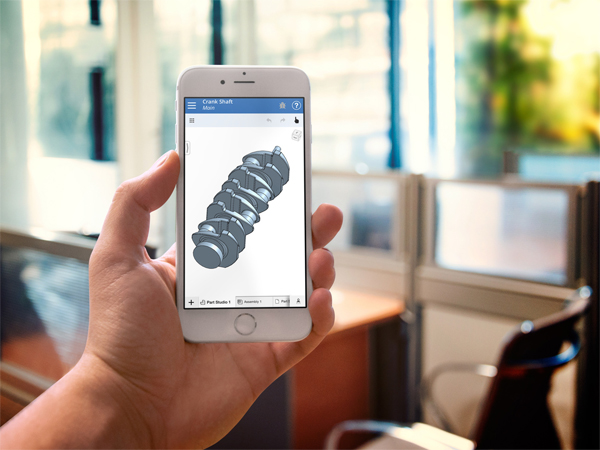
"We don't stream CAD data as graphics, so, in that sense, it's not like Netflix," clarifies John McEleney, cofounder of Onshape. "We sent snippets of data, and we also stretch the application's ability by tapping the user's local machine's GPU, be it a laptop, a phone, or a tablet."
The decision to launch a cloud-hosted CAD application was in part a gamble on increasing bandwidth. "That's the wave we're riding on; we knew bandwidth would improve over time," says McEleney. "You'll definitely see performance increases when 5G hits, but the beauty of our position is, we don't need to do any extra work to take advantage of it"
Onshape released its first public beta in 2015. Unlike many legacy CAD programs, Onshape wrote its architecture from the ground up to run from the cloud. You can run Onshape from a browser on a standard workstation; but you can also run it from mobile tablets and smartphones.
"The performance you get depends on your connection. For example, if you happen to be in a place without WiFi, and you choose to tether to your 5G-enabled phone, you'll get great performance," explains McEleney.
The impact of 5G will probably be felt in, for instance, "the first time you're loading a model," says McEleney. "
As product designers draw benefits from 5G, they're also bound to be designing 5G-powered devices--IoT-enabled wearables, smart factory monitoring systems, and field devices that receive and transmit data using 5G, for example.
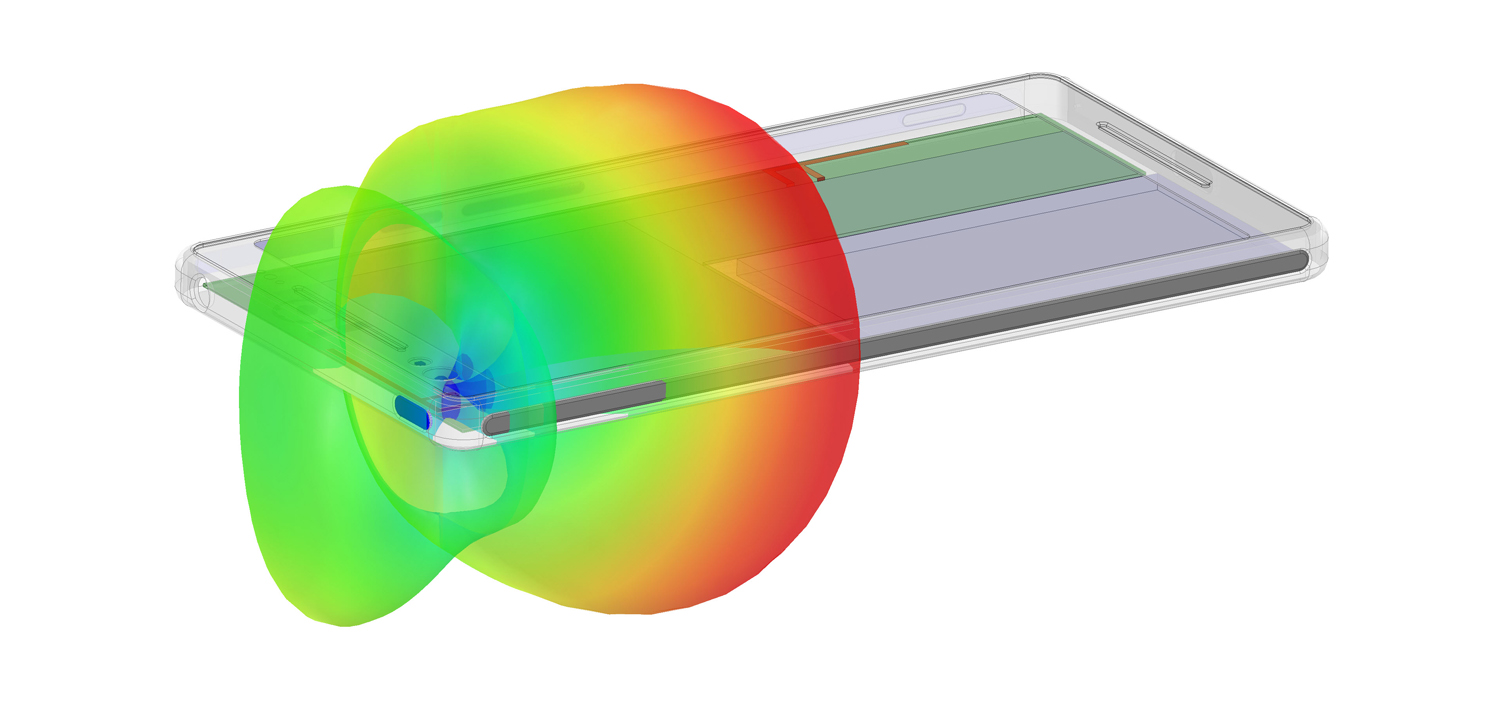
"For 5G, product designers will have to design and simulate more complex RF (radio frequency) systems," remarks Shawn Carpenter, senior product manager, high frequency, ANSYS. "They'll have to look at a broader spectrum of frequencies the product needs to accommodate. So they'll have to design antenna systems and electronics that are more complex."
In 2015, just as Onshape launched its first public beta, simulation software maker ANSYS was also finalizing its acquisition of Delcross, a computer-aided engineering (CAE) software developer that specializes in high frequency electromagnetic (EM) and RF coexistence EMI analysis. Previously employed by Delcross, Carpenter was appointed to his current role at ANSYS as the outcome of the acquisition.
"We've now implemented tools to model the interaction between millimeter wave antennas and the physical environment," explains Carpenter. "This also applies to 5G, as this could let you evaluate beam formation."
Such tools will play an important role in autonomous vehicle development, where car-to-car and car-to-network communication outreaches must be part of the design considerations.

Sometimes smaller problems demand a great deal more computing power to solve. Designers working at nanoscale electronics have discovered it.
"At the millimeter wave frequency, simulation problems get significantly larger," notes Carpenter. "So what you were able to solve once on a desktop workstation may now need high performance computing. We're working on more efficient ways to solve simulation problems."
One of the simulation solvers in ANSYS's portfolio is HFSS SBR+ (formerly Delcross Savant), part of the technology the company acquired from Delcross. The product is an advanced antenna performance simulation software, designed to address many 5G-related electronics design issues.
"This solver is one way to solver problems that are much larger," says Carpenter. This could, for example, help someone simulate the way energy propagates from a transmission device through a tower.
Simulation ray bouncing behavior--a method for simulating frequencies--"maps quite well to the GPU, one of the areas we're looking at for solving simulation more efficiently," says Carpenter.
The use of the GPU's parallel processing capacity lets simulation software to speed up on certain types of simulation problems. ANSYS is among many developers who have struck up partnerships with leading GPU makers to facilitate GPU-acceleration.

Engineering simulation is our sole focus. For more than 45 years, we have consistently advanced this technology to meet evolving customer needs.ANSYS develops, markets and supports engineering simulation software used to predict how product…

Study on HPC and Cloud Computing for Engineering Simulation
This new research report explores how companies are using HPC and simulation on the cloud.

Kenneth Wong is Digital Engineering's resident blogger and senior editor. Email him at [email protected] or share your thoughts or suggestions at digitaleng.news/facebook.
Follow DE






About Us · Contact Us · Editorial Team · Advertising · Privacy Policy · Subscriber Services · © 2026 Digital Engineering 24/7 · Peerless Media