Helping design and engineering professionals discover, evaluate and specify technologies and processes that shorten the design cycle and enable success.


Alert!
Digital Engineering ceased publication on July 1, 2026. This website remains available as an archive of engineering content.
For inquiries or information, please email [email protected].

May 2026 Special Focus: Artificial Intelligence in Design and Simulation
In this Special Focus Issue, learn about the latest developments in the integration of artificial intelligence into engineering workflows.

April 2026 Special Focus Issue: Generative Design
In this Special Focus Issue, Digital Engineering takes a look at how generative design solutions can be used across different types of design problems and with a variety of manufacturing approaches to accelerate design space exploration, and…
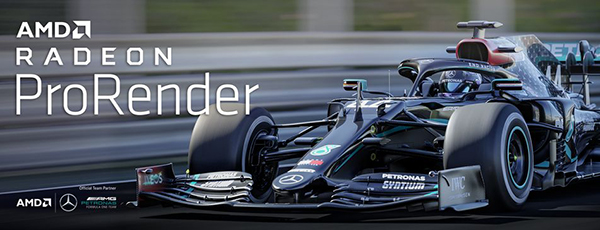
AMD Radeon ProRender, available in over a dozen digital content creation and CAD applications, is a fast, easy rendering engine built on industry standards that lets users create photorealistic images on virtually any GPU, any CPU and any OS1, AMD reports.
The company has released some updates for developers including an update to the beta of its upcoming Radeon ProRender 2.0 SDK and new beta versions of open-source plug-ins for Autodesk Maya, Blender and SideFX Houdini.
Back in May, AMD released the first beta of the Radeon ProRender 2.0 SDK, the next generation of its rendering software that is part of the Radeon ProRender Developer Suite, and now it is releasing an updated beta with more new features.
In addition to the features and improvements of Radeon ProRender 2.0, the company is adding three key new additions to the latest beta: MaterialX support, LPE (Light Path Expression) AOVs and sphere and disk light types.
MaterialX is an open standard created by Lucasfilm for the transfer of materials between applications and renderers. It addresses the need for a common standard for the look of 3D assets (including shaders, textures and materials) in content creation workflows that often use multiple applications.
Radeon ProRender 2.0 now supports standard MaterialX nodes, including the “Standard Surface” shader, and by using its updated SDK developers can now easily add support for this industry standard into their application.
In the current version of the Radeon ProRender SDK and the plug-ins and application integrations built upon it, we support a wide variety of common AOVs (Arbitrary Output Variables). However, these predefined AOVs don’t always fit an artist’s needs, so in Radeon ProRender 2.0 we’ve added support for LPE (Light Path Expressions) AOVs. This gives developers nearly unlimited options to define AOVs in their application or the ability to let users create their own custom AOVs based on the desired light path.
For even more details on AMD's latest updates, click here.
Sources: Press materials received from the company and additional information gleaned from the company’s website.


AMD, or Advanced Micro Devices, has driven innovation in high-performance computing, graphics and visualization technologies. They develop high-performance computing and visualization products to solve some of the world’s toughest and most…

Accelerating Electric Vehicle Development with Multidisciplinary Simulation and High-Performance Computing
In this new Making the Case guide, learn how a unified approach to design and multidisciplinary simulation from Dassault Systèmes, combined with high-performance computing powered by AMD EPYC™ processors, can accelerate EV design.

DE's editors contribute news and new product announcements to Digital Engineering. Press releases may be sent to them via [email protected].
Follow DE
Join over 90,000 engineering professionals who get fresh engineering news as soon as it is published.






About Us · Contact Us · Editorial Team · Advertising · Privacy Policy · Subscriber Services · © 2026 Digital Engineering 24/7 · Peerless Media