Helping design and engineering professionals discover, evaluate and specify technologies and processes that shorten the design cycle and enable success.


Alert!
Digital Engineering ceased publication on July 1, 2026. This website remains available as an archive of engineering content.
For inquiries or information, please email [email protected].

Cut Retrieval-Augmented Generation (RAG) Hallucinations by 50%
Most teams hit the same wall with enterprise AI: LLMs that hallucinate, pipelines that don’t scale, and infrastructure that’s harder to design than the models themselves.

What Is Intelligent BOM Management? A Guide to Smarter Product Development
Learn how intelligent Bill of Materials (BOM) management helps teams collaborate, reduce errors, and bring innovative products to market faster with cloud-based PLM tools.
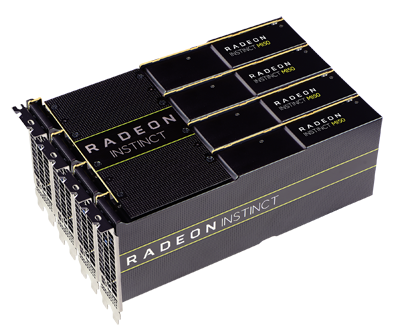
AMD unveils the AMD Radeon Instinct MI60 and MI50 accelerators, 7nm datacenter GPUs, designed to deliver the compute performance required for next-generation deep learning, HPC, cloud computing and rendering applications. Researchers, scientists and developers can use AMD Radeon Instinct accelerators for large-scale simulations, climate change, computational biology and more.
“Legacy GPU architectures limit IT managers from effectively addressing the constantly evolving demands of processing and analyzing huge datasets for modern cloud datacenter workloads,” says David Wang, senior vice president of engineering, Radeon Technologies Group at AMD. “Combining world-class performance and a flexible architecture with a robust software platform and the industry’s leading-edge ROCm open software ecosystem, the new AMD Radeon Instinct accelerators provide the critical components needed to solve the most difficult cloud computing challenges today and into the future.”
The AMD Radeon Instinct MI60 and MI50 accelerators feature flexible mixed-precision capabilities, powered by high-performance compute units that expand the types of workloads these accelerators can address, including a range of HPC and deep learning applications. The new AMD Radeon Instinct MI60 and MI50 accelerators were designed to efficiently process workloads such as rapidly training complex neural networks, delivering higher levels of floating point performance, greater efficiencies and new features for datacenter and departmental deployments.
The AMD Radeon Instinct MI60 and MI50 accelerators provide fast floating-point performance and hyper-fast HBM2 (second-generation High-Bandwidth Memory) with up to 1 TB/s memory bandwidth speeds. They are also the first GPUs capable of supporting next-generation PCIe 4.02 interconnect, which is up to 2X faster than other x86 CPU-to-GPU interconnect technologies, and feature AMD Infinity Fabric Link GPU interconnect technology that enables GPU-to-GPU communications that are up to 6X faster than PCIe Gen 3 interconnect speeds.
AMD also announced a new version of the ROCm open software platform for accelerated computing that supports the architectural features of the new accelerators, including optimized deep learning operations (DLOPS) and the AMD Infinity Fabric Link GPU interconnect technology. Designed for scale, ROCm allows customers to deploy high-performance, energy-efficient heterogeneous computing systems in an open environment.
“Google believes that open source is good for everyone,” says Rajat Monga, engineering director, TensorFlow, Google. “We've seen how helpful it can be to open source machine learning technology, and we’re glad to see AMD embracing it. With the ROCm open software platform, TensorFlow users will benefit from GPU acceleration and a more robust open source machine learning ecosystem.”
Key features of the AMD Radeon Instinct MI60 and MI50 accelerators include:
AMD announced a new version of its ROCm open software platform designed to speed development of high-performance, energy-efficient heterogeneous computing systems. In addition to support for the new Radeon Instinct accelerators, ROCm software version 2.0 provides updated math libraries for the new DLOPS; support for 64-bit Linux operating systems including CentOS, RHEL and Ubuntu; optimizations of existing components; and support for the latest versions of the most popular deep learning frameworks, including TensorFlow 1.11, PyTorch (Caffe2) and others.
The AMD Radeon Instinct MI60 accelerator is expected to ship to datacenter customers by the end of 2018. The AMD Radeon Instinct MI50 accelerator is expected to begin shipping to data center customers by the end of Q1 2019. The ROCm 2.0 open software platform is expected to be available by the end of 2018.
Sources: Press materials received from the company.


AMD, or Advanced Micro Devices, has driven innovation in high-performance computing, graphics and visualization technologies. They develop high-performance computing and visualization products to solve some of the world’s toughest and most…
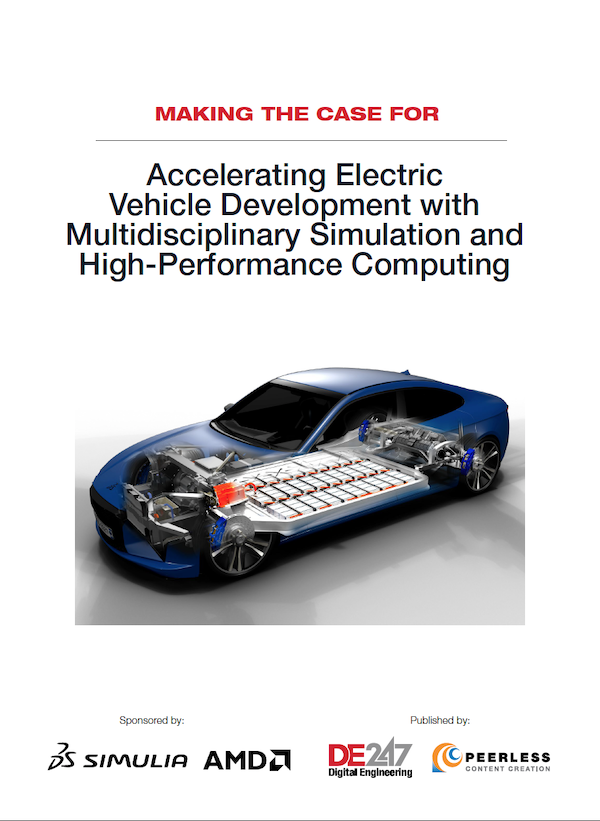
Accelerating Electric Vehicle Development with Multidisciplinary Simulation and High-Performance Computing
In this new Making the Case guide, learn how a unified approach to design and multidisciplinary simulation from Dassault Systèmes, combined with high-performance computing powered by AMD EPYC™ processors, can accelerate EV design.

DE's editors contribute news and new product announcements to Digital Engineering. Press releases may be sent to them via [email protected].
Follow DE
Join over 90,000 engineering professionals who get fresh engineering news as soon as it is published.






About Us · Contact Us · Editorial Team · Advertising · Privacy Policy · Subscriber Services · © 2026 Digital Engineering 24/7 · Peerless Media