Helping design and engineering professionals discover, evaluate and specify technologies and processes that shorten the design cycle and enable success.


Alert!
Digital Engineering ceased publication on July 1, 2026. This website remains available as an archive of engineering content.
For inquiries or information, please email [email protected].

Digital Engineering April 2026
In the latest issue of Digital Engineering, we take a look at the latest innovations in design for additive manufacturing, including the use of natural language inputs, social media cosplayers, and AI integration. The issue also includes a feature…

January Special Focus Issue: Design for Additive
In this Special Focus Issue of Digital Engineering, learn about the latest advancements in design for additive manufacturing, including new software tools, additive in automotive, custom medical devices, and more.
At the recent Augmented World Expo (AWE), Lenovo introduces its first enterprise-targeted AR headgear. Dubbed ThinkReality A6, the device is powered by a smartphone-size compute box that you can carry, small enough to fit in your pocket.
Lenovo also offers ThinkReality software kit, which contains sample applications. The company expects developers will take the sample applications and customize them for their own verticals, such as manufacturing, healthcare, and architecture.
Also at the show is nreal, offering its AR glasses that look more like casual, fashion items than a tech gadget. It lets you project digital objects and scenes onto real-world surfaces (for example, tabletops).
Both Lenovo ThinkReality and nreal power their devices with small portable compute boxes, allowing users to roam and interact with digital objects with much more freedom.

Varjo is at the show to let attendees try out its XR-1 AR system.
Varjo's technology uses eye tracking, which allows users to use their eyesight -- where they choose to focus on -- as the selection system. Without the need to hold and operate joysticks for object selection and commands, Varjo's hands free approach gives developers more options to incorporate complex manual tasks in training apps.
You can't physically touch the holograms inside the Looking Glass Factory's holographic displays, but you can virtually. Objects respond to gesture commands in the same way they do in touch screen devices. Moreover, if the digital object itself has built-in physics, it responds to pokes and pushes with virtual hands. This opens doors to simulation software makers who may want to give users a more natural way to apply forces and pressures on digital design for design exploration.
Looking Glass now offers a desktop display system with built-in compute power and a touch-panel display for file navigation, allowing the box to operate independently (that is, without the need to borrow processing power from a workstation via a cord).
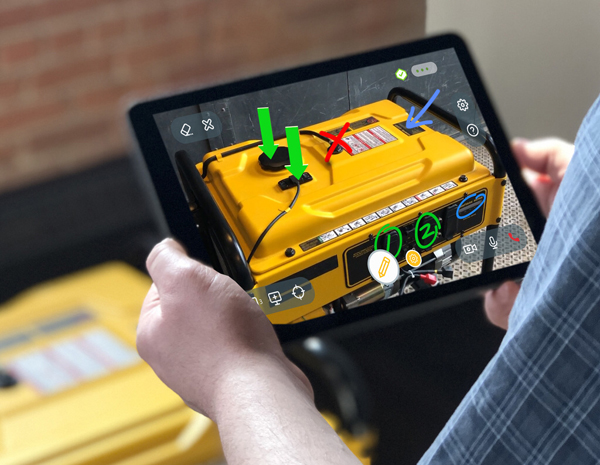
With the rise of AR-VR hardware comes the need to publish AR-VR content, like apps for design review, training, remote technical help, or maintenance instruction. For this market, Scope AR offers its WorkLink publishing software, which lets you use CAD data to produce instruction manuals, compatible with mobile devices and AR headsets. Scope AR offers its software by subscription, as SaaS.


We are proud to be the world's largest PC vendor. Our portfolio also includes workstations, servers, storage solutions, IT management software, smart TVs, tablets, smartphones, and even apps.As the world becomes faster, more demanding, and…
Making the Case for Engineering Workstation Upgrades
In this Making the Case whitepaper, Lenovo outlines how upgrading to the latest generation of professional workstations can provide a return on investment through increased engineering efficiency and greater flexibility.

Kenneth Wong is Digital Engineering's resident blogger and senior editor. Email him at [email protected] or share your thoughts or suggestions at digitaleng.news/facebook.
Follow DE






About Us · Contact Us · Editorial Team · Advertising · Privacy Policy · Subscriber Services · © 2026 Digital Engineering 24/7 · Peerless Media