Helping design and engineering professionals discover, evaluate and specify technologies and processes that shorten the design cycle and enable success.


Alert!
Digital Engineering ceased publication on July 1, 2026. This website remains available as an archive of engineering content.
For inquiries or information, please email [email protected].

Digital Engineering April 2026
In the latest issue of Digital Engineering, we take a look at the latest innovations in design for additive manufacturing, including the use of natural language inputs, social media cosplayers, and AI integration. The issue also includes a feature…

January Special Focus Issue: Design for Additive
In this Special Focus Issue of Digital Engineering, learn about the latest advancements in design for additive manufacturing, including new software tools, additive in automotive, custom medical devices, and more.
How do you solve the problem of meniscal injuries, one of the most common medical issues for U.S. Service Members? Turns out, one of the more interesting answers is the nascent world of 3D bioprinting and more specifically, 3D bioprinting in space.
Redwire Corp., a leader in space infrastructure, just successfully 3D bioprinted the first human knee meniscus on orbit using its upgraded 3D BioFabrication Facility (BFF) on the International Space Station (ISS). Why launch such a ground-breaking experiment into the atmosphere as opposed to conducting the same experimentation in a souped up R&D lab on earth? The answer is that biological printing, particularly of the complex structures comprising human organs and tissue, has proven difficult in Earth’s gravity, according to NASA.
The BFF, an upgraded 3D printer developed by Redwire, was upgraded earlier this year to allow for greater temperature control when printing bioinks that are sensitive to temperatures. That latest unit was shipped to the ISS along with Redwire’s Advanced Space Experiment Processor (ADSEP) which is used in conjunction with the BFF to culture the 3D printed living cells for 14 days to produce the meniscus. The pair’s latest success builds on a 2019 phase I experiment where the BFF was used to 3D print a meniscus-shaped scaffold using bioink derived from human tissue proteins, but without the addition of living cells.
The successful meniscus print was returned to Earth for further analysis, with scientists hoping to better understand bioprinting in space as well as ways in which to improve the BFF terrestrial model. According to a NASA write up, “one of the ultimate long-term goals of the BFF is to develop the capability to print complex tissues and organs that may be used to treat patients on the ground and in future deep space exploration crews.”
One of the main drivers for 3D bioprinting human tissue is to address the organ shortage on earth, said a Redwire scientist, noting that there are too many people on the transplant list and not enough organs to meet the need.
Redwire is working with the Uniformed Services University of the Health Sciences Center for Biotechnology (4D Bio), a biomedical research center tasked with exploring and adapting promising biotechnologies for the benefit of the military. According to the center, meniscal injuries are among the most common orthopedic injuries affecting service members of the U.S. military.
3D bioprinting in space to benefit patients on earth is a long-term goal for the BFF, although NASA foresees the technology coming to the aid of crew members in space who experience musculoskeletal injuries on deep space missions. More broadly, the investigation has application on earth by “improving knowledge on the capability for treating such injuries in harsh and remote environments using biofabrication. Results also advance an understanding of musculoskeletal cell response to the loss of compressive force in microgravity, which help support development of improved tissue-engineered solutions for meniscal injuries,” according to the NASA write up.
In addition to efforts to 3D bioprint human tissue in space, additive manufacturing is playing a central role in space exploration, used for everything from on-demand parts production to extraterrestrial housing construction.
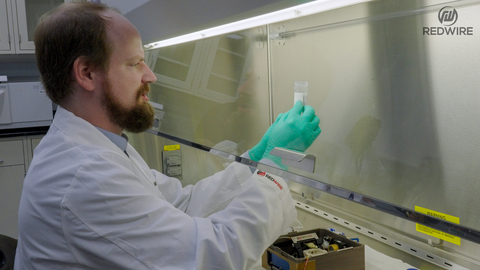
Watch this video to learn more about Redwire’s effort to 3D bioprint the first human knee meniscus in space.


Beth Stackpole is a contributing editor to Digital Engineering. Send e-mail about this article to [email protected].
Follow DE






About Us · Contact Us · Editorial Team · Advertising · Privacy Policy · Subscriber Services · © 2026 Digital Engineering 24/7 · Peerless Media