Helping design and engineering professionals discover, evaluate and specify technologies and processes that shorten the design cycle and enable success.


Alert!
Digital Engineering ceased publication on July 1, 2026. This website remains available as an archive of engineering content.
For inquiries or information, please email [email protected].

May 2026 Special Focus: Artificial Intelligence in Design and Simulation
In this Special Focus Issue, learn about the latest developments in the integration of artificial intelligence into engineering workflows.

April 2026 Special Focus Issue: Generative Design
In this Special Focus Issue, Digital Engineering takes a look at how generative design solutions can be used across different types of design problems and with a variety of manufacturing approaches to accelerate design space exploration, and…
Innatera, a company vested in brain-like neuromorphic computing for ultra-low-power intelligence at the sensor edge, selected Synopsys for design and validation of its next-generation neuromorphic microcontrollers. Synopsys' solutions for electrostatic discharge (ESD) and power integrity analysis will help Innatera scale its operations for edge processing in industrial sensors, robotics, wearables, and smart home technologies.
Neuromorphic microcontrollers process information through Spiking Neural Networks (SNNs) that mimic how biological neurons communicate, delivering brain-inspired intelligence at the sensor edge. This event-driven approach enables real-time, ultra-low-power operation in sensor-rich environments.
Innatera's architecture combines mixed-signal analog computation, dense interconnects, and low-voltage design—enablers of efficiency but potential sources of electrical noise and ESD sensitivity. To address these challenges, Innatera leverages PathFinder-SC and Totem to validate power integrity, and manage noise coupling.
PathFinder-SC simulates ESD events at scale, identifying vulnerabilities and root causes before the final design goes to manufacturing and ensuring chips are functioning optimally against real-world electrostatic occurrences.
Totem performs detailed power integrity analysis at the transistor level. By pairing Totem's high-fidelity modeling of typical operating conditions with PathFinder-SC's capacity to identify and address ESD risks, the solution provides designers with a tool that protects against expected and unexpected electrical challenges throughout the chip's life cycle.
"Innatera's mission to redefine edge AI through neuromorphic computing requires both technological innovation and reliable design collaboration," says Aditya Dalakoti, director of systems on a chip and mixed-signal at Innatera. "Synopsys stood out for its leading technology and unwavering support for startups in the edge AI ecosystem. Its ESD analysis solution and collaborative approach enable us to scale into real-world, adaptive applications with enhanced speed, usability, and versatility."
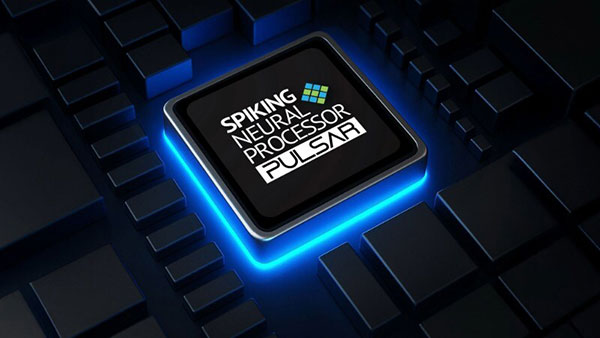
For example, Innatera used Synopsys technology to validate the design of Pulsar, a commercial neuromorphic microcrontroller. Pulsar optimizes AI workloads at the edge by combining flexible computing architecture. Using SNNs, Pulsar only reacts to registered sensor changes, improving data transfer speeds and battery power for "always-on" devices like wearables and smart sensors.
"By enabling Innatera to accelerate product development and scale confidently, Synopsys reinforces its role as a catalyst for cutting-edge technologies shaping the future of embedded AI," says Prith Banerjee, senior vice president at Ansys, part of Synopsys. "This collaboration underscores our commitment to empowering innovation across the semiconductor ecosystem, from global enterprises to emerging startups. As edge computing becomes increasingly central to real-time intelligence, Synopsys simulation is helping innovators bring efficient AI where it's most needed."
Sources: Press materials received from the company and additional information gleaned from the company’s website.


Synopsys, Inc. (Nasdaq: SNPS) is the Silicon to Software™ partner for innovative companies developing the electronic products and software applications we rely on every day. As the world's 15th largest software company, Synopsys has a long…

DE's editors contribute news and new product announcements to Digital Engineering. Press releases may be sent to them via [email protected].
Follow DE






About Us · Contact Us · Editorial Team · Advertising · Privacy Policy · Subscriber Services · © 2026 Digital Engineering 24/7 · Peerless Media