Helping design and engineering professionals discover, evaluate and specify technologies and processes that shorten the design cycle and enable success.


Alert!
Digital Engineering ceased publication on July 1, 2026. This website remains available as an archive of engineering content.
For inquiries or information, please email [email protected].
Sponsored

Cut Retrieval-Augmented Generation (RAG) Hallucinations by 50%
Most teams hit the same wall with enterprise AI: LLMs that hallucinate, pipelines that don’t scale, and infrastructure that’s harder to design than the models themselves.

What Is Intelligent BOM Management? A Guide to Smarter Product Development
Learn how intelligent Bill of Materials (BOM) management helps teams collaborate, reduce errors, and bring innovative products to market faster with cloud-based PLM tools.

 Dear DE Reader:
When it comes to making computing electronics for end users, OEMs and so forth, PNY has global creds. If you're not using one of their PREVAILPRO mobile workstations right now, you're likely using something they made anyway.
PNY also collaborates with all the names you know to make products available and to make them shine. NVIDIA is one example, and PNY has assembled a landing page with what you need to know about the NVIDIA Quadro GV100 GPU (graphics processing unit). The GV100 is a game-changer for workstations and HPC (high-performance computing). PNY's GV100 landing page pulls together and adds value to the details. It's well done.
Remember, the GV100 is currently the only Quadro-class GPU leveraging NVIDIA’s next-generation Volta architecture. NVIDIA offers libraries, frameworks and software development kits to help developers create Volta-optimized and tuned applications. In short, Volta has the resources and brawn for the 3D design, engineering, manufacturing and scientific jobs you really can't toss at your workstation today without dumbing down your objectives.
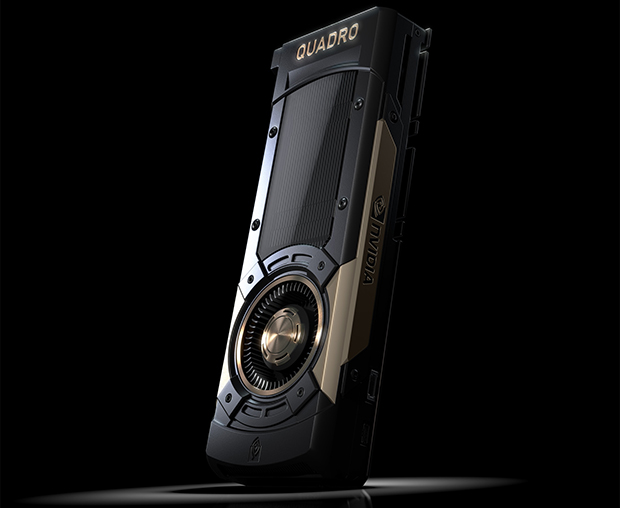 With teraflops of single- and double-precision performance combined with its teraflops of purpose-built performance for deep learning and artificial intelligence, the NVIDIA Quadro GV100 should make extreme design, rendering, simulation and virtual reality applications a routine part of your day. Image courtesy of PNY Technologies Inc.
In hands-on terms: The GV100 is for sophisticated AI (artificial intelligence), deep and machine learning, generative design, photorealistic simulation, real-time ray tracing, visualization and professional VR (virtual reality) applications. Compute-intensive ANSYS or Abaqus simulations should run with alacrity. Quickly creating photorealistic images or animations directly from CAD designs should become routine.
Three keys here. One, the GV100 has a minimum of 32GB of scalable HBM2 (high-bandwidth, second-generation) memory. Bandwidth pops at 870GB per second.
Two, it has 5,120 NVIDIA CUDA parallel-processing cores and 640 Tensor Cores. Tensor cores are purpose-built for deep learning matrix arithmetic and AI.
Three, mixed-precision performance. In spec speak, that's 7.4 TFLOPS (1 trillion floating-point operations per second) double-precision and 14.8 TFLOPS single-precision performance plus 118.5 TFLOPS of tensor operation.
When you land on PNY's GV100 landing page, first watch the short video. Next, read down until you see the stand-alone GV100 pic. Hover your mouse over it for some quick specs. Then click the green title bar under the image. This brings up the mother lode of details on the GV100—pictures, in-depth technical details, spec lists, how to contact PNY for specific questions, etc. Name it, it's there.
PNY's NVIDIA GV100 landing page is thorough, well-designed and easy to navigate. The NVIDIA Quadro GV100 GPU with its Volta-optimized performance is about to change how you work. Hit today's link and learn about tomorrow's workflow. Well worth it.
Thanks, Pal. – Lockwood
Anthony J. Lockwood, Editor at Large, DE


Anthony J. Lockwood is Digital Engineering's founding editor. He is now retired. Contact him via [email protected].
Follow DE






About Us · Contact Us · Editorial Team · Advertising · Privacy Policy · Subscriber Services · © 2026 Digital Engineering 24/7 · Peerless Media