Helping design and engineering professionals discover, evaluate and specify technologies and processes that shorten the design cycle and enable success.


Sponsored

May 2026 Special Focus: Artificial Intelligence in Design and Simulation
In this Special Focus Issue, learn about the latest developments in the integration of artificial intelligence into engineering workflows.

Design & Simulation Software Guide 2025
In this Special Issue, Digital Engineering presents its second annual guide to design and simulation software vendors.
Product design development complexity has been increasing steadily for several years, along with the technology to support it. The use of smart algorithms, AI and machine learning help a great deal in simplifying the orchestration of product life-cycles while automations assist engineers in focusing on what matters, avoiding menial tasks.
In support of simulation-driven design, ESTECO keeps evolving its VOLTA SPDM platform to guide the management of simulation data configurations, secure and streamline information and facilitate collaboration with global access for teams distributed in different geographical areas.
Always on the lookout for better ways to provide traceability and enable informed decision making for product design optimization, ESTECO has recently addressed a new challenge.
Organizing the digital infrastructure that enables model integration and interconnectivity across departments has proved to be crucial in simulation orchestration. Without a representation of the flow of activities and data in place, decision makers struggle to access the key product design metrics.This might result in a scenario where lack of visibility and traceability exponentially increases the time spent looking for the right data.
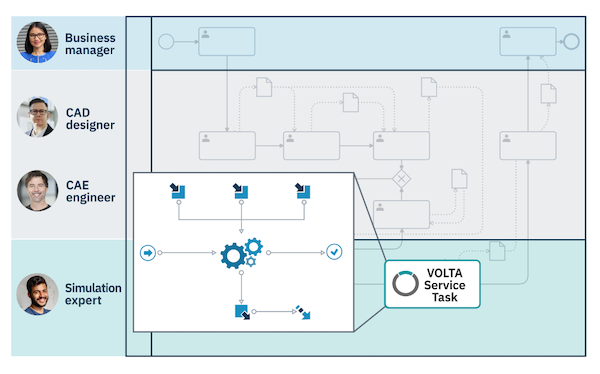
That’s why ESTECO has embedded Business Process Management technology into VOLTA. The new BPM framework provides the formalization and automation of the design product development, maximizing the enterprise-wide flow of engineering data. Companies can expect to increase process visibility, align interaction between management, engineering and simulation departments and speed up product development.
With a BPMN graphical representation and process automation capacities, engineers have real-time process visibility. The BPM capabilities allow to break down silos across departments, capture information and drive optimal decision making. The day-to-day activities in simulation-driven product development are mapped, evaluated and broken into human and simulation service tasks. Everyone involved in the process understands the context of their tasks and gets a cross-domain view of the entire process, making it easier to spot inefficiencies and implement improvements. BPM empowers SPDM technology - ensuring full traceability and repeatable use of engineering data and best practices across all stages of the engineering design cycle.
ESTECO Headquarters
AREA Science Park
Padriciano 99, 34149 TRIESTE (ITALY)
esteco.com


With almost 20 years’ experience, the company supports leading organizations in designing the products of the future, today. Our smart engineering suite brings enterprise-wide solutions for design optimization, simulation data management and…
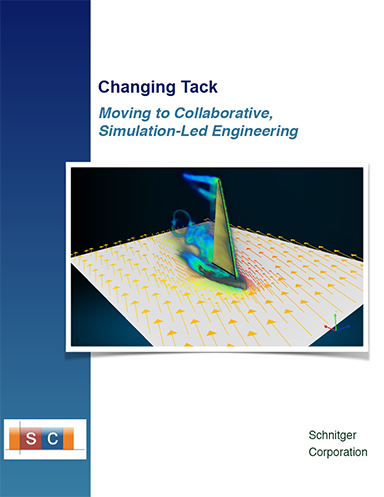
Moving to Collaborative, Simulation-Led Engineering
Simulation is an important part of any enterprise’s quest to create better products, more quickly. Optimizing early in a design cycle can jump-start innovation, enabling the team to explore more alternatives, more quickly — and to make trade-offs based on physical data rather than on gut feel.

Brian Albright is the editorial director of Digital Engineering.
Contact him at [email protected].

Join over 90,000 engineering professionals who get fresh engineering news as soon as it is published.






About Us · Contact Us · Editorial Team · Advertising · Privacy Policy · Subscriber Services · © 2026 Digital Engineering 24/7 · Peerless Media