Helping design and engineering professionals discover, evaluate and specify technologies and processes that shorten the design cycle and enable success.


Alert!
Digital Engineering ceased publication on July 1, 2026. This website remains available as an archive of engineering content.
For inquiries or information, please email [email protected].

May 2026 Special Focus: Artificial Intelligence in Design and Simulation
In this Special Focus Issue, learn about the latest developments in the integration of artificial intelligence into engineering workflows.

April 2026 Special Focus Issue: Generative Design
In this Special Focus Issue, Digital Engineering takes a look at how generative design solutions can be used across different types of design problems and with a variety of manufacturing approaches to accelerate design space exploration, and…

Matthew Gueller chuckled when I asked him if he does rendering, as if to say, "Do you even need to ask?"
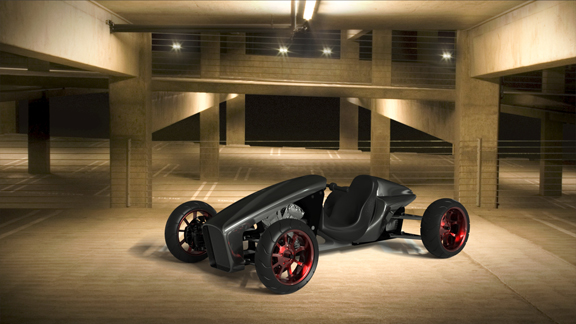
Being a professional visualization artist and surface designer, Matthew sees a large chunk of his time consumed by rendering. "Some of the images we have to render -- they're one-to-one ratio, at 72 DPI poster resolution -- can take up to 16 hours to finish," he noted. "Lots of materials involved, large data sets -- they're very CPU-intense."
He's discovered that, with the right hardware upgrade, he can cut down that 16 hours to under 10 minutes. The performance increase didn't come from CPU upgrade alone (he did upgrade the CPU setup from a quad-core to a dual 8-core system); it involved GPU acceleration. Matthew plans to share the exact configuration of his hardware in his upcoming talk at the GPU Technology Conference (GTC), hosted by NVIDIA. (Note: DE is a GTC media partner.)
Faster rendering was impressive in itself, but what really rocked Matthew's boat was the ability to do real-time review with colleagues and clients. "It was no longer offline rendering; it was real-time rendering, interactive. That's a huge jump in performance," he said.
Traditionally rendering involves setting up a scene, assigning materials to the 3D model, then waiting for hours while the system computes the still image. But GPU-accelerated rendering, in Matthew's experience, produces real-time, interactive images that can be manipulated and edited live on a high-def screen. "Designers were able to look at the model from different perspectives, and interact with it to understand what they're seeing," he noted.
Because NVIDIA Kepler architecture allows virtualized GPUs (or cloud-hosted GPUs), Matthew and his colleagues are considering remote access to the primary rendering system. This setup will allow multiple artists to share a single workstation, by remotely accessing the host machine from other lightweight devices.
Matthew relies on Bunkspeed SHOT, a rendering program that supports GPU acceleration, to visualize his designs. A standard workstation comes equipped with a single GPU. In newer workstations powered by NVIDIA Maximus technology, Kepler architecture makes it possible to drive acceleration with 2 GPUs. But Matthew found a way to pack even more power than that into his Lenovo system using extension hardware.
For the complete list of GTC presentations for manufacturing, visit this page.


Kenneth Wong is Digital Engineering's resident blogger and senior editor. Email him at [email protected] or share your thoughts or suggestions at digitaleng.news/facebook.
Follow DE






About Us · Contact Us · Editorial Team · Advertising · Privacy Policy · Subscriber Services · © 2026 Digital Engineering 24/7 · Peerless Media