Helping design and engineering professionals discover, evaluate and specify technologies and processes that shorten the design cycle and enable success.


Alert!
Digital Engineering ceased publication on July 1, 2026. This website remains available as an archive of engineering content.
For inquiries or information, please email [email protected].
May 2026 Special Focus: Artificial Intelligence in Design and Simulation
In this Special Focus Issue, learn about the latest developments in the integration of artificial intelligence into engineering workflows.

April 2026 Special Focus Issue: Generative Design
In this Special Focus Issue, Digital Engineering takes a look at how generative design solutions can be used across different types of design problems and with a variety of manufacturing approaches to accelerate design space exploration, and…
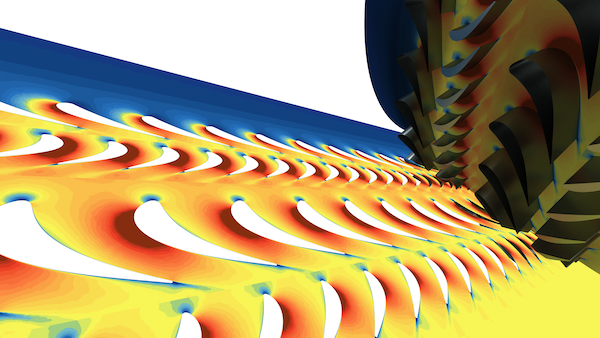
Simcenter STAR-CCM+ has been awarded Amazon Web Services (AWS) High Performance Computing (HPC) Competency status, a sign that simulation workloads are continuing to become more frequent, more complex, and more integral to digital design processes.
The AWS designation indicates that Siemens Digital Industries Software has demonstrated the deep experience to help customers optimize HPC workloads for performance and efficiency using AWS’ elastic and scalable cloud infrastructure. Siemens is among the first AWS partners to achieve this status, giving customers the confidence that STAR-CCM+ will perform at optimal levels in the cloud HPC environment, according to Deryl Synder, Siemens’ vice president, Computational Continuum Mechanics.
The work with AWS and other cloud platforms is part of Siemens’ continued commitment to drive simulation performance improvements and to help entrench simulation in more engineering workloads. “To achieve their goals, engineering organizations are asking for more simulation with more complexity, delivering meaningful results quickly that properly guide design decisions,” Synder explains. “This is driving businesses to leverage the endless compute capacity available through the cloud.”
Cloud HPC, and the AWS designation specifically, can also benefit smaller businesses who are leveraging more simulation to create innovative products, he says. “It doesn’t make sense for them to build and maintain compute facilities,” he explains. “Cloud HPC is not only cost effective, it allows them to be laser focused on creating the best designs.”
The move to Cloud HPC, as part of the steady migration to fully cloud-based CAD, PLM, and simulation software, helps improve engineering processes by enabling a digital twin in one location. The trend also bolsters collaboration within an organization as well as with partners and suppliers at levels not possible before, Synder adds.
As part of its new feature set, Simcenter STAR-CCM+ 2021.1 includes a new surrogate model feature, as part of the Design Manager, which lets engineers predict the performance of thousands of variants. With the new function, users can either analyze the probability of failure of variants around the designated design or leverage the function globally, across the design space, to create a database of performance results that can be later tapped by the simulation team.
The new release also features new data analysis features for turbomachinery applications along with a new Electric Circuit Editor that lets engineers sketch sophisticated circuits with an easy-to-use graphical interface, helping them shave time off the design cycle. The release also expands electromagnetic application coverage for electric machines through a new excitation coil model, which aids in the design of higher power density machines with closed coils.
To aid in democratization of simulation results, Simcenter STAR-CCM+ 2021.1 allows users to open simulation files in read-only mode without consuming a license, which helps them more easily check set-up, make comparisons, and apply best practices.
For a deep dive into HPC applications on AWS specific to virtual wind tunnel applications, check out this event.


Simcenter™ software, from Siemens Digital Industries Software, uniquely combines system simulation, 3D CAE and test to help you predict performance across all critical attributes earlier and throughout the entire product lifecycle. By combining…
Making the Case for Artificial Intelligence and Machine Learning in Engineering
In this paper, Siemens Digital Industries Software and Digital Engineering will provide an overview of how AI/ML-enabled software can improve design workflows, while also addressing common questions and concerns around implementing this technology in an engineering organization.

Beth Stackpole is a contributing editor to Digital Engineering. Send e-mail about this article to [email protected].
Follow DE






About Us · Contact Us · Editorial Team · Advertising · Privacy Policy · Subscriber Services · © 2026 Digital Engineering 24/7 · Peerless Media