Helping design and engineering professionals discover, evaluate and specify technologies and processes that shorten the design cycle and enable success.


Alert!
Digital Engineering ceased publication on July 1, 2026. This website remains available as an archive of engineering content.
For inquiries or information, please email [email protected].

Cut Retrieval-Augmented Generation (RAG) Hallucinations by 50%
Most teams hit the same wall with enterprise AI: LLMs that hallucinate, pipelines that don’t scale, and infrastructure that’s harder to design than the models themselves.

What Is Intelligent BOM Management? A Guide to Smarter Product Development
Learn how intelligent Bill of Materials (BOM) management helps teams collaborate, reduce errors, and bring innovative products to market faster with cloud-based PLM tools.
Oregon State University has announced $100 million in gifts to launch a $200 million research and education center that will house one of the nation’s most powerful supercomputers and team-based research in artificial intelligence, materials science and robotics to solve global challenges in areas such as climate science, oceanography, sustainability and water resources, the university reports.
The center will be named the Jen-Hsun and Lori Huang Collaborative Innovation Complex following a gift of $50 million tothe OSU Foundation from Jen-Hsun Huang, founder and CEO of NVIDIA, and his wife Lori, both of whom are Oregon State University graduates.
“The Jen-Hsun and Lori Huang Collaborative Innovation Complex at Oregon State University will be much more than a building," says OSU President Jayathi Murthy. "It will serve as a university-wide promise and as a hub for advancing groundbreaking solutions for the betterment of humanity, the environment and the economy.
Murthy said the three-story, 150,000-sq.-ft. center is being designed and is anticipated to open in 2025. It will be built in the northwest corner of OSU’s Corvallis campus.
The Huangs graduated from Oregon high schools and met while undergraduates in OSU’s College of Engineering.
“We discovered our love for computer science and engineering at OSU. We hope this gift will help inspire future generations of students also to fall in love with technology and its capacity to change the world,” say Jen-Hsun and Lori Huang.
“AI is the most transformative technology of our time,” they add. “To harness this force, engineering students need access to a supercomputer, a time machine, to accelerate their research. This new AI supercomputer will enable OSU students and researchers to make very important advances in climate science, oceanography, materials science, robotics, and other fields.”
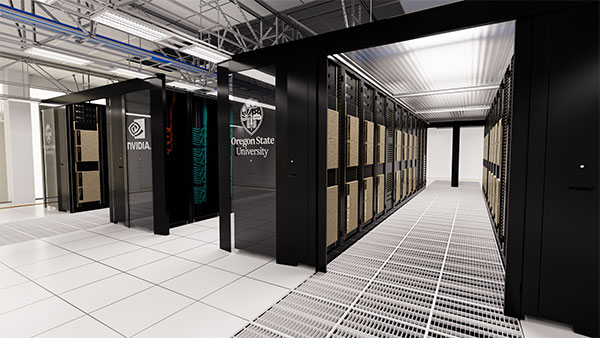
The center will employ a NVIDIA supercomputer to support faculty in addressing complex computational problems. The OSU supercomputer—powered by next-generation NVIDIA CPUs, GPUs and networking—is expected to be among the world’s fastest university supercomputers, powerful enough to train large AI models and perform complex digital twin simulations. The complex will also have a sclean room and other specialized research facilities.
“The Jen-Hsun and Lori Huang Collaborative Innovation Complex will be an incredible contributor to our state and world by supporting innovation, entrepreneurship and partnerships with industry and other higher education institutions,” said Edward Feser, OSU provost and executive vice president.
“The collaborative innovation complex will be a key component of efforts championed by federal and state, business and academic leaders to support the competitiveness of Oregon’s semiconductor industry," adds Feser. "OSU is committed to supporting the full workforce development pipeline for the sector, by partnering with community colleges and other Oregon universities to create seamless pathways to traditional and alternative credentials and by preparing bachelor through Ph.D. degree graduates.”
During the 2023 Oregon legislative session, OSU will request $75 million in state-paid bonding to match philanthropic and university contributions for the collaborative innovation complex. The university and OSU Foundation also will seek additional public, private sector and philanthropic support for equipment, faculty support and research programs within the complex. This will include funding to support targeted faculty hires and the university’s goals to increase diversity in STEM fields.
The complex will build on OSU’s distinction in engineering and computer science, says Scott Ashford, dean of OSU’s College of Engineering.
The complex will feature a supercomputer incorporating NVIDIA DGX SuperPOD and OVX SuperPOD systems. Water used to cool it will help heat more than 500,000 square feet of building space on OSU’s Corvallis campus.
The complex will include laboratories for materials scientists, environmental researchers and others throughout the university, as well as an extended-reality theater, robotics and drone playground and a do-it-yourself maker space.
“It will transform not only the College of Engineering, but the entire university, and have an economic and environmental impact on the state of Oregon and the nation,” Ashford says.
He said environmental and electronics researchers working in the complex may design sensors for use at sea or in forests tomonitor hard-to-track endangered species and then use AI to analyze data gathered. As well, OSU faculty, along with collaborators from other universities, business and state and federal agencies, will pursue techniques in the center’s clean room for makingcomputer chips. Robotics researchers and students will be able to use theater-aided simulations of drones and robots operating within real-world settings.
Sources: Press materials received from the company and additional information gleaned from the company’s website.


Since its founding in 1993, NVIDIA (NASDAQ: NVDA) has been a pioneer in accelerated computing. The company’s invention of the GPU in 1999 sparked the growth of the PC gaming market, redefined computer graphics, ignited the era of modern AI and…
Cut Retrieval-Augmented Generation (RAG) Hallucinations by 50%
Most teams hit the same wall with enterprise AI: LLMs that hallucinate, pipelines that don’t scale, and infrastructure that’s harder to design than the models themselves.

DE's editors contribute news and new product announcements to Digital Engineering. Press releases may be sent to them via [email protected].
Follow DE
Join over 90,000 engineering professionals who get fresh engineering news as soon as it is published.






About Us · Contact Us · Editorial Team · Advertising · Privacy Policy · Subscriber Services · © 2026 Digital Engineering 24/7 · Peerless Media